
生物胁迫产生的活性氧:对植物的影响及内生微生物的缓解作用
ROS generated from biotic stress: Effects on plants and alleviation by endophytic microbes.
作者信息
Sahu Pramod Kumar, Jayalakshmi K, Tilgam Jyotsana, Gupta Amrita, Nagaraju Yalavarthi, Kumar Adarsh, Hamid Saima, Singh Harsh Vardhan, Minkina Tatiana, Rajput Vishnu D, Rajawat Mahendra Vikram Singh
机构信息
Indian Council of Agricultural Research (ICAR)-National Bureau of Agriculturally Important Microorganisms, Uttar Pradesh, India.
Plant Pathology, Indian Council of Agricultural Research (ICAR)-Directorate of Onion Garlic Research, Maharashtra, India.
出版信息
Front Plant Sci. 2022 Oct 24;13:1042936. doi: 10.3389/fpls.2022.1042936. eCollection 2022.
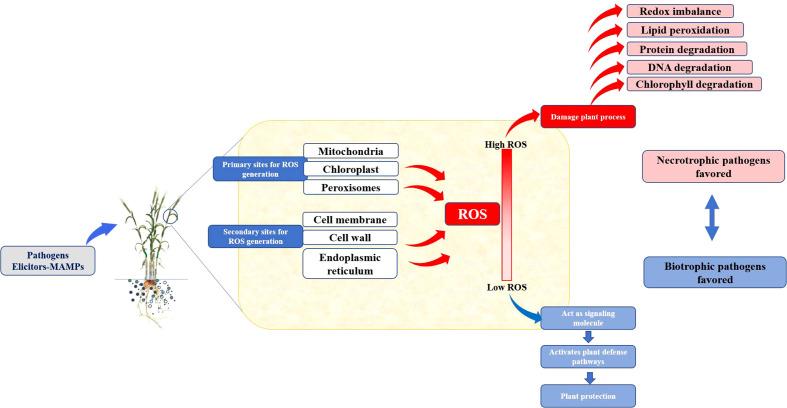
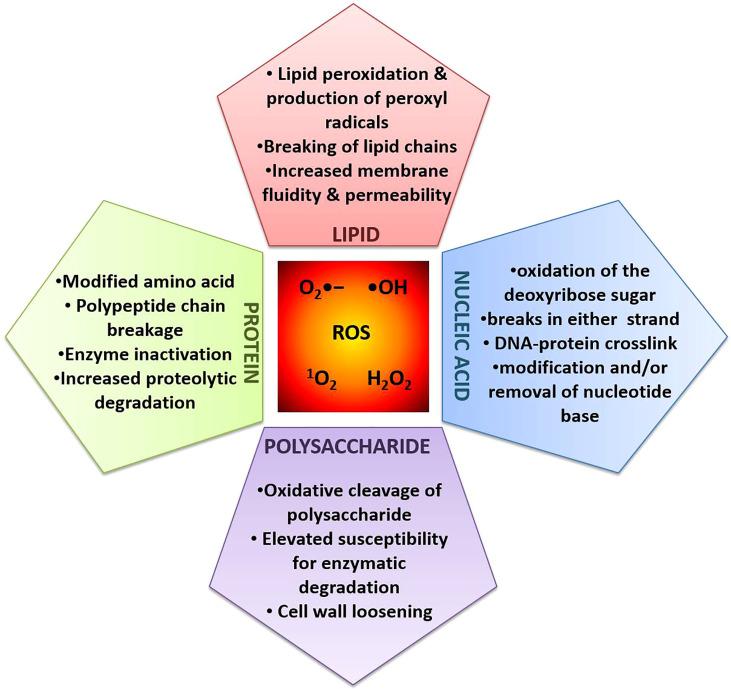
Aerobic living is thought to generate reactive oxygen species (ROS), which are an inevitable chemical component. They are produced exclusively in cellular compartments in aerobic metabolism involving significant energy transfer and are regarded as by-products. ROS have a significant role in plant response to pathogenic stress, but the pattern varies between necrotrophs and biotrophs. A fine-tuned systemic induction system is involved in ROS-mediated disease development in plants. In regulated concentrations, ROS act as a signaling molecule and activate different pathways to suppress the pathogens. However, an excess of these ROS is deleterious to the plant system. Along with altering cell structure, ROS cause a variety of physiological reactions in plants that lower plant yield. ROS also degrade proteins, enzymes, nucleic acids, and other substances. Plants have their own mechanisms to overcome excess ROS and maintain homeostasis. Microbes, especially endophytes, have been reported to maintain ROS homeostasis in both biotic and abiotic stresses by multiple mechanisms. Endophytes themselves produce antioxidant compounds and also induce host plant machinery to supplement ROS scavenging. The structured reviews on how endophytes play a role in ROS homeostasis under biotic stress were very meager, so an attempt was made to compile the recent developments in ROS homeostasis using endophytes. This review deals with ROS production, mechanisms involved in ROS signaling, host plant mechanisms in alleviating oxidative stress, and the roles of endophytes in maintaining ROS homeostasis under biotic stress.
需氧生活被认为会产生活性氧(ROS),这是一种不可避免的化学成分。它们仅在涉及大量能量转移的有氧代谢的细胞区室中产生,并被视为副产品。ROS在植物对病原胁迫的反应中起重要作用,但坏死营养型和活体营养型之间的模式有所不同。一个微调的系统诱导系统参与植物中ROS介导的疾病发展。在调节浓度下,ROS作为信号分子发挥作用并激活不同途径以抑制病原体。然而,过量的这些ROS对植物系统是有害的。除了改变细胞结构外,ROS还会在植物中引起各种生理反应,从而降低植物产量。ROS还会降解蛋白质、酶、核酸和其他物质。植物有自己的机制来克服过量的ROS并维持体内平衡。据报道,微生物,尤其是内生菌,通过多种机制在生物和非生物胁迫下维持ROS稳态。内生菌自身产生抗氧化化合物,并诱导宿主植物机制补充ROS清除。关于内生菌在生物胁迫下如何在ROS稳态中发挥作用的结构化综述非常少,因此试图汇编利用内生菌在ROS稳态方面的最新进展。本综述涉及ROS的产生、ROS信号传导所涉及的机制、宿主植物减轻氧化应激的机制以及内生菌在生物胁迫下维持ROS稳态中的作用。

 Zotero 插件