
用于药物过敏相互作用检查的共享可互操作临床决策支持服务:实施研究
Shared Interoperable Clinical Decision Support Service for Drug-Allergy Interaction Checks: Implementation Study.
作者信息
Jung Sungwon, Bae Sungchul, Seong Donghyeong, Oh Ock Hee, Kim Yoomi, Yi Byoung-Kee
机构信息
Department of Health Sciences and Technology, Samsung Advanced Institute for Health Sciences and Technology, Sungkyunkwan University, Seoul, Republic of Korea.
Data Science Research Institute, Samsung Medical Center, Seoul, Republic of Korea.
出版信息
JMIR Med Inform. 2022 Nov 10;10(11):e40338. doi: 10.2196/40338.
BACKGROUND
Clinical decision support (CDS) can improve health care with respect to the quality of care, patient safety, efficiency, and effectiveness. Establishing a CDS system in a health care setting remains a challenge. A few hospitals have used self-developed in-house CDS systems or commercial CDS solutions. Since these in-house CDS systems tend to be tightly coupled with a specific electronic health record system, the functionality and knowledge base are not easily shareable. A shared interoperable CDS system facilitates the sharing of the knowledge base and extension of CDS services.
OBJECTIVE
The study focuses on developing and deploying the national CDS service for the drug-allergy interaction (DAI) check for health care providers in Korea that need to introduce the service but lack the budget and expertise.
METHODS
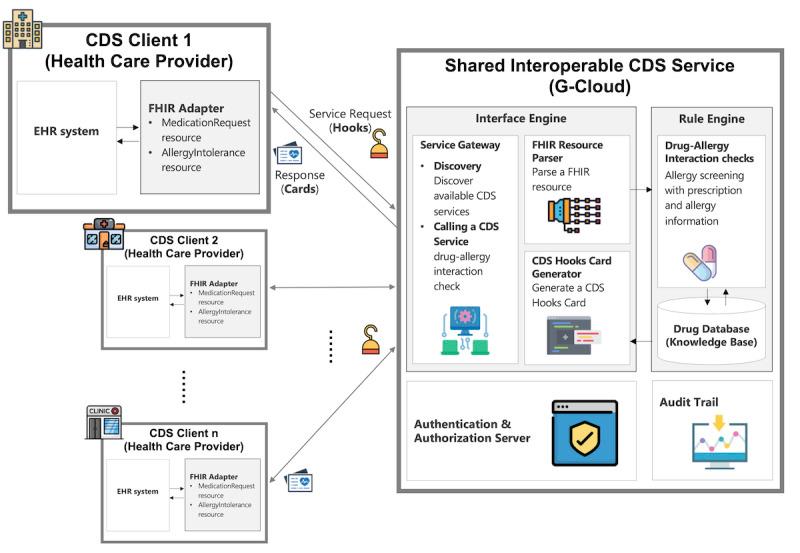
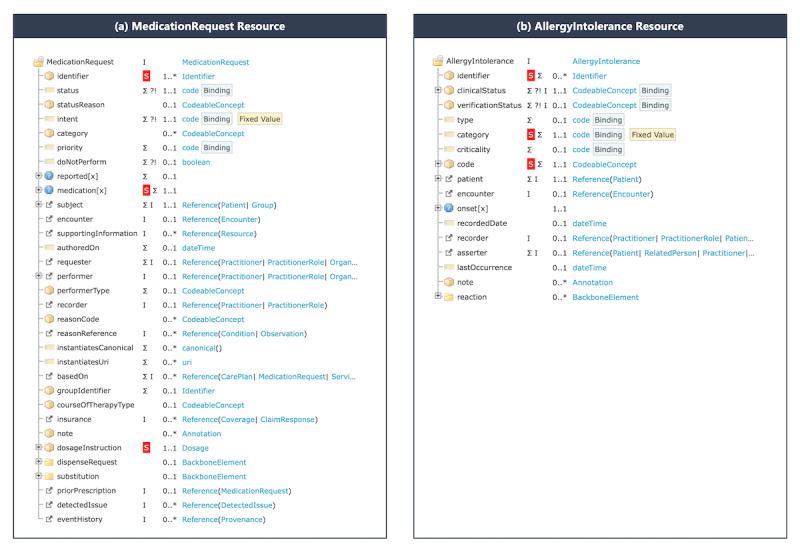
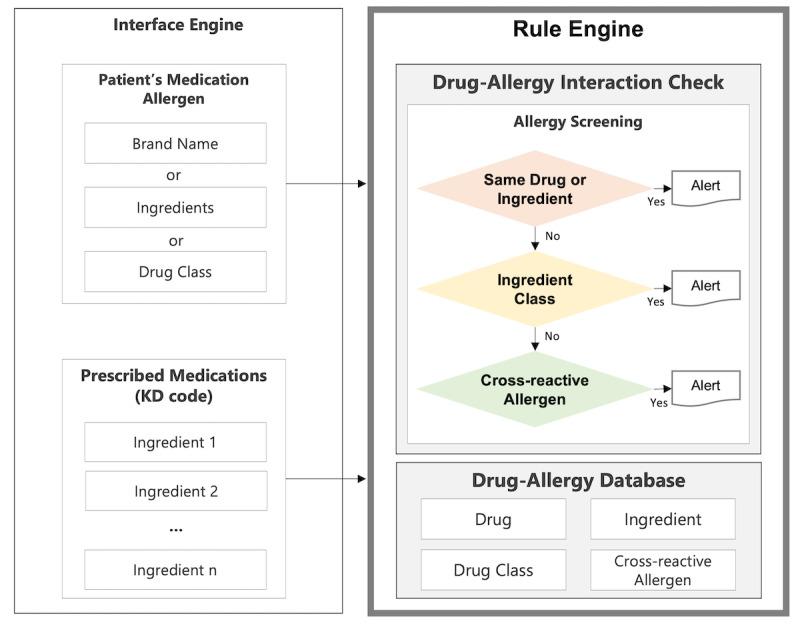
To provide the shared interoperable CDS service, we designed and implemented the system based on the CDS Hooks specification and Health Level Seven (HL7) Fast Healthcare Interoperability Resources (FHIR) standard. The study describes the CDS development process. The system development went through requirement analysis, design, implementation, and deployment. In particular, the concept architecture was designed based on the CDS Hooks structure. The MedicationRequest and AllergyIntolerance resources were profiled to exchange data using the FHIR standard. The discovery and DAI check application programming interfaces and rule engine were developed.
RESULTS
The CDS service was deployed on G-Cloud, a government cloud service. In March 2021, the CDS service was launched, and 67 health care providers participated in the CDS service. The health care providers participated in the service with 1,008,357 DAI checks for 114,694 patients, of which 33,054 (3.32%) cases resulted in a "warning."
CONCLUSIONS
Korea's Ministry of Health and Welfare has been trying to build an HL7 FHIR-based ecosystem in Korea. As one of these efforts, the CDS service initiative has been conducted. To promote the rapid adoption of the HL7 FHIR standard, it is necessary to accelerate practical service development and to appeal to policy makers regarding the benefits of FHIR standardization. With the development of various case-specific implementation guides using the Korea Core implementation guide, the FHIR standards will be distributed nationwide, and more shared interoperable health care services will be introduced in Korea.
背景
临床决策支持(CDS)在医疗质量、患者安全、效率和有效性方面可改善医疗保健。在医疗环境中建立CDS系统仍然是一项挑战。一些医院使用自行开发的内部CDS系统或商业CDS解决方案。由于这些内部CDS系统往往与特定的电子健康记录系统紧密耦合,其功能和知识库不易共享。一个共享的可互操作CDS系统有助于知识库的共享和CDS服务的扩展。
目的
本研究专注于为韩国需要引入药物过敏相互作用(DAI)检查服务但缺乏预算和专业知识的医疗保健提供者开发和部署国家CDS服务。
方法
为了提供共享的可互操作CDS服务,我们基于CDS Hooks规范和卫生级别七(HL7)快速医疗保健互操作性资源(FHIR)标准设计并实施了该系统。本研究描述了CDS的开发过程。系统开发经历了需求分析、设计、实施和部署。特别是,概念架构是基于CDS Hooks结构设计的。对用药申请(MedicationRequest)和过敏不耐受(AllergyIntolerance)资源进行了概要分析,以便使用FHIR标准交换数据。开发了发现和DAI检查应用程序编程接口以及规则引擎。
结果
CDS服务部署在政府云服务G-Cloud上。2021年3月,CDS服务启动,67家医疗保健提供者参与了该CDS服务。这些医疗保健提供者对114,694名患者进行了1,008,357次DAI检查,其中33,054例(3.32%)出现“警告”。
结论
韩国卫生福利部一直在努力在韩国建立基于HL7 FHIR的生态系统。作为这些努力之一,开展了CDS服务倡议。为了促进HL7 FHIR标准的快速采用,有必要加速实际服务开发,并向政策制定者宣传FHIR标准化的好处。随着使用韩国核心实施指南开发各种特定案例的实施指南,FHIR标准将在全国范围内推广,韩国将引入更多共享的可互操作医疗保健服务。

 Zotero 插件