
当前和新型治疗方法治疗新生血管性年龄相关性黄斑变性。
Current and Novel Therapeutic Approaches for Treatment of Neovascular Age-Related Macular Degeneration.
机构信息
Department of Ophthalmology, Harvey and Bernice Jones Eye Institute, University of Arkansas for Medical Sciences, Little Rock, AR 72207, USA.
Department of Ophthalmology, Cairo University Hospitals, Cairo 11261, Egypt.
出版信息
Biomolecules. 2022 Nov 3;12(11):1629. doi: 10.3390/biom12111629.
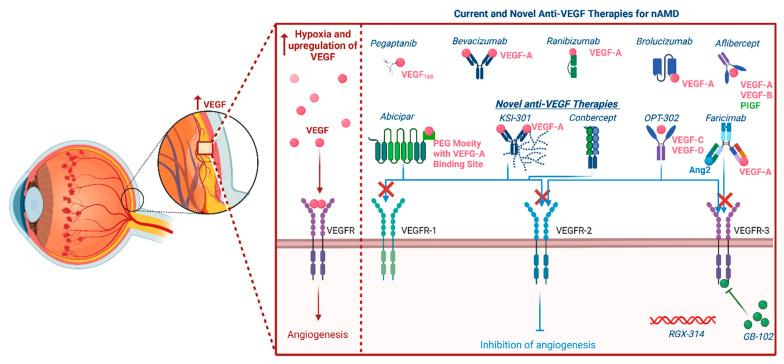
Age-related macular degeneration AMD is one of the leading causes of blindness in the elderly population. An advanced form of AMD known as neovascular AMD (nAMD) is implicated as the main attributor of visual loss among these patients. The hallmark feature of nAMD is the presence of neovascular structures known as choroidal neovascular membranes (CNVs), along with fluid exudation, hemorrhages, and subretinal fibrosis. These pathological changes eventually result in anatomical and visual loss. A type of proangiogenic factor known as vascular endothelial growth factor (VEGF) has been known to mediate the pathological process behind nAMD. Therefore, therapy has transitioned over the years from laser therapy that ablates the lesions to using Anti-VEGF to target the pathology directly. In this work, we provide an overview of current and emerging therapies for the treatment of nAMD. Currently approved Anti-VEGF agents include ranibizumab, aflibercept, and brolucizumab. Bevacizumab, also an Anti-VEGF agent, is used to manage nAMD even though this is an off-label use. While Anti-VEGF agents have provided a favorable prognosis for nAMD, they are associated with a substantial financial burden for patients and the healthcare system, due to their high cost as well as the need for frequent repeat treatments and visits. Emerging therapies and studies aim to extend the intervals between required treatments and introduce new treatment modalities that would improve patients' compliance and provide superior results.
年龄相关性黄斑变性(AMD)是导致老年人群视力丧失的主要原因之一。一种称为新生血管性 AMD(nAMD)的 AMD 晚期形式被认为是这些患者视力丧失的主要原因。nAMD 的特征是存在称为脉络膜新生血管膜(CNV)的新生血管结构,以及液体渗出、出血和视网膜下纤维化。这些病理变化最终导致解剖和视力丧失。一种称为血管内皮生长因子(VEGF)的促血管生成因子已被证明介导 nAMD 的病理过程。因此,多年来,治疗方法已从消融病变的激光治疗转变为使用抗 VEGF 直接针对该病理学。在这项工作中,我们提供了 nAMD 治疗的当前和新兴疗法的概述。目前批准的抗 VEGF 药物包括雷珠单抗、阿柏西普和康柏西普。贝伐单抗也是一种抗 VEGF 药物,尽管这是一种超适应证使用,但也用于治疗 nAMD。虽然抗 VEGF 药物为 nAMD 提供了有利的预后,但由于其高成本以及频繁重复治疗和就诊的需求,它们给患者和医疗保健系统带来了巨大的经济负担。新兴的治疗方法和研究旨在延长所需治疗之间的间隔,并引入新的治疗方式,从而提高患者的依从性并提供更好的效果。
 Zotero 插件