
用于选择性细胞膜成像的自组装钌(II)-香豆素配合物
Self-Assembled Ru(II)-Coumarin Complexes for Selective Cell Membrane Imaging.
作者信息
Liu Jiyin, Xie Xiaochun, Lu Junna, He Yi, Shao Dan, Chen Fangman
机构信息
National Engineering Research Center for Tissue Restoration and Reconstruction, South China University of Technology, Guangzhou 510006, China.
School of Chemistry, Sun Yat-sen University, Guangzhou 510006, China.
出版信息
Pharmaceutics. 2022 Oct 25;14(11):2284. doi: 10.3390/pharmaceutics14112284.
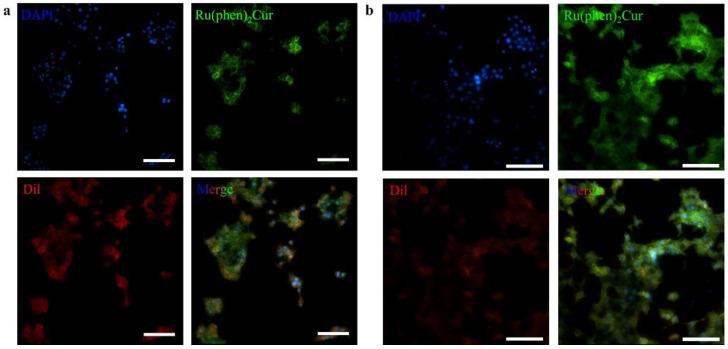
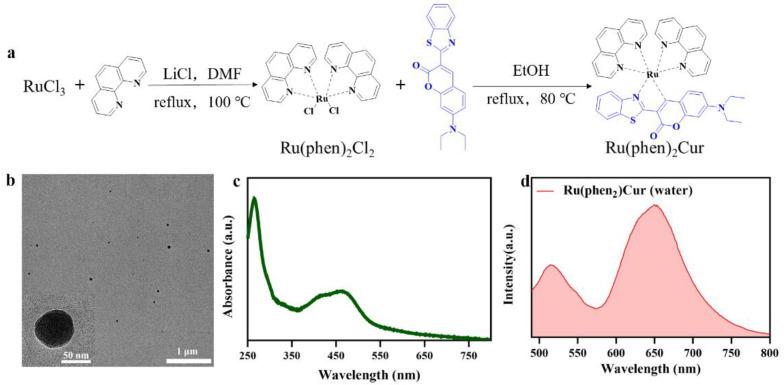
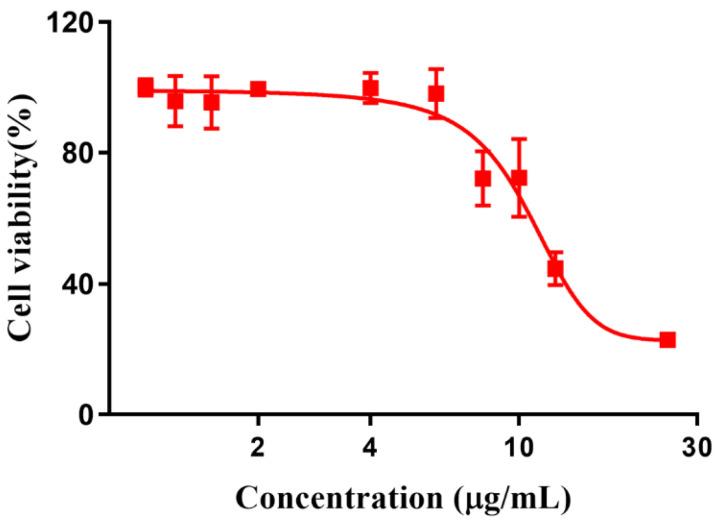
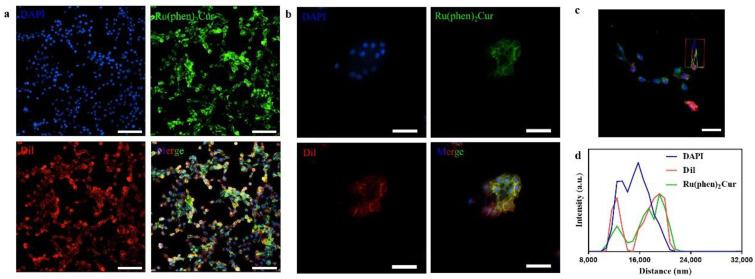
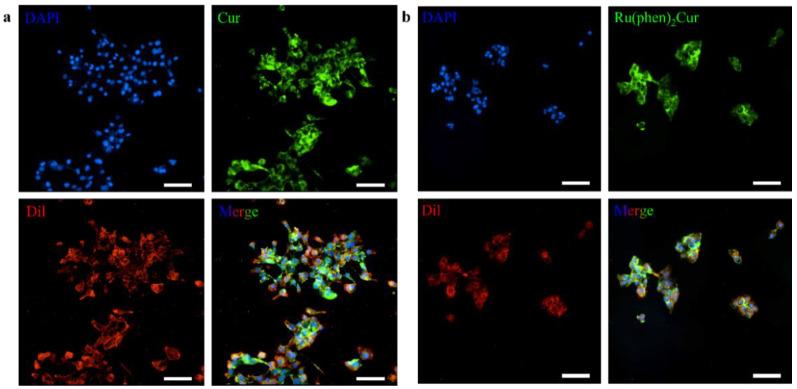
The cell membrane, as the protecting frontier of cells, is closely related to crucial biological behaviors including cell growth, death, and division. Lots of fluorescent probes have been fabricated to monitor cell membranes due to their simplicity and intuitiveness. However, the efficiency of those traditional probes has been limited by their susceptibility to photobleaching and poor water solubility. In this study, we have reported Ru(II)-coumarin complexes consisting of ruthenium, 1,10-phenanthroline, and coumarin 6 to further form self-assembled nanoprobes, for cell membrane targeting and imaging. The fluorescent property could be switchable from red to green through the dynamic disassembly of nanoprobes. Compared with commercial Dil, biocompatible nanoprobes exhibited superior stability for long-term cell imaging, along with remarkedly reduced background interference. Therefore, our self-assembled nanoprobe provides a powerful solution for investigating lipid trafficking with optical imaging.
细胞膜作为细胞的保护前沿,与包括细胞生长、死亡和分裂在内的关键生物学行为密切相关。由于其简单性和直观性,许多荧光探针已被制备用于监测细胞膜。然而,这些传统探针的效率受到其易光漂白和水溶性差的限制。在本研究中,我们报道了由钌、1,10-菲咯啉和香豆素6组成的Ru(II)-香豆素配合物,以进一步形成自组装纳米探针,用于细胞膜靶向和成像。通过纳米探针的动态拆解,荧光特性可从红色切换为绿色。与市售的Dil相比,生物相容性纳米探针在长期细胞成像中表现出优异的稳定性,同时背景干扰显著降低。因此,我们的自组装纳米探针为利用光学成像研究脂质转运提供了有力的解决方案。


 Zotero 插件