
儿童多系统炎症综合征出院后糖皮质激素使用与临床结局的关系
Postdischarge Glucocorticoid Use and Clinical Outcomes of Multisystem Inflammatory Syndrome in Children.
机构信息
Division of Immunology, Boston Children's Hospital, Boston, Massachusetts.
Department of Pediatrics, Harvard Medical School, Boston, Massachusetts.
出版信息
JAMA Netw Open. 2022 Nov 1;5(11):e2241622. doi: 10.1001/jamanetworkopen.2022.41622.
IMPORTANCE
Minimal data are available regarding the postdischarge treatment of multisystem inflammatory syndrome in children (MIS-C).
OBJECTIVES
To evaluate clinical characteristics associated with duration of postdischarge glucocorticoid use and assess postdischarge clinical course, laboratory test result trajectories, and adverse events in a multicenter cohort with MIS-C.
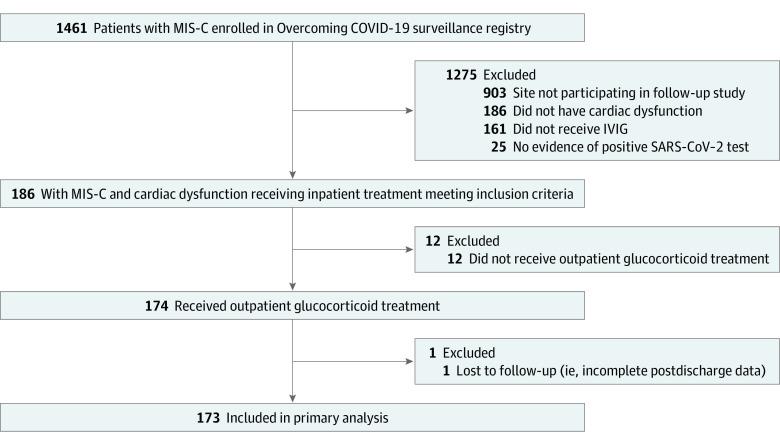
DESIGN, SETTING, AND PARTICIPANTS: This retrospective cohort study included patients with MIS-C hospitalized with severe illness and followed up for 3 months in an ambulatory setting. Patients younger than 21 years who were admitted between May 15, 2020, and May 31, 2021, at 13 US hospitals were included. Inclusion criteria were inpatient treatment comprising intravenous immunoglobulin, diagnosis of cardiovascular dysfunction (vasopressor requirement or left ventricular ejection fraction ≤55%), and availability of complete outpatient data for 3 months.
EXPOSURES
Glucocorticoid treatment.
MAIN OUTCOMES AND MEASURES
Main outcomes were patient characteristics associated with postdischarge glucocorticoid treatment, laboratory test result trajectories, and adverse events. Multivariable regression was used to evaluate factors associated with postdischarge weight gain (≥2 kg in 3 months) and hyperglycemia during illness.
RESULTS
Among 186 patients, the median age was 10.4 years (IQR, 6.7-14.2 years); most were male (107 [57.5%]), Black non-Hispanic (60 [32.3%]), and Hispanic or Latino (59 [31.7%]). Most children were critically ill (intensive care unit admission, 163 [87.6%]; vasopressor receipt, 134 [72.0%]) and received inpatient glucocorticoid treatment (178 [95.7%]). Most were discharged with continued glucocorticoid treatment (173 [93.0%]); median discharge dose was 42 mg/d (IQR, 30-60 mg/d) or 1.1 mg/kg/d (IQR, 0.7-1.7 mg/kg/d). Inpatient severity of illness was not associated with duration of postdischarge glucocorticoid treatment. Outpatient treatment duration varied (median, 23 days; IQR, 15-32 days). Time to normalization of C-reactive protein and ferritin levels was similar for glucocorticoid duration of less than 3 weeks vs 3 or more weeks. Readmission occurred in 7 patients (3.8%); none was for cardiovascular dysfunction. Hyperglycemia developed in 14 patients (8.1%). Seventy-five patients (43%) gained 2 kg or more after discharge (median 4.1 kg; IQR, 3.0-6.0 kg). Inpatient high-dose intravenous and oral glucocorticoid therapy was associated with postdischarge weight gain (adjusted odds ratio, 6.91; 95% CI, 1.92-24.91).
CONCLUSIONS AND RELEVANCE
In this multicenter cohort of patients with MIS-C and cardiovascular dysfunction, postdischarge glucocorticoid treatment was often prolonged, but clinical outcomes were similar in patients prescribed shorter courses. Outpatient weight gain was common. Readmission was infrequent, with none for cardiovascular dysfunction. These findings suggest that strategies are needed to optimize postdischarge glucocorticoid courses for patients with MIS-C.
背景
关于儿童多系统炎症综合征(MIS-C)出院后的治疗,目前仅有少量数据。
目的
评估与出院后糖皮质激素使用时间相关的临床特征,并评估多中心队列中 MIS-C 患者的出院后临床过程、实验室检测结果轨迹和不良事件。
设计、地点和参与者:这是一项回顾性队列研究,纳入了于 2020 年 5 月 15 日至 2021 年 5 月 31 日期间在 13 家美国医院因严重疾病住院且在门诊环境中接受 3 个月随访的 21 岁以下 MIS-C 患者。纳入标准包括:静脉注射免疫球蛋白治疗、心血管功能障碍(需要血管加压药或左心室射血分数≤55%)的诊断以及可获得完整的 3 个月门诊数据。
暴露因素
糖皮质激素治疗。
主要结局和测量指标
主要结局为与出院后糖皮质激素治疗相关的患者特征、实验室检测结果轨迹和不良事件。多变量回归用于评估与出院后体重增加(3 个月内增加≥2kg)和疾病期间高血糖相关的因素。
结果
在 186 例患者中,中位年龄为 10.4 岁(IQR,6.7-14.2 岁);大多数为男性(107[57.5%])、黑种非裔(60[32.3%])和西班牙裔或拉丁裔(59[31.7%])。大多数儿童病情严重(入住重症监护病房,163[87.6%];接受血管加压药治疗,134[72.0%])且接受了住院糖皮质激素治疗(178[95.7%])。大多数患者出院时继续接受糖皮质激素治疗(173[93.0%]);出院时的中位剂量为 42mg/d(IQR,30-60mg/d)或 1.1mg/kg/d(IQR,0.7-1.7mg/kg/d)。住院严重程度与出院后糖皮质激素治疗时间无关。门诊治疗时间长短不一(中位数为 23 天;IQR,15-32 天)。糖皮质激素治疗持续时间少于 3 周与 3 周或更长时间相比,C 反应蛋白和铁蛋白水平恢复正常的时间相似。7 例(3.8%)患者再次入院,均非心血管功能障碍。14 例(8.1%)患者发生高血糖。75 例(43%)患者出院后体重增加 2kg 或以上(中位数为 4.1kg;IQR,3.0-6.0kg)。住院期间高剂量静脉和口服糖皮质激素治疗与出院后体重增加相关(调整后比值比,6.91;95%CI,1.92-24.91)。
结论和相关性
在这项患有 MIS-C 和心血管功能障碍的多中心队列研究中,出院后糖皮质激素治疗通常持续时间较长,但接受较短疗程治疗的患者临床结局相似。门诊体重增加较为常见。再次入院频率较低,均非因心血管功能障碍。这些发现表明,需要制定策略以优化 MIS-C 患者出院后的糖皮质激素治疗方案。

 Zotero 插件