
超正统犹太教徒发生主要骨质疏松性骨折的风险。
Risk of major osteoporotic fractures among ultra-orthodox Jews.
机构信息
Maccabi Healthcare Services, Tel Aviv, Israel.
Department of Family Medicine, Sackler Faculty of Medicine, Tal Aviv University, Tel Aviv, Israel.
出版信息
Osteoporos Int. 2023 Jan;34(1):111-118. doi: 10.1007/s00198-022-06522-8. Epub 2022 Nov 11.
UNLABELLED
The Ultra-Orthodox Jewish population has behaviors that can influence the risk for osteoporotic fractures. We investigated whether this population is more prone to osteoporotic fractures than non-Orthodox Jewish. We did not find a significant difference in osteoporotic fracture rates between the two populations despite major differences in exposure to potential risk factors.
INTRODUCTION
The Ultra-Orthodox Jewish population is a conservative population with unique cultural behaviors such as modest clothing and specific dietary restrictions, which can influence bone density and risk for osteoporotic fractures. The aim of this study is to investigate whether the Ultra-Orthodox Jewish population is more prone to osteoporotic fractures than the non-Orthodox Jewish population.
METHODS
This retrospective cohort study utilized computerized records from Maccabi Health Service. Study population included patients 65 years and older without a history of osteoporotic fracture, who reside in regions of Ultra-Orthodox and non-Orthodox Jews. The primary outcome was the adjusted risk to osteoporotic fracture during 9 years of follow-up. Cox regression included patient characteristics and risk factors for osteoporosis.
RESULTS
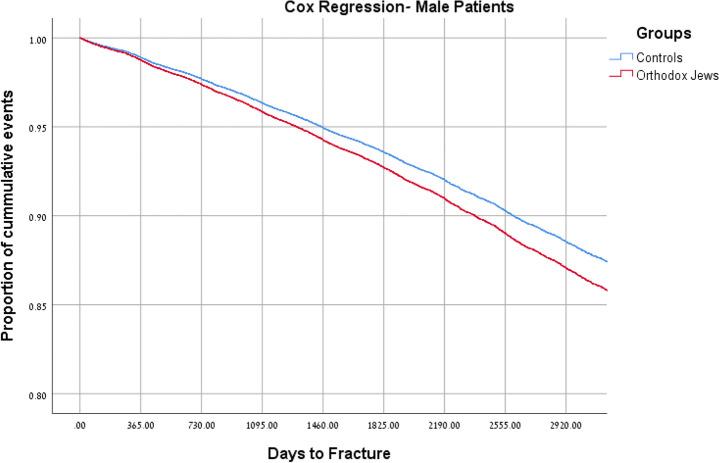
A total of 115,134 patients were included in this study: 5397 patients residing in Ultra-Orthodox regions (51.0% female) and 109,737 patients residing in non-Orthodox regions (52.6% female). A total of 16,352 (14.2%) patients had an osteoporotic fracture during the study period. There was no significant difference in fracture rate between Ultra-Orthodox and non-Orthodox (14.3% vs. 14.2%, p = 0.827). Among Ultra-Orthodox and non-Orthodox females and males, there were no significant differences in fracture rates (19.1% vs. 19.1% p = 0.982 and 9.3% vs. 8.8% p = 0.311, respectively). The adjusted hazard risk for the Ultra-Orthodox Jews was 1.026, 95% CI: 0.95-1.11, p = 0.512.
CONCLUSION
We did not find a significant difference in the rate of osteoporotic fractures between Ultra-Orthodox and non-Orthodox populations despite major differences in exposure to potential risk factors. Results suggest that the perception of risk factors relevant for the religious communities should be re-evaluated.
目的
研究表明,Ultra-Orthodox 犹太人群体的行为可能会影响骨质疏松性骨折的风险。我们旨在调查 Ultra-Orthodox 犹太人群体是否比非犹太教人群更容易发生骨质疏松性骨折。
方法
本回顾性队列研究利用 Maccabi 医疗保健服务的计算机记录。研究人群包括没有骨质疏松性骨折病史且年龄在 65 岁及以上的患者,他们居住在 Ultra-Orthodox 和非犹太教地区。主要结局是在 9 年的随访期间发生骨质疏松性骨折的调整风险。Cox 回归包括患者特征和骨质疏松风险因素。
结果
这项研究共纳入了 115134 名患者:居住在 Ultra-Orthodox 地区的有 5397 名患者(51.0%为女性),居住在非犹太教地区的有 109737 名患者(52.6%为女性)。在研究期间,共有 16352 名(14.2%)患者发生了骨质疏松性骨折。Ultra-Orthodox 和非犹太教地区的骨折发生率没有显著差异(14.3%比 14.2%,p=0.827)。在 Ultra-Orthodox 和非犹太教女性和男性中,骨折发生率也没有显著差异(19.1%比 19.1%,p=0.982 和 9.3%比 8.8%,p=0.311)。Ultra-Orthodox 犹太人的调整后危险比为 1.026,95%CI:0.95-1.11,p=0.512。
结论
尽管暴露于潜在风险因素方面存在显著差异,但我们并未发现 Ultra-Orthodox 和非犹太教人群之间骨质疏松性骨折发生率存在显著差异。结果表明,应重新评估与宗教社区相关的风险因素的认知。

 Zotero 插件