
上皮膜蛋白 2(EMP2)调节成年视网膜色素上皮细胞系中的缺氧诱导血管生成。
Epithelial membrane protein 2 (EMP2) regulates hypoxia-induced angiogenesis in the adult retinal pigment epithelial cell lines.
机构信息
UCLA Stein Eye Institute and the Department of Ophthalmology, David Geffen School of Medicine at UCLA, Los Angeles, CA, USA.
Department of Pathology Lab Medicine, 4525 MacDonald Research Laboratories, David Geffen School of Medicine at UCLA, Los Angeles, CA, 90095, USA.
出版信息
Sci Rep. 2022 Nov 12;12(1):19432. doi: 10.1038/s41598-022-22696-x.
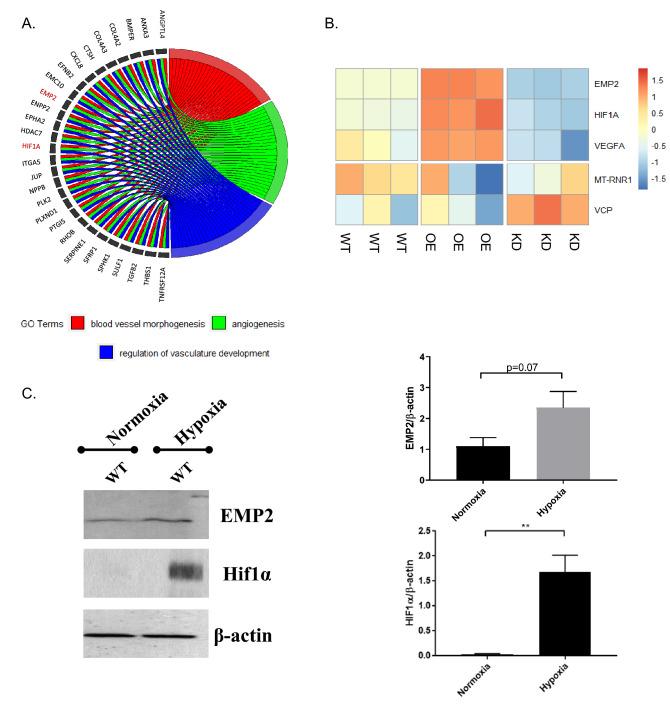
Pathologic retinal neovascularization is a potentially blinding consequence seen in many common diseases including diabetic retinopathy, retinopathy of prematurity, and retinal vaso-occlusive diseases. This study investigates epithelial membrane protein 2 (EMP2) and its role as a possible modulator of angiogenesis in human retinal pigment epithelium (RPE) under hypoxic conditions. To study its effects, the RPE cell line ARPE-19 was genetically modified to either overexpress EMP2 or knock down its levels, and RNA sequencing and western blot analysis was performed to confirm the changes in expression at the RNA and protein level, respectively. Protein expression was evaluated under both normoxic conditions or hypoxic stress. Capillary tube formation assays with human umbilical vein endothelial cells (HUVEC) were used to evaluate functional responses. EMP2 expression was found to positively correlate with expression of pro-angiogenic factors HIF1α and VEGF at both mRNA and protein levels under hypoxic conditions. Mechanistically, EMP2 stabilized HIF1α expression through downregulation of von Hippel Lindau protein (pVHL). EMP2 mediated changes in ARPE-19 cells were also found to alter the secretion of a paracrine factor(s) in conditioned media that can regulate HUVEC migration and capillary tube formation in in vitro functional angiogenesis assays. This study identifies EMP2 as a potential mediator of angiogenesis in a human RPE cell line. EMP2 levels positively correlate with pro-angiogenic mediators HIF1α and VEGF, and mechanistically, EMP2 regulates HIF1α through downregulation of pVHL. This study supports further investigation of EMP2 as a promising novel target for therapeutic treatment of pathologic neovascularization in the retina.
病理性视网膜新生血管是许多常见疾病(包括糖尿病视网膜病变、早产儿视网膜病变和视网膜血管阻塞性疾病)中潜在的致盲后果。本研究探讨了上皮膜蛋白 2(EMP2)及其在缺氧条件下作为人视网膜色素上皮(RPE)中血管生成的可能调节剂的作用。为了研究其作用,通过基因修饰 ARPE-19 细胞系使其过表达 EMP2 或敲低其水平,并进行 RNA 测序和 Western blot 分析,分别在 RNA 和蛋白质水平上确认表达的变化。在常氧条件或缺氧应激下评估蛋白质表达。用人脐静脉内皮细胞(HUVEC)进行毛细血管管形成测定,以评估功能反应。发现在缺氧条件下,EMP2 的表达与促血管生成因子 HIF1α 和 VEGF 的表达在 mRNA 和蛋白质水平上呈正相关。在机制上,EMP2 通过下调 von Hippel Lindau 蛋白(pVHL)稳定 HIF1α 的表达。还发现 EMP2 在 ARPE-19 细胞中的变化改变了条件培养基中旁分泌因子(s)的分泌,该因子可以调节体外功能性血管生成测定中的 HUVEC 迁移和毛细血管管形成。这项研究确定 EMP2 是一种人 RPE 细胞系中血管生成的潜在介质。EMP2 水平与促血管生成介质 HIF1α 和 VEGF 呈正相关,并且在机制上,EMP2 通过下调 pVHL 来调节 HIF1α。这项研究支持进一步研究 EMP2 作为治疗视网膜病理性新生血管的有前途的新靶标。


 Zotero 插件