
下调肝组织中 GHR/STAT5/IGF-1 信号通路的表达促进 HCV 相关肝细胞癌的发生和侵袭:与 Snail-1 和 TGF-β 受体 2 的相互作用。
Down-regulation of hepatic expression of GHR/STAT5/IGF-1 signaling pathway fosters development and aggressiveness of HCV-related hepatocellular carcinoma: Crosstalk with Snail-1 and type 2 transforming growth factor-beta receptor.
机构信息
Department of Internal Medicine, School of Medicine, Minia University, Minia, Egypt.
Department of Pathology, School of Medicine, Minia University, Minia, Egypt.
出版信息
PLoS One. 2022 Nov 14;17(11):e0277266. doi: 10.1371/journal.pone.0277266. eCollection 2022.
BACKGROUND AND AIMS
So far, few clinical trials are available concerning the role of growth hormone receptor (GHR)/signal transducer and activator of transcription 5 (STAT5)/insulin like growth factor-1 (IGF-1) axis in hepatocarcinogenesis. The aim of this study was to evaluate the hepatic expression of GHR/STAT5/IGF-1 signaling pathway in hepatocellular carcinoma (HCC) patients and to correlate the results with the clinico-pathological features and disease outcome. The interaction between this signaling pathway and some inducers of epithelial-mesenchymal transition (EMT), namely Snail-1 and type 2 transforming growth factor-beta receptor (TGFBR2) was studied too.
MATERIAL AND METHODS
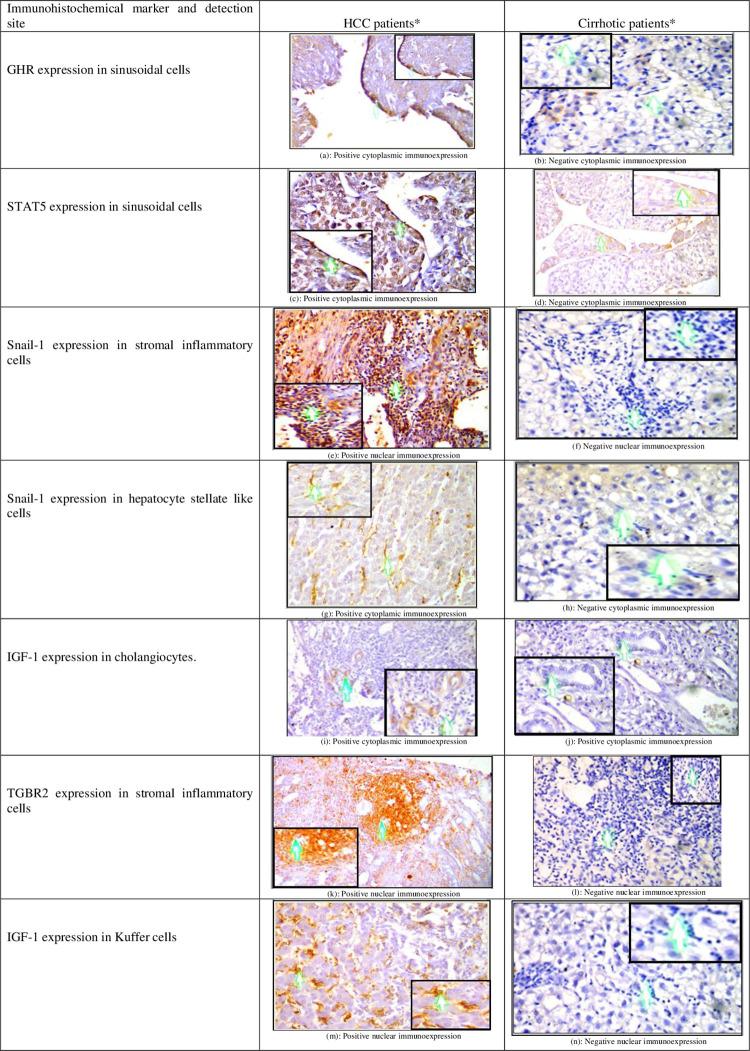
A total of 40 patients with HCV-associated HCC were included in this study. They were compared to 40 patients with HCV-related cirrhosis without HCC, and 20 healthy controls. The hepatic expression of GHR, STAT5, IGF-1, Snail-1 and TGFBR2 proteins were assessed by immunohistochemistry.
RESULTS
Compared with cirrhotic patients without HCC and healthy controls, cirrhotic patients with HCC had significantly lower hepatic expression of GHR, STAT5, and IGF-1proteins. They also displayed significantly lower hepatic expression of TGFBR2, but higher expression of Snail-1 versus the non-HCC cirrhotic patients and controls. Serum levels of alpha-fetoprotein (AFP) showed significant negative correlations with hepatic expression of GHR (r = -0.31; p = 0.029) and STAT5 (r = -0.29; p = 0.04). Hepatic expression of Snail-1 also showed negative correlations with GHR, STAT5, and IGF-1 expression (r = -0.55, p = 0.02; r = -0.472, p = 0.035, and r = -0.51, p = 0.009, respectively), whereas, hepatic expression of TGFBR2 was correlated positively with the expression of all these proteins (r = 0.47, p = 0.034; 0.49, p = 0.023, and r = 0.57, p<0.001, respectively). Moreover, we reported that decreased expression of GHR was significantly associated with serum AFP level>100 ng/ml (p = 0.048), increased tumor size (p = 0.02), vascular invasion (p = 0.002), and advanced pathological stage (p = 0.01). Similar significant associations were found between down-regulation of STAT5 expression and AFP level > 100 ng/ml (p = 0.006), vascular invasion (p = 0.009), and advanced tumor stage (p = 0.007). Also, attenuated expression of IGF-1 showed a significant association with vascular invasion (p < 0.001). Intriguingly, we detected that lower expression of GHR, STAT5 and IGF-1 were considered independent predictors for worse outcome in HCC.
CONCLUSION
Decreased expression of GHR/STAT5/IGF-1 signaling pathway may have a role in development, aggressiveness, and worse outcome of HCV-associated HCC irrespective of the liver functional status. Snail-1 and TGFBR2 as inducers of EMT may be key players. However, large prospective multicenter studies are needed to validate these results.
背景与目的
迄今为止,关于生长激素受体(GHR)/信号转导子和转录激活子 5(STAT5)/胰岛素样生长因子 1(IGF-1)轴在肝癌发生中的作用的临床试验很少。本研究旨在评估肝细胞癌(HCC)患者肝组织中 GHR/STAT5/IGF-1 信号通路的表达,并将结果与临床病理特征和疾病结局相关联。还研究了该信号通路与上皮-间充质转化(EMT)的一些诱导物之间的相互作用,即 SNAI1 和转化生长因子-β受体 2(TGFBR2)。
材料与方法
本研究纳入了 40 例 HCV 相关性 HCC 患者,并与 40 例无 HCC 的 HCV 相关肝硬化患者和 20 例健康对照者进行比较。采用免疫组织化学法检测 GHR、STAT5、IGF-1、SNAI1 和 TGFBR2 蛋白在肝组织中的表达。
结果
与无 HCC 的肝硬化患者和健康对照组相比,伴有 HCC 的肝硬化患者肝组织中 GHR、STAT5 和 IGF-1 蛋白的表达明显降低。他们还显示出明显较低的 TGFBR2 肝表达,但 SNAI1 的表达较高,与无 HCC 的肝硬化患者和对照组相比。血清甲胎蛋白(AFP)水平与 GHR(r = -0.31;p = 0.029)和 STAT5(r = -0.29;p = 0.04)的肝表达呈显著负相关。SNAI1 的肝表达也与 GHR、STAT5 和 IGF-1 的表达呈负相关(r = -0.55,p = 0.02;r = -0.472,p = 0.035 和 r = -0.51,p = 0.009),而 TGFBR2 的肝表达与这些蛋白的表达呈正相关(r = 0.47,p = 0.034;r = 0.49,p = 0.023 和 r = 0.57,p < 0.001)。此外,我们报告 GHR 表达降低与血清 AFP 水平>100ng/ml(p = 0.048)、肿瘤增大(p = 0.02)、血管侵犯(p = 0.002)和晚期病理分期(p = 0.01)显著相关。STAT5 表达下调与 AFP 水平>100ng/ml(p = 0.006)、血管侵犯(p = 0.009)和晚期肿瘤分期(p = 0.007)也存在显著关联。IGF-1 表达减弱与血管侵犯显著相关(p < 0.001)。有趣的是,我们发现 GHR、STAT5 和 IGF-1 的低表达被认为是 HCV 相关 HCC 预后不良的独立预测因素。
结论
GHR/STAT5/IGF-1 信号通路的表达降低可能在 HCV 相关 HCC 的发生、侵袭性和预后不良中起作用,而与肝功能状态无关。SNAI1 和 TGFBR2 作为 EMT 的诱导物可能是关键因素。然而,需要更大规模的前瞻性多中心研究来验证这些结果。


 Zotero 插件