
美国成年人中香烟优惠券收受与短期戒烟之间的纵向关联。
The Longitudinal Association Between Cigarette Coupon Receipt and Short-term Smoking Cessation Among US Adults.
机构信息
Department of Epidemiology, University of Michigan School of Public Health, 1415 Washington Heights, Ann Arbor, MI, USA.
Tobacco Control Research Branch, National Cancer Institute, 9609 Medical Center Drive, Rockville, MD, USA.
出版信息
Nicotine Tob Res. 2023 Mar 22;25(4):738-745. doi: 10.1093/ntr/ntac258.
INTRODUCTION
To help offset the increased price of cigarettes and promote brand loyalty, tobacco companies distribute coupons, particularly to price-sensitive consumers. Few studies, however, have examined the longitudinal association between coupon receipt and smoking cessation.
AIMS AND METHODS
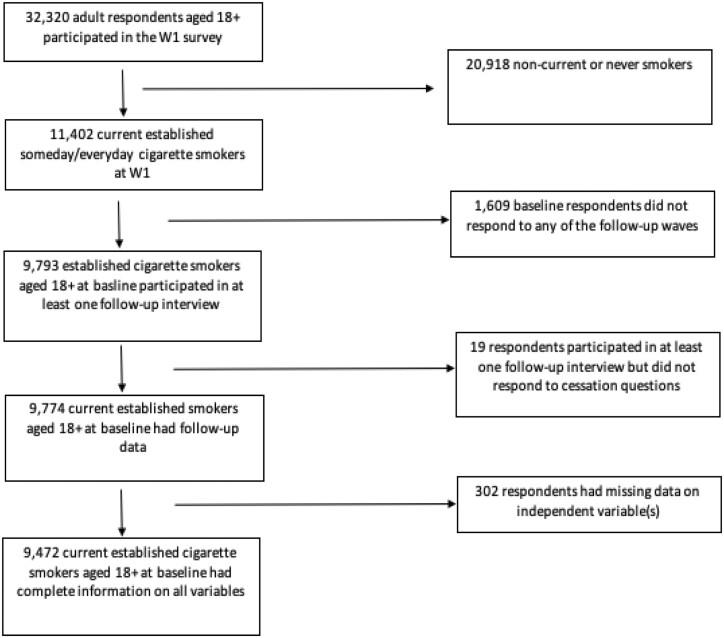
Using adult data from waves 1-5 (2013-2019) of the Population Assessment of Tobacco and Health Study, we examined the longitudinal association between coupon receipt and short-term smoking cessation. Multivariable discrete-time survival models were fit to an unbalanced person-period dataset for adult respondents (≥18 years) with current established smoking status at baseline (person n = 9472, risk period n = 29 784). Short-term smoking cessation was measured as discontinued cigarette use (no past 30-day cigarette use at follow-up) and self-reported complete quitting. Coupon receipt was measured as a time-varying exposure, measured in the wave preceding the outcome. Tobacco dependence and time-varying cigarette use intensity were controlled as potential confounders. Effect modification by age, sex, race-ethnicity, and education was assessed by examining interaction terms.
RESULTS
We found that adults who received a coupon were 19% less likely to quit smoking compared to adults who did not receive a coupon, adjusting for covariates (adjusted hazard rate [aHR]: 0.81, 95% CI: 0.74-0.89). None of the interaction terms were statistically significant, suggesting that the association between coupon receipt and short-term smoking cessation may not differ across the sociodemographic groups that we examined.
CONCLUSIONS
Taken together, our results reveal that coupon receipt reduces the likelihood of short-term smoking cessation, and that this association does not differ by age, sex, race-ethnicity, or education.
IMPLICATIONS (97/100): Tobacco companies distribute coupons for tobacco products to price-sensitive customers in the United States, and these coupons can be particularly effective in partly offsetting the impact of a tax increases and promoting brand loyalty. This study provides longitudinal evidence that coupon receipt is associated with a decrease in short-term smoking cessation among US adults who smoke cigarettes after adjusting for covariates and tobacco-related confounders. The findings from this study suggest that coupons are an effective tool for tobacco companies to prevent adults who smoke from quitting, and a national ban on coupons may help to facilitate smoking cessation.
引言
为了弥补香烟价格上涨带来的损失,并培养消费者对品牌的忠诚度,烟草公司会发放优惠券,尤其是针对价格敏感的消费者。然而,很少有研究探讨过收到优惠券与戒烟之间的纵向关联。
目的和方法
本研究使用来自 2013 年至 2019 年“人口烟草与健康评估研究”(Population Assessment of Tobacco and Health Study)第 1-5 波的数据,分析了收到优惠券与短期戒烟之间的纵向关联。多变量离散时间生存模型适用于基线时具有当前固定吸烟状态的成年受访者(≥18 岁,个体人数为 9472 人,风险期人数为 29784 人)的非平衡个体-时期数据集。短期戒烟的衡量标准为停止使用香烟(随访时无过去 30 天使用香烟的情况)和自我报告的完全戒烟。优惠券的收取被视为一种时变暴露,在结果出现之前的波中进行测量。烟草依赖和时变香烟使用强度被控制为潜在混杂因素。通过检验交互项来评估年龄、性别、种族和教育的作用修饰。
结果
调整了混杂因素后,与未收到优惠券的成年人相比,收到优惠券的成年人戒烟的可能性降低了 19%(调整后的危险比[aHR]:0.81,95%置信区间[CI]:0.74-0.89)。没有一个交互项具有统计学意义,这表明收到优惠券与短期戒烟之间的关联在我们研究的社会人口学群体中可能没有差异。
结论
总的来说,我们的研究结果表明,收到优惠券会降低短期戒烟的可能性,并且这种关联不因年龄、性别、种族-民族或教育程度而有所不同。
意义(97/100):美国的烟草公司向价格敏感的客户分发烟草产品优惠券,这些优惠券在部分抵消税收增加的影响和促进品牌忠诚度方面非常有效。这项研究提供了纵向证据,表明在美国成年人中,在调整了混杂因素和与烟草相关的混杂因素后,收到优惠券与短期戒烟的可能性降低有关。本研究结果表明,优惠券是烟草公司防止吸烟成年人戒烟的有效工具,全国范围内禁止优惠券可能有助于促进戒烟。
 Zotero 插件