
用于在哺乳动物细胞中快速筛选和鉴定对甲型流感病毒具有抗病毒活性的小分子的超灵敏化学发光神经氨酸酶探针。
Ultrasensitive chemiluminescent neuraminidase probe for rapid screening and identification of small-molecules with antiviral activity against influenza A virus in mammalian cells.
作者信息
Shelef Omri, Gutkin Sara, Feder Daniel, Ben-Bassat Ariel, Mandelboim Michal, Haitin Yoni, Ben-Tal Nir, Bacharach Eran, Shabat Doron
机构信息
School of Chemistry, Raymond and Beverly Sackler Faculty of Exact Sciences, Tel-Aviv University Tel Aviv 69978 Israel
School of Neurobiology, Biochemistry and Biophysics, George S. Wise Faculty of Life Sciences, Tel Aviv University Tel Aviv 69978 Israel.
出版信息
Chem Sci. 2022 Sep 26;13(42):12348-12357. doi: 10.1039/d2sc03460c. eCollection 2022 Nov 2.
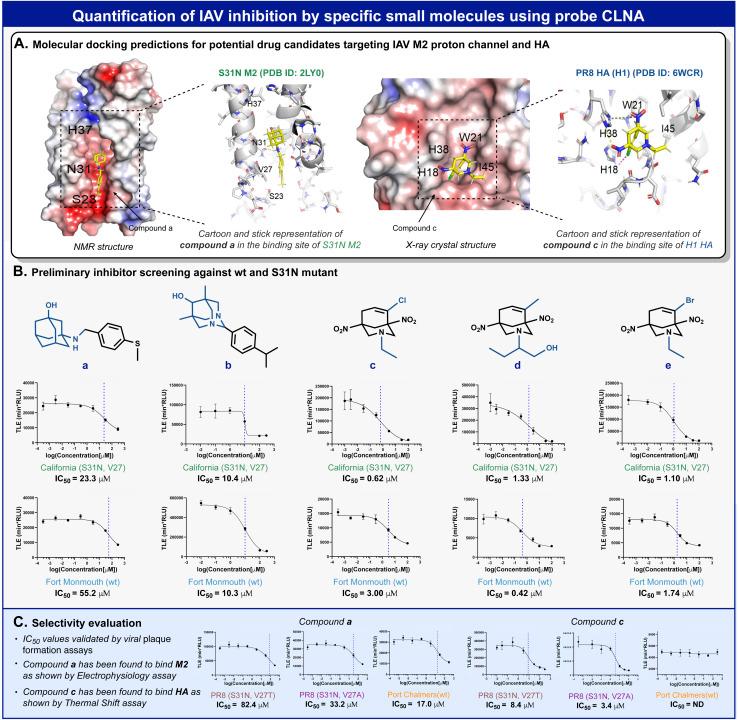
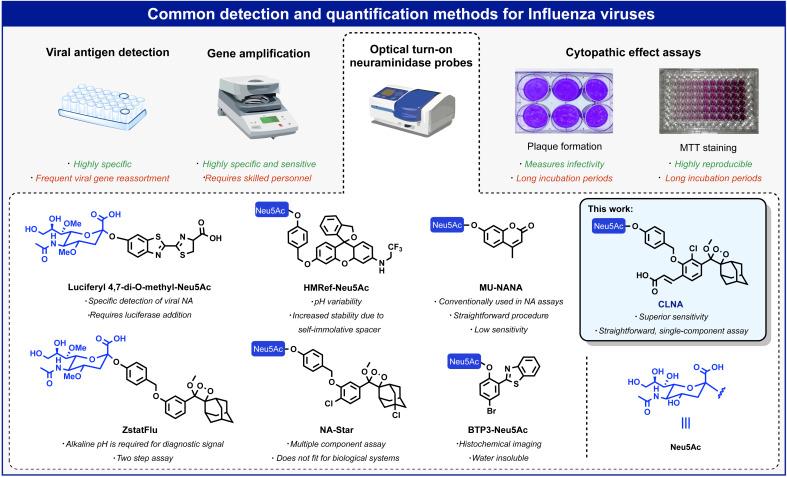
Influenza A virus is the most virulent influenza subtype and is associated with large-scale global pandemics characterized by high levels of morbidity and mortality. Developing simple and sensitive molecular methods for detecting influenza viruses is critical. Neuraminidase, an exo-glycosidase displayed on the surface of influenza virions, is responsible for the release of the virions and their spread in the infected host. Here, we present a new phenoxy-dioxetane chemiluminescent probe (CLNA) that can directly detect neuraminidase activity. The probe exhibits an effective turn-on response upon reaction with neuraminidase and produces a strong emission signal at 515 nm with an extremely high signal-to-noise ratio. Comparison measurements of our new probe with previously reported analogous neuraminidase optical probes showed superior detection capability in terms of response time and sensitivity. Thus, as far as we know, our probe is the most sensitive neuraminidase probe known to date. The chemiluminescence turn-on response produced by our neuraminidase probe enables rapid screening for small molecules that inhibit viral replication through different mechanisms as validated directly in influenza A-infected mammalian cells using the known inhibitors oseltamivir and amantadine. We expect that our new chemiluminescent neuraminidase probe will prove useful for various applications requiring neuraminidase detection including drug discovery assays against various influenza virus strains in mammalian cells.
甲型流感病毒是最具毒性的流感亚型,与以高发病率和高死亡率为特征的大规模全球大流行有关。开发简单且灵敏的检测流感病毒的分子方法至关重要。神经氨酸酶是一种展示在流感病毒粒子表面的外切糖苷酶,负责病毒粒子的释放及其在受感染宿主中的传播。在此,我们展示了一种新型苯氧基二氧杂环丁烷化学发光探针(CLNA),它能够直接检测神经氨酸酶活性。该探针与神经氨酸酶反应时呈现出有效的开启响应,并在515nm处产生强烈的发射信号,信噪比极高。将我们的新型探针与先前报道的类似神经氨酸酶光学探针进行比较测量,结果表明在响应时间和灵敏度方面具有卓越的检测能力。因此,据我们所知,我们的探针是迄今为止已知的最灵敏的神经氨酸酶探针。我们的神经氨酸酶探针产生的化学发光开启响应能够快速筛选通过不同机制抑制病毒复制的小分子,这已通过使用已知抑制剂奥司他韦和金刚烷胺在甲型流感感染的哺乳动物细胞中直接验证。我们期望我们的新型化学发光神经氨酸酶探针将被证明可用于各种需要检测神经氨酸酶的应用,包括针对哺乳动物细胞中各种流感病毒株的药物发现测定。


 Zotero 插件