
印度社区居住的老年人中的财富差距和脆弱性。
Wealth disparity and frailty among community-dwelling older adults in India.
机构信息
Faculty of Health, School of Nursing and Midwifery, University of Technology Sydney, Building 10, Level 7, 235 Jones St, Ultimo, NSW, 2007, Australia.
Department of Sociology, University of Maryland, College Park, MD, 20742, USA.
出版信息
BMC Public Health. 2022 Nov 18;22(1):2123. doi: 10.1186/s12889-022-14434-9.
BACKGROUND
Due to the vast socioeconomic diversity among its residents, studying health inequality in India is of particular interest. This study aimed to investigate the wealth-based inequalities in physical frailty and to quantify the contributions of potential predictors of frailty to this inequality.
METHODS
Data were drawn from the first wave of the Longitudinal Ageing Study in India (LASI) conducted during 2017-18. Logistic regression analysis was used to examine the association between wealth status and frailty. We used the concentration index to measure the magnitude of wealth-related inequality in frailty. A decomposition analysis based on the logit model was used to assess the contribution of each predictor to the total inequality.
RESULTS
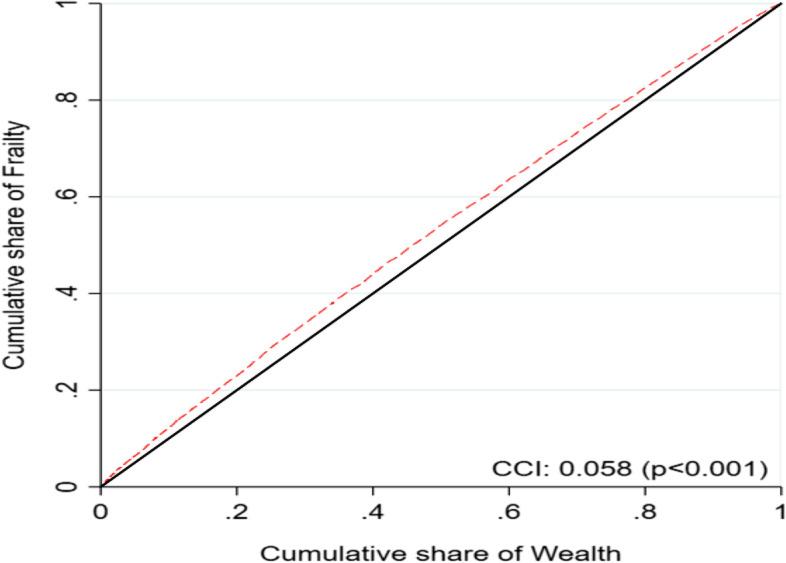
The prevalence of physical frailty was significantly higher among the older adults in the poor group than in the non-poor group [Difference (poor vs. non-poor): 6.4%; p < 0.001]. Regression results indicated that older adults in the poorest group were 23% more likely to be physically frail than those in the richest category [Adjusted odds ratio (AOR) = 1.23; 95% confidence interval (CI): 1.11, 1.38]. The overall concentration index of frailty was 0.058 among the older adults, indicating that frailty is more concentrated among older adults with poor wealth status. Body mass index, wealth index, educational status, and region were the major and significant contributors to the socioeconomic status (SES) related inequalities in frailty.
CONCLUSIONS
Results suggest the need for formulating effective prevention and intervention strategies to decelerate the development of physical frailty among older adults in India, especially those with poor socioeconomic background.
背景
由于其居民在社会经济方面存在巨大差异,因此研究印度的健康不平等问题具有特殊意义。本研究旨在探讨基于财富的身体虚弱不平等现象,并量化虚弱的潜在预测因素对这种不平等的贡献。
方法
数据来自于 2017-18 年进行的印度纵向老龄化研究(LASI)的第一波。使用逻辑回归分析来检验财富状况与虚弱之间的关联。我们使用集中指数来衡量虚弱方面财富相关不平等的程度。基于对数模型的分解分析用于评估每个预测因素对总不平等的贡献。
结果
与非贫困组相比,贫困组的老年人身体虚弱的患病率明显更高[差异(贫困与非贫困):6.4%;p<0.001]。回归结果表明,最贫困组的老年人比最富裕组的老年人更容易出现身体虚弱,可能性高 23%[调整后的优势比(AOR)=1.23;95%置信区间(CI):1.11, 1.38]。老年人整体虚弱的集中指数为 0.058,表明虚弱在财富状况较差的老年人中更为集中。身体质量指数、财富指数、教育程度和地区是导致身体虚弱与社会经济地位(SES)相关不平等的主要和重要因素。
结论
结果表明,有必要制定有效的预防和干预策略,以减缓印度老年人身体虚弱的发展,特别是那些社会经济背景较差的老年人。
 Zotero 插件