
预测透析患者的死亡风险:监测透析结局倡议中使用传统和先进建模技术评估风险因素。
Predicting mortality risk in dialysis: Assessment of risk factors using traditional and advanced modeling techniques within the Monitoring Dialysis Outcomes initiative.
机构信息
Fresenius Medical Care, Global Medical Office, Waltham, Massachusetts, USA.
Maastricht University Medical Center, Maastricht, The Netherlands.
出版信息
Hemodial Int. 2023 Jan;27(1):62-73. doi: 10.1111/hdi.13053. Epub 2022 Nov 20.
INTRODUCTION
Several factors affect the survival of End Stage Kidney Disease (ESKD) patients on dialysis. Machine learning (ML) models may help tackle multivariable and complex, often non-linear predictors of adverse clinical events in ESKD patients. In this study, we used advanced ML method as well as a traditional statistical method to develop and compare the risk factors for mortality prediction model in hemodialysis (HD) patients.
MATERIALS AND METHODS
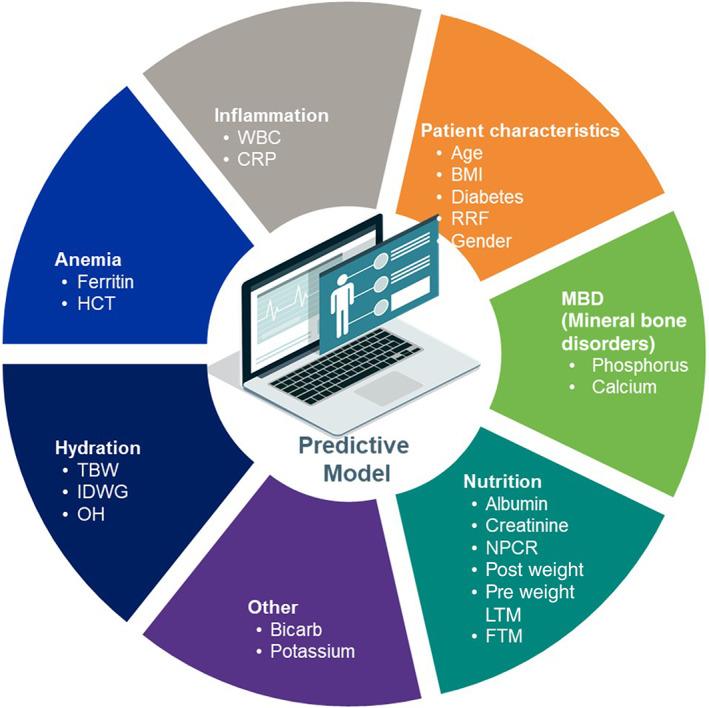
We included data HD patients who had data across a baseline period of at least 1 year and 1 day in the internationally representative Monitoring Dialysis Outcomes (MONDO) Initiative dataset. Twenty-three input parameters considered in the model were chosen in an a priori manner. The prediction model used 1 year baseline data to predict death in the following 3 years. The dataset was randomly split into 80% training data and 20% testing data for model development. Two different modeling techniques were used to build the mortality prediction model.
FINDINGS
A total of 95,142 patients were included in the analysis sample. The area under the receiver operating curve (AUROC) of the model on the test data with XGBoost ML model was 0.84 on the training data and 0.80 on the test data. AUROC of the logistic regression model was 0.73 on training data and 0.75 on test data. Four out of the top five predictors were common to both modeling strategies.
DISCUSSION
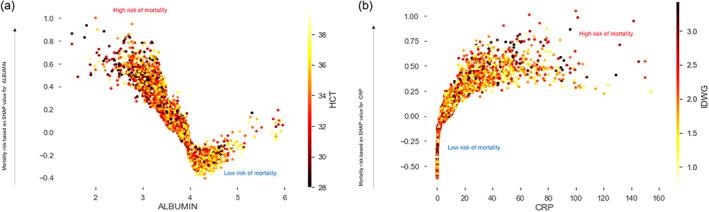
In the internationally representative MONDO data for HD patients, we describe the development of a ML model and a traditional statistical model that was suitable for classification of a prevalent HD patient's 3-year risk of death. While both models had a reasonably high AUROC, the ML model was able to identify levels of hematocrit (HCT) as an important risk factor in mortality. If implemented in clinical practice, such proof-of-concept models could be used to provide pre-emptive care for HD patients.
简介
影响终末期肾病(ESKD)透析患者生存的因素有很多。机器学习(ML)模型可能有助于解决 ESKD 患者不良临床事件的多变量和复杂、通常是非线性预测因素。在这项研究中,我们使用了先进的 ML 方法和传统的统计学方法,开发并比较了血液透析(HD)患者死亡风险预测模型的危险因素。
材料与方法
我们纳入了国际代表性监测透析结局(MONDO)计划数据集中至少有 1 年零 1 天基线期数据的 HD 患者数据。模型中考虑了 23 个预设输入参数。该预测模型使用 1 年的基线数据来预测接下来 3 年内的死亡。数据集被随机分为 80%的训练数据和 20%的测试数据用于模型开发。使用两种不同的建模技术构建了死亡率预测模型。
结果
共有 95142 名患者纳入分析样本。在 XGBoost ML 模型的测试数据上,模型的受试者工作特征曲线(AUROC)下面积在训练数据上为 0.84,在测试数据上为 0.80。逻辑回归模型在训练数据上的 AUROC 为 0.73,在测试数据上为 0.75。两种建模策略中前五个预测因素中有四个是共同的。
讨论
在国际代表性的 MONDO 血液透析患者数据中,我们描述了 ML 模型和传统统计学模型的开发,这两种模型都适合对常见血液透析患者 3 年内死亡风险进行分类。虽然这两种模型的 AUROC 都相当高,但 ML 模型能够识别出红细胞压积(HCT)作为死亡的一个重要危险因素。如果在临床实践中实施,这样的概念验证模型可以用于为血液透析患者提供预防性护理。


 Zotero 插件