
在先前治疗过的多发性骨髓瘤(CASTOR)中,用达雷妥尤单抗、硼替佐米和地塞米松治疗的总生存期:一项随机、开放标签、III 期试验。
Overall Survival With Daratumumab, Bortezomib, and Dexamethasone in Previously Treated Multiple Myeloma (CASTOR): A Randomized, Open-Label, Phase III Trial.
机构信息
Erasmus MC Cancer Institute, Rotterdam, the Netherlands.
Mayo Clinic Florida, Jacksonville, FL.
出版信息
J Clin Oncol. 2023 Mar 10;41(8):1600-1609. doi: 10.1200/JCO.21.02734. Epub 2022 Nov 22.
PURPOSE
At the primary analysis of CASTOR (median follow-up, 7.4 months), daratumumab plus bortezomib and dexamethasone (D-Vd) significantly prolonged progression-free survival versus bortezomib and dexamethasone (Vd) alone in relapsed or refractory multiple myeloma (RRMM). We report updated efficacy and safety results at the final analysis for overall survival (OS).
METHODS
CASTOR was a multicenter, randomized, open-label, phase III study during which eligible patients with ≥ 1 line of prior therapy were randomly assigned to Vd (up to eight cycles) with or without daratumumab (until disease progression). After positive primary analysis and protocol amendment, patients receiving Vd were offered daratumumab monotherapy after disease progression.
RESULTS
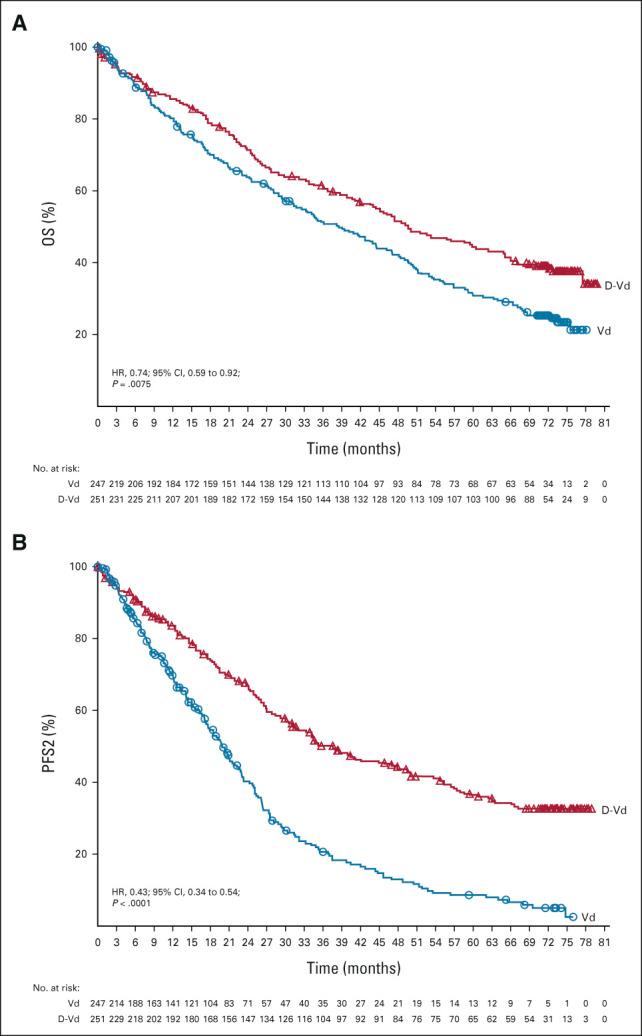
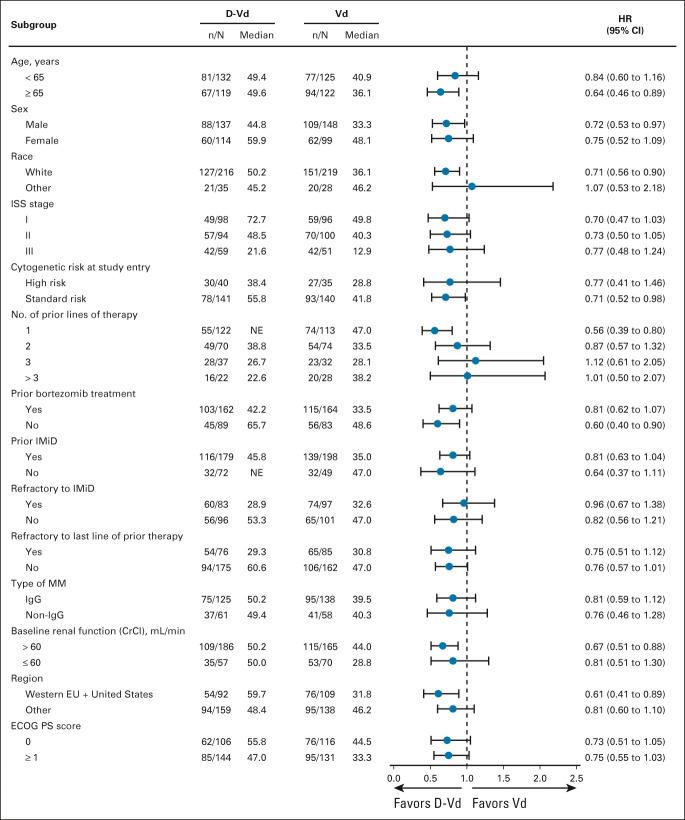
At a median (range) follow-up of 72.6 months (0.0-79.8), significant OS benefit was observed with D-Vd (hazard ratio, 0.74; 95% CI, 0.59 to 0.92; = .0075). Median OS was 49.6 months with D-Vd versus 38.5 months with Vd. Prespecified subgroup analyses demonstrated an OS advantage with D-Vd versus Vd for most subgroups, including patients age ≥ 65 years and patients with one or two prior lines of therapy, International Staging System stage III disease, high-risk cytogenetic abnormalities, and prior bortezomib treatment. The most common (≥ 10%) grade 3/4 treatment-emergent adverse events with D-Vd versus Vd were thrombocytopenia (46.1% 32.9%), anemia (16.0% 16.0%), neutropenia (13.6% 4.6%), lymphopenia (10.3% 2.5%), and pneumonia (10.7% 10.1%).
CONCLUSION
D-Vd significantly prolonged OS in patients with RRMM, with the greatest OS benefit observed in patients with one prior line of therapy. To our knowledge, our results, together with the OS benefit observed with daratumumab plus lenalidomide and dexamethasone in the phase III POLLUX study, demonstrate for the first time an OS benefit with daratumumab-containing regimens in RRMM (ClinicalTrials.gov identifier: NCT02136134 [CASTOR]).
目的
在 CASTOR 的首次分析(中位随访时间为 7.4 个月)中,与硼替佐米和地塞米松(Vd)单药治疗相比,达雷妥尤单抗联合硼替佐米和地塞米松(D-Vd)显著延长了复发或难治性多发性骨髓瘤(RRMM)患者的无进展生存期。我们报告了最终总生存期(OS)分析的更新疗效和安全性结果。
方法
CASTOR 是一项多中心、随机、开放标签、III 期研究,入组了至少接受过一线治疗的患者,这些患者被随机分配至接受 Vd(最多 8 个周期)联合或不联合达雷妥尤单抗(直至疾病进展)。在主要分析呈阳性且方案修订后,接受 Vd 治疗的患者在疾病进展后接受达雷妥尤单抗单药治疗。
结果
中位(范围)随访 72.6 个月(0.0-79.8)时,D-Vd 显著改善了 OS(风险比,0.74;95%CI,0.59 至 0.92;P=0.0075)。D-Vd 组的中位 OS 为 49.6 个月,而 Vd 组为 38.5 个月。预设的亚组分析显示,在大多数亚组中,D-Vd 组的 OS 均优于 Vd 组,包括年龄≥65 岁和接受过 1 线或 2 线治疗、国际分期系统(ISS)III 期疾病、高危细胞遗传学异常和既往硼替佐米治疗的患者。D-Vd 组与 Vd 组最常见(≥10%)的 3/4 级治疗相关不良事件为血小板减少症(46.1%比 32.9%)、贫血(16.0%比 16.0%)、中性粒细胞减少症(13.6%比 4.6%)、淋巴细胞减少症(10.3%比 2.5%)和肺炎(10.7%比 10.1%)。
结论
D-Vd 显著延长了 RRMM 患者的 OS,其中单药治疗患者的 OS 获益最大。据我们所知,我们的结果与 III 期 POLLUX 研究中达雷妥尤单抗联合来那度胺和地塞米松观察到的 OS 获益一起,首次证明了 RRMM 患者接受含达雷妥尤单抗方案治疗的 OS 获益(临床试验编号:NCT02136134[CASTOR])。
 Zotero 插件