
确定对老年人行走影响最大的预测因素。
Determination of the Predictors with the Greatest Influence on Walking in the Elderly.
机构信息
Research Institute of Human Ecology, Yeungnam University, Gyeongsan 38541, Republic of Korea.
Neuromuscular Control Laboratory, Yeungnam University, Gyeongsan 38541, Republic of Korea.
出版信息
Medicina (Kaunas). 2022 Nov 13;58(11):1640. doi: 10.3390/medicina58111640.
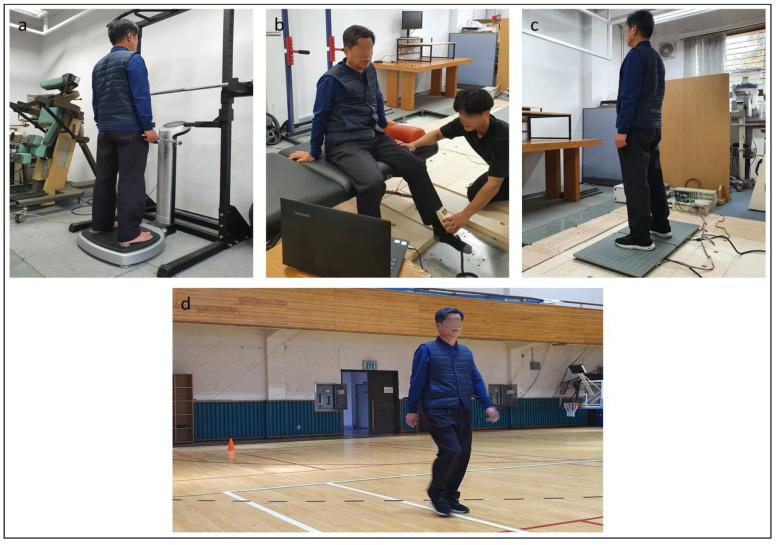
Previous studies have revealed that independent variables (lower extremity strength, postural control ability, and body composition) influence gait performance and variability, but the difference in the relative influence between these variables is unclear. Hence, this study determines the variable that is the most influential predictor of gait performance and variability among potential independent variables in the elderly. Seventy-eight subjects aged ≥60 years participated. For each subject, the gait variables and lower extremity muscle strength were measured using an accelerometer worn on both feet during a 6-minute walk and a manual force sensor, respectively. The static balance ability was measured through two force plates, and the body composition was measured by applying bioelectrical impedance analysis. Linear regression analyses were performed stepwise to determine whether these variables affect gait performance and variability. After adjusting for sex and gait performance, the ankle strength, body fat mass, mean velocity in the medial-lateral direction, ankle plantar flexion strength, and girth were predictors of gait speed dorsiflexion, gait performance, swing width of the gait performance, walking speed, and gait variability, respectively. Overall, gait performance in the elderly is related to muscle strength, postural control, and body composition in a complex manner, but gait variability appears to be more closely related to ankle muscle strength. This study provides further evidence that muscle strength is important in motor function and stability.
先前的研究表明,独立变量(下肢力量、姿势控制能力和身体成分)会影响步态表现和变异性,但这些变量相对影响的差异尚不清楚。因此,本研究旨在确定在老年人的潜在独立变量中,哪个变量对步态表现和变异性的影响最大。
共有 78 名年龄≥60 岁的受试者参与了本研究。对于每位受试者,在进行 6 分钟步行时,分别使用双脚上佩戴的加速度计和手动力传感器测量步态变量和下肢肌肉力量;通过两个测力板测量静态平衡能力;并通过生物电阻抗分析测量身体成分。采用逐步线性回归分析来确定这些变量是否会影响步态表现和变异性。
在调整性别和步态表现后,踝关节力量、体脂肪量、内侧-外侧方向的平均速度、踝关节跖屈力量和周长分别是步速背屈、步态表现、步态摆动宽度、行走速度和步态变异性的预测因子。
综上所述,老年人的步态表现与肌肉力量、姿势控制和身体成分以复杂的方式相关,但步态变异性似乎与踝关节肌肉力量更为密切相关。本研究进一步证明了肌肉力量在运动功能和稳定性中的重要性。
 Zotero 插件