
高浓度胎牛血清可挽救感染引起的mTOR下调。
High Concentration of FBS Can Save mTOR Down-Regulation Caused by Infection.
作者信息
Wu Xiaochun, Ma Jinrui, Jia Shangdong, Zhang Xudong, Zhang Xinlan, An Zhen, Wei Yanquan, Xing Xiaoyong, Wen Fengqin, Gao Yuan, Bao Shijun
机构信息
College of Veterinary Medicine, Gansu Agricultural University, Lanzhou 730070, China.
College of Life Science and Technology, Gansu Agricultural University, Lanzhou 730070, China.
出版信息
Vet Sci. 2022 Nov 11;9(11):630. doi: 10.3390/vetsci9110630.
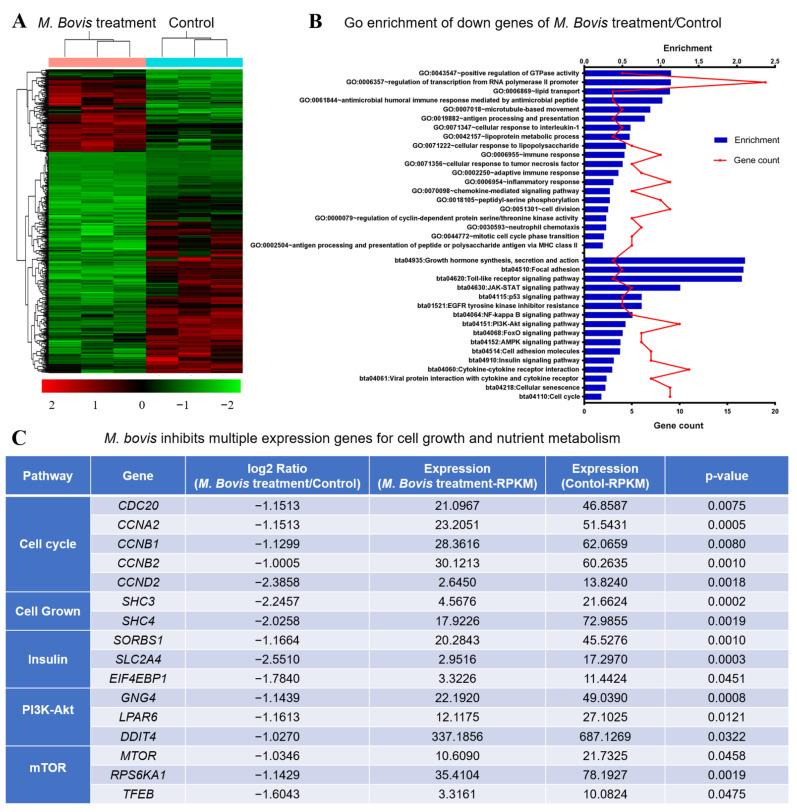
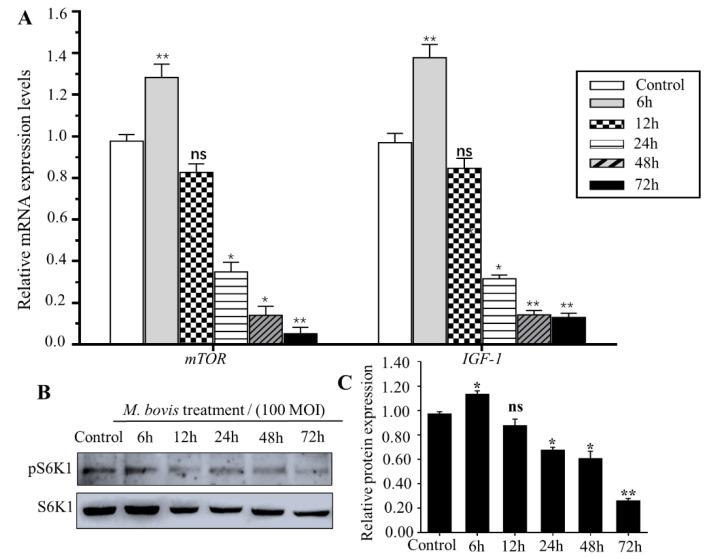
() is an important pathogen that causes a variety of diseases, such as bovine respiratory diseases and causes significant losses to the national cattle industry every year, seriously affecting the development of the cattle industry worldwide. The pathogenic mechanism of infection is still unknown, which leads to the lack of timely diagnosis and treatment. In this study, embryonic bovine lung (EBL) cells, infected with were collected for gene profiling and detection of marker genes in the mTOR signaling pathway. The result showed that infection significantly inhibits EBL growth in a dose-dependent manner. The transcription profiling data uncovered that infection repressed a series of gene expressions in EBL cells, which are mainly related to metabolic process and immune response. Notably, many marker genes in the PI3K-Akt-mTOR pathway showed down-regulation after infection. Further evidence showed that infection inhibits expression of mTOR signaling pathway marker genes in EBL cells, which are time dependent. To further understand the -induced inhibitory effect of mTOR signaling pathway, this study employed FBS as a supplement for exogenous nutrients and found that addition of a high concentration of FBS can rescue -induced cell damage. In addition, a high concentration of FBS can rescue down-regulated mTOR signaling, including increasing transcriptional expression and protein phosphorylation level of mTOR pathway marker genes. This study demonstrated that infection leads to inhibition of the nutrient metabolic pathway mTOR in a time-dependent manner, which would be helpful to further understand infection mechanism and develop a new efficient anti-mycoplasma strategy targeting mTOR signaling.
(某病原体)是一种重要的病原体,可引发多种疾病,如牛呼吸道疾病,每年给国家养牛业造成重大损失,严重影响全球养牛业的发展。该病原体的致病机制仍不清楚,这导致缺乏及时的诊断和治疗方法。在本研究中,收集感染了(该病原体)的胚胎牛肺(EBL)细胞用于基因谱分析以及检测mTOR信号通路中的标记基因。结果表明,(该病原体)感染以剂量依赖的方式显著抑制EBL细胞生长。转录谱数据显示,(该病原体)感染抑制了EBL细胞中一系列基因的表达,这些基因主要与代谢过程和免疫反应相关。值得注意的是,PI3K - Akt - mTOR通路中的许多标记基因在(该病原体)感染后呈现下调。进一步的证据表明,(该病原体)感染在EBL细胞中抑制mTOR信号通路标记基因的表达,且具有时间依赖性。为进一步了解(该病原体)对mTOR信号通路的抑制作用,本研究使用胎牛血清(FBS)作为外源性营养补充剂,发现添加高浓度的FBS可以挽救(该病原体)诱导的细胞损伤。此外,高浓度的FBS可以挽救下调的mTOR信号,包括增加mTOR通路标记基因的转录表达和蛋白磷酸化水平。本研究表明,(该病原体)感染以时间依赖的方式导致营养代谢通路mTOR受到抑制,这将有助于进一步了解(该病原体)的感染机制,并开发一种针对mTOR信号的新型高效抗支原体策略。



 Zotero 插件