
社区居住老年人生活质量评估:台湾大规模调查。
Assessing Quality of Life with Community Dwelling Elderly Adults: A Mass Survey in Taiwan.
机构信息
Department of Healthcare Information and Management, Ming Chuan University, 5 De Ming Rd., Gui Shan District, Taoyuan City 333, Taiwan.
Department of Pediatrics, Taipei City Hospital, No.145, Zhengzhou Rd., Datong Dist., Taipei City 103, Taiwan.
出版信息
Int J Environ Res Public Health. 2022 Nov 8;19(22):14621. doi: 10.3390/ijerph192214621.
BACKGROUND
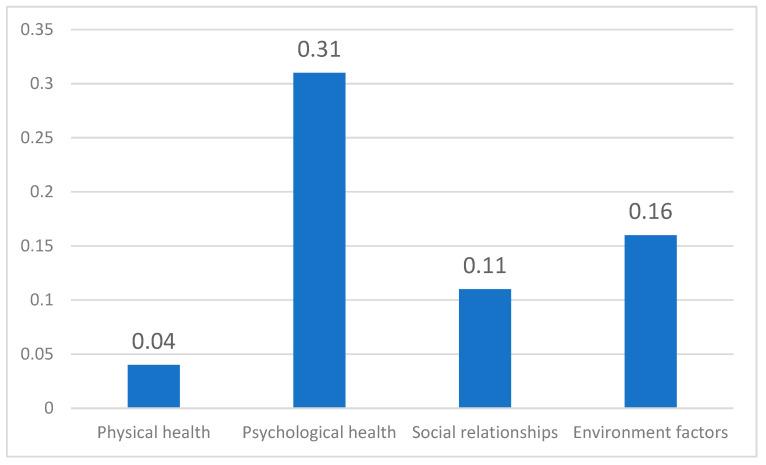
With the growing life expectancy for older adults, this study aims to examine the correlation among sociodemographic characteristics and the combined effect of QoL-related domains including physical health, psychological health, social relationships, and environmental factors with the overall QoL level of older adults in Taiwan.
METHODS
The WHOQOL-BREF Taiwanese Version questionnaire was adopted and conducted using a randomized telephone interview system from community household elders. In total, 1078 participants aged 65 years and older were recruited. A multiple regression model was used to examine the statistical significance between the overall QoL score as the dependent variable and the sociodemographic characteristics, and 26 items of QoL-related questionnaires as the independent variables.
RESULTS
Categories including female, aged 85 years and above, higher education level, and better financial situation had significantly higher overall QoL level. Except the physical health domain and six items, the correlations among all other domains and their including items of questionnaires with overall QoL level were significant.
CONCLUSION
The Taiwanese WHOQOL-BREF questionnaire can be used to examine the overall QoL level of elders in Taiwan. Nevertheless, the robust systems of universal health care and long-term care in Taiwan may have led to the no significance of the six items.
背景
随着老年人预期寿命的延长,本研究旨在探讨社会人口统计学特征与生活质量相关领域(包括身体健康、心理健康、社会关系和环境因素)的综合影响与台湾老年人整体生活质量水平之间的相关性。
方法
采用世界卫生组织生活质量简表台湾版问卷,通过随机电话访谈系统对社区老年居民进行调查。共招募了 1078 名 65 岁及以上的参与者。使用多元回归模型来检验总体生活质量评分作为因变量与社会人口统计学特征以及与生活质量相关的 26 个问卷项目作为自变量之间的统计学意义。
结果
女性、85 岁及以上、较高教育水平和较好的经济状况等类别具有显著更高的总体生活质量水平。除身体健康领域和六个项目外,所有其他领域及其问卷中的项目与总体生活质量水平之间存在显著相关性。
结论
台湾世界卫生组织生活质量简表问卷可用于评估台湾老年人的总体生活质量水平。然而,台湾健全的全民健康保险和长期护理体系可能导致这六个项目没有意义。
 Zotero 插件