
基于握力的恶病质指数作为癌症恶病质和癌症患者预后的预测指标。
Hand grip strength-based cachexia index as a predictor of cancer cachexia and prognosis in patients with cancer.
机构信息
Department of Gastrointestinal Surgery/Department of Clinical Nutrition, Beijing Shijitan Hospital, Capital Medical University, Beijing, China.
Beijing International Science and Technology Cooperation Base for Cancer Metabolism and Nutrition, Beijing, China.
出版信息
J Cachexia Sarcopenia Muscle. 2023 Feb;14(1):382-390. doi: 10.1002/jcsm.13139. Epub 2022 Nov 29.
BACKGROUND
The cachexia index is a useful predictor for cancer cachexia and prognostic assessment. However, its use is limited because of high testing costs and complicated testing procedures. Thus, in this study, we aimed to develop a hand grip strength (HGS)-based cancer cachexia index (H-CXI) as a potential predictor of cancer cachexia and prognosis in patients with cancer.
METHODS
Here, 14 682 patients with cancer were studied, including the discovery (6592), internal validation (2820) and external validation (5270) cohorts. The H-CXI was calculated as [HGS (kg)/height (m) × serum albumin (g/L)]/neutrophil-to-lymphocyte ratio. The Kaplan-Meier method was used to create survival curves, and the log-rank test was used to compare time-event relationships between groups. A Cox proportional hazard regression model was used to determine independent risk factors for overall survival (OS). Logistic regression analysis was used to assess the association of the H-CXI with short-term outcomes and cancer cachexia.
RESULTS
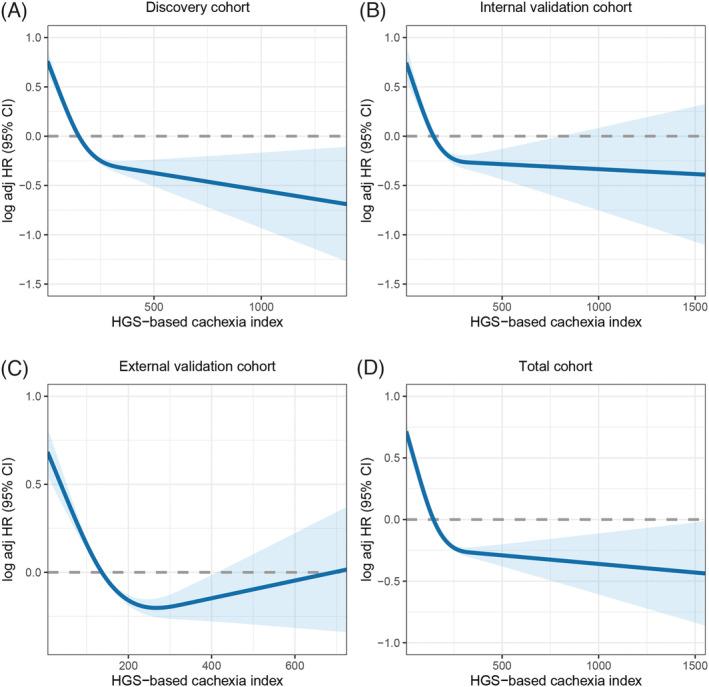
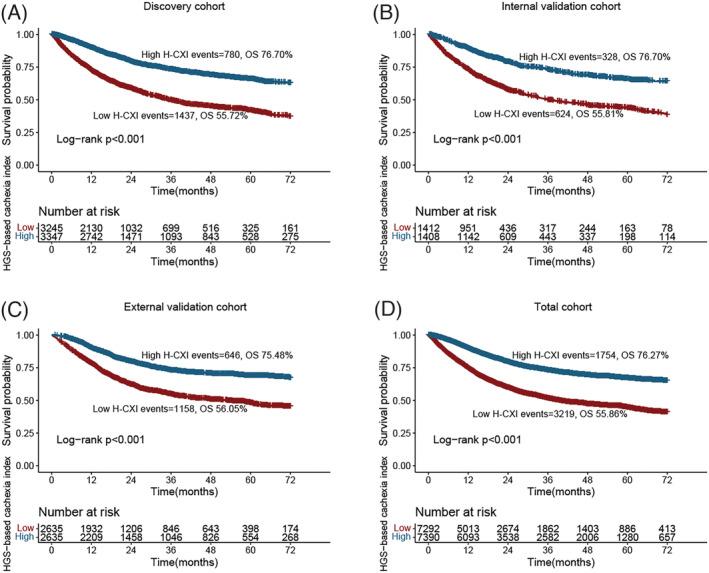
There was a significant non-linear relationship between the H-CXI and OS in all cohorts. Patients with a low H-CXI had significantly lower OS than those with a high H-CXI in the discovery cohort (6-year survival percentage: 55.72% vs. 76.70%, log-rank P < 0.001), internal validation cohort (6-year survival percentage: 55.81% vs. 76.70%, log-rank P < 0.001), external validation cohort (6-year survival percentage: 56.05% vs. 75.48%, log-rank P < 0.001) and total cohort (6-year survival percentage: 55.86% vs. 76.27%, log-rank P < 0.001). Notably, the prognostic stratification effect of the H-CXI in patients with advanced-stage disease was more significant than that in patients with early-stage disease. The multivariate Cox proportional risk regression model confirmed that a low H-CXI negatively affected the prognosis of patients with cancer in the discovery cohort [hazard ratio (HR) 0.75, 95% confidence interval (CI) 0.71-0.80, P < 0.001], internal validation cohort (HR 0.79, 95 %CI 0.72-0.86, P < 0.001), external validation cohort (HR 0.84, 95% CI 0.79-0.89, P < 0.001) and total cohort (HR 0.80, 95% CI 0.77-0.83, P < 0.001). Multivariate logistic regression models showed that a low H-CXI was an independent risk factor predicting adverse short-term outcomes and cancer cachexia in patients with cancer.
CONCLUSIONS
The simple and practical H-CXI is a promising predictor for cancer cachexia and prognosis in patients with cancer.
背景
恶液质指数是预测癌症恶液质和预后评估的有用指标。然而,由于检测成本高和检测程序复杂,其应用受到限制。因此,本研究旨在开发一种基于握力(HGS)的癌症恶液质指数(H-CXI),作为癌症患者癌症恶液质和预后的潜在预测指标。
方法
本研究纳入了 14682 例癌症患者,包括发现队列(6592 例)、内部验证队列(2820 例)和外部验证队列(5270 例)。H-CXI 的计算方法为[HGS(kg)/身高(m)×血清白蛋白(g/L)]/中性粒细胞与淋巴细胞比值。采用 Kaplan-Meier 法绘制生存曲线,对数秩检验比较组间时间事件关系。采用 Cox 比例风险回归模型确定总生存期(OS)的独立预后因素。采用 logistic 回归分析评估 H-CXI 与短期结局和癌症恶液质的相关性。
结果
在所有队列中,H-CXI 与 OS 之间均存在显著的非线性关系。在发现队列(6 年生存率:55.72%比 76.70%,对数秩 P<0.001)、内部验证队列(6 年生存率:55.81%比 76.70%,对数秩 P<0.001)、外部验证队列(6 年生存率:56.05%比 75.48%,对数秩 P<0.001)和总队列(6 年生存率:55.86%比 76.27%,对数秩 P<0.001)中,H-CXI 低值组的 OS 显著低于 H-CXI 高值组。值得注意的是,H-CXI 在晚期疾病患者中的预后分层效果比早期疾病患者更显著。多变量 Cox 比例风险回归模型证实,H-CXI 低值对癌症患者的预后产生负面影响,在发现队列[风险比(HR)0.75,95%置信区间(CI)0.71-0.80,P<0.001]、内部验证队列(HR 0.79,95%CI 0.72-0.86,P<0.001)、外部验证队列(HR 0.84,95%CI 0.79-0.89,P<0.001)和总队列(HR 0.80,95%CI 0.77-0.83,P<0.001)中均如此。多变量 logistic 回归模型显示,H-CXI 低值是癌症患者短期不良结局和癌症恶液质的独立预测因素。
结论
简便实用的 H-CXI 是预测癌症患者癌症恶液质和预后的一种有前途的指标。

 Zotero 插件