
利用F-FBPA PET/CT探索诊断恶性肿瘤的SUV阈值。
Exploration of the threshold SUV for diagnosis of malignancy using F-FBPA PET/CT.
作者信息
Isohashi Kayako, Kanai Yasukazu, Aihara Teruhito, Hu Naonori, Fukushima Kentaro, Baba Ichiro, Hirokawa Fumitoshi, Kakino Ryo, Komori Tsuyoshi, Nihei Keiji, Hatazawa Jun, Ono Koji
机构信息
Department of Kansai BNCT Medical Center, Osaka Medical and Pharmaceutical University, 2-7, Daigaku-Machi, Takatsuki City, Osaka, 569-8686, Japan.
Department of Nuclear Medicine and Tracer Kinetics, Osaka University Graduate School of Medicine, 2-2, Yamadaoka, Suita City, Osaka, 565-0871, Japan.
出版信息
Eur J Hybrid Imaging. 2022 Dec 5;6(1):35. doi: 10.1186/s41824-022-00156-z.
BACKGROUND
The goal of the study was to evaluate the diagnostic ability of F-FBPA PET/CT for malignant tumors. Findings from F-FBPA and F-FDG PET/CT were compared with pathological diagnoses in patients with malignant tumors or benign lesions.
METHODS
A total of 82 patients (45 males, 37 females; median age, 63 years; age range, 20-89 years) with various types of malignant tumors or benign lesions, such as inflammation and granulomas, were examined by F-FDG and F-FBPA PET/CT. Tumor uptake of FDG or FBPA was quantified using the maximum standardized uptake value (SUVmax). The final diagnosis was confirmed by cytopathology or histopathological findings of the specimen after biopsy or surgery. A ROC curve was constructed from the SUVmax values of each PET image, and the area under the curve (AUC) and cutoff values were calculated.
RESULTS
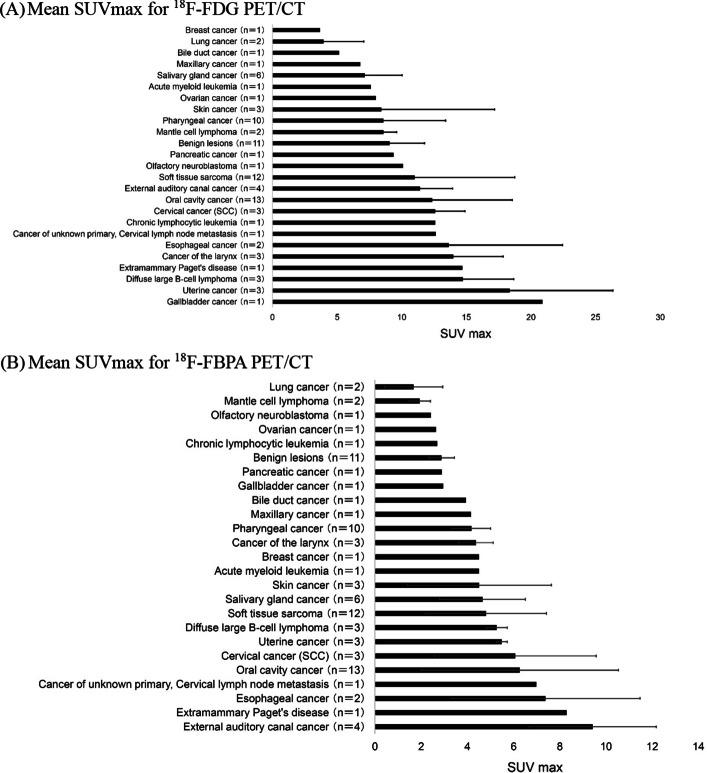
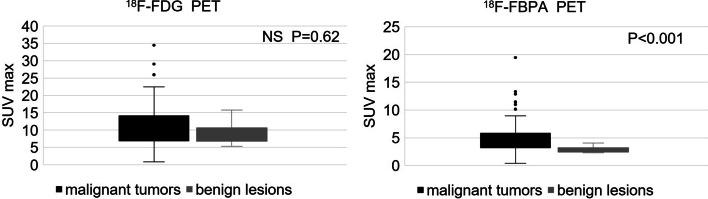
The SUVmax for F-FDG PET/CT did not differ significantly for malignant tumors and benign lesions (10.9 ± 6.3 vs. 9.1 ± 2.7 P = 0.62), whereas SUVmax for F-FBPA PET/CT was significantly higher for malignant tumors (5.1 ± 3.0 vs. 2.9 ± 0.6, P < 0.001). The best SUVmax cutoffs for distinguishing malignant tumors from benign lesions were 11.16 for F-FDG PET/CT (sensitivity 0.909, specificity 0.390) and 3.24 for F-FBPA PET/CT (sensitivity 0.818, specificity 0.753). ROC analysis showed significantly different AUC values for F-FDG and F-FBPA PET/CT (0.547 vs. 0.834, p < 0.001).
CONCLUSION
F-FBPA PET/CT showed superior diagnostic ability over F-FDG PET/CT in differential diagnosis of malignant tumors and benign lesions. The results of this study suggest that F-FBPA PET/CT diagnosis may reduce false-positive F-FDG PET/CT diagnoses.
背景
本研究的目的是评估F-FBPA PET/CT对恶性肿瘤的诊断能力。将F-FBPA和F-FDG PET/CT的检查结果与恶性肿瘤或良性病变患者的病理诊断结果进行比较。
方法
共有82例患有各种类型恶性肿瘤或良性病变(如炎症和肉芽肿)的患者(45例男性,37例女性;中位年龄63岁;年龄范围20 - 89岁)接受了F-FDG和F-FBPA PET/CT检查。使用最大标准化摄取值(SUVmax)对FDG或FBPA的肿瘤摄取情况进行量化。最终诊断通过活检或手术后标本的细胞病理学或组织病理学结果得以证实。根据每个PET图像的SUVmax值构建ROC曲线,并计算曲线下面积(AUC)和临界值。
结果
F-FDG PET/CT的SUVmax在恶性肿瘤和良性病变之间无显著差异(10.9±6.3对9.1±2.7,P = 0.62),而F-FBPA PET/CT的SUVmax在恶性肿瘤中显著更高(5.1±3.0对2.9±0.6,P < 0.001)。F-FDG PET/CT区分恶性肿瘤与良性病变的最佳SUVmax临界值为11.16(敏感性0.909,特异性0.390),F-FBPA PET/CT为3.24(敏感性0.818,特异性0.753)。ROC分析显示F-FDG和F-FBPA PET/CT的AUC值有显著差异(0.547对0.834,p < 0.001)。
结论
在恶性肿瘤和良性病变的鉴别诊断中,F-FBPA PET/CT显示出优于F-FDG PET/CT的诊断能力。本研究结果表明,F-FBPA PET/CT诊断可能减少F-FDG PET/CT的假阳性诊断。



 Zotero 插件