
骨动员是否会干扰围产母牛的能量代谢?
Does bone mobilization interfere with energy metabolism in transition cows?
作者信息
Matthaei M O, Kononov S U, Rehage J, Szura G, Leiter I, Hansen K, Daenicke S, von Soosten D, Kersten S, Meyer Ulrich, Wilkens M R
机构信息
Institute of Animal Nutrition, Nutrition Diseases and Dietetics, Faculty of Veterinary Medicine, University of Leipzig, 01403 Leipzig, Saxony, Germany.
Clinic for Cattle, University of Veterinary Medicine Hannover, Foundation, 30173 Hannover, Lower Saxony, Germany.
出版信息
JDS Commun. 2022 Sep 3;3(6):451-455. doi: 10.3168/jdsc.2022-0239. eCollection 2022 Nov.
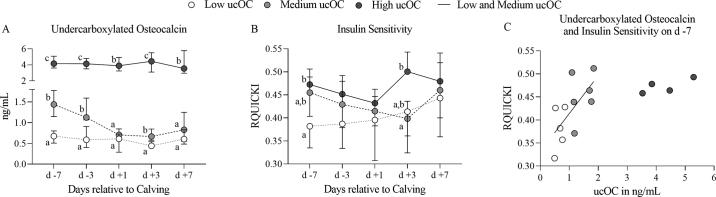
The onset of lactation represents a challenge for both mineral homeostasis and energy metabolism in high-performing dairy cows. It has been shown that subclinical and clinical hypocalcemia increases the risk of ketosis and recent studies suggest that bone-derived endocrine factors could play a role in intermediary metabolism. Therefore, we analyzed serum samples from calculated d -7, calculated d -3, d +1, d +3, and d +7 relative to calving from 15 multiparous cows for total Ca, the bone resorption marker CrossLaps, the bone formation marker intact osteocalcin, undercarboxylated osteocalcin (ucOC), insulin, glucose, nonesterified fatty acids, β-hydroxybutyrate, and insulin-like growth factor 1. Serum concentrations of Ca on d -3 and d +1 were associated with parameters of energy metabolism on d +3 and d +7. As we found large variations for serum concentrations of ucOC already on d -7, we allocated the cows retrospectively to 3 groups: low ucOC, medium ucOC, and high ucOC. These groups differed not only in their ucOC dynamics, but also in insulin sensitivity estimated using the revised quantitative insulin sensitivity index (RQUICKI). High ucOC cows presented with the highest RQUICKI throughout the entire observation period. Our data further support the hypothesis that low serum Ca precedes disturbances of energy metabolism. Furthermore, from our preliminary results it can be assumed that the potential link between mineral homeostasis, bone turnover, and intermediary metabolism should be further investigated.
泌乳的开始对高产奶牛的矿物质稳态和能量代谢而言都是一项挑战。研究表明,亚临床和临床低钙血症会增加酮病风险,并且近期研究表明,骨源内分泌因子可能在中间代谢中发挥作用。因此,我们分析了15头经产奶牛在相对于产犊的计算第 -7天、计算第 -3天、第 +1天、第 +3天和第 +7天的血清样本,检测了总钙、骨吸收标志物I型胶原交联羧基末端肽(CrossLaps)、骨形成标志物完整骨钙素、未羧化骨钙素(ucOC)、胰岛素、葡萄糖、非酯化脂肪酸、β-羟基丁酸酯和胰岛素样生长因子1。第 -3天和第 +1天的血清钙浓度与第 +3天和第 +7天的能量代谢参数相关。由于我们发现第 -7天ucOC的血清浓度就已经存在很大差异,我们将这些奶牛回顾性地分为3组:低ucOC组、中ucOC组和高ucOC组。这些组不仅在ucOC动态变化方面存在差异,在使用修订后的定量胰岛素敏感性指数(RQUICKI)估算的胰岛素敏感性方面也存在差异。在整个观察期内,高ucOC奶牛的RQUICKI最高。我们的数据进一步支持了低血清钙先于能量代谢紊乱这一假说。此外,从我们的初步结果可以推测,矿物质稳态、骨转换和中间代谢之间的潜在联系应进一步研究。

 Zotero 插件