
闭环氧控制改善高流量鼻导管吸氧下儿科患者的氧合——一项随机交叉研究
Closed-loop oxygen control improves oxygenation in pediatric patients under high-flow nasal oxygen-A randomized crossover study.
作者信息
Sandal Ozlem, Ceylan Gokhan, Topal Sevgi, Hepduman Pinar, Colak Mustafa, Novotni Dominik, Soydan Ekin, Karaarslan Utku, Atakul Gulhan, Schultz Marcus J, Ağın Hasan
机构信息
Department of Pediatric Intensive Care Unit, Dr. Behcet Uz Children's Disease and Surgery Training and Research Hospital, Health Sciences University, İzmir, Turkey.
Department of Medical Research, Hamilton Medical AG, Bonaduz, Switzerland.
出版信息
Front Med (Lausanne). 2022 Nov 16;9:1046902. doi: 10.3389/fmed.2022.1046902. eCollection 2022.
BACKGROUND
We assessed the effect of a closed-loop oxygen control system in pediatric patients receiving high-flow nasal oxygen therapy (HFNO).
METHODS
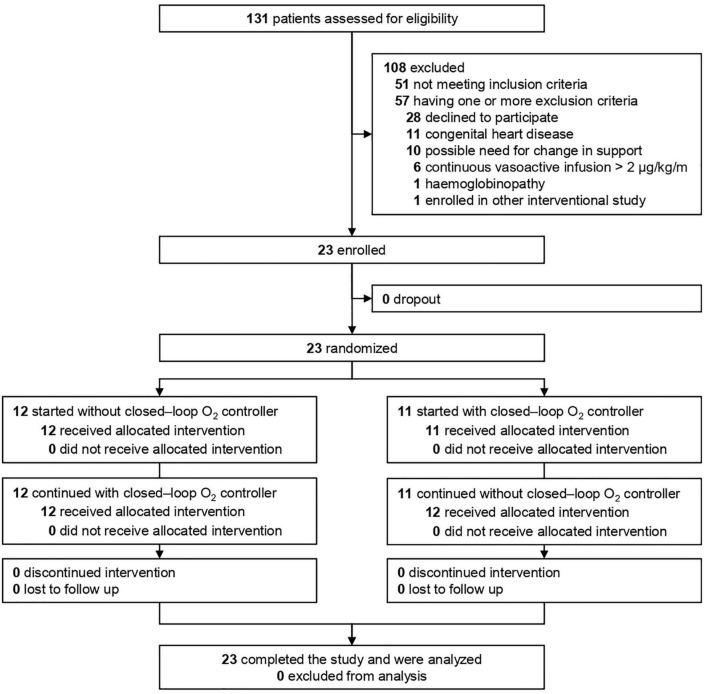
A multicentre, single-blinded, randomized, and cross-over study. Patients aged between 1 month and 18 years of age receiving HFNO for acute hypoxemic respiratory failure (AHRF) were randomly assigned to start with a 2-h period of closed-loop oxygen control or a 2-h period of manual oxygen titrations, after which the patient switched to the alternative therapy. The endpoints were the percentage of time spent in predefined SpO ranges (primary), FiO, SpO/FiO, and the number of manual adjustments.
FINDINGS
We included 23 patients, aged a median of 18 (3-26) months. Patients spent more time in a predefined optimal SpO range when the closed-loop oxygen controller was activated compared to manual oxygen titrations [91⋅3% (IQR 78⋅4-95⋅1%) vs. 63⋅0% (IQR 44⋅4-70⋅7%)], mean difference [28⋅2% (95%-CI 20⋅6-37⋅8%); < 0.001]. Median FiO was lower [33⋅3% (IQR 26⋅6-44⋅6%) vs. 42⋅6% (IQR 33⋅6-49⋅9%); = 0.07], but median SpO/FiO was higher [289 (IQR 207-348) vs. 194 (IQR 98-317); = 0.023] with closed-loop oxygen control. The median number of manual adjustments was lower with closed-loop oxygen control [0⋅0 (IQR 0⋅0-0⋅0) vs. 0⋅5 (IQR 0⋅0-1⋅0); < 0.001].
CONCLUSION
Closed-loop oxygen control improves oxygenation therapy in pediatric patients receiving HFNO for AHRF and potentially leads to more efficient oxygen use. It reduces the number of manual adjustments, which may translate into decreased workloads of healthcare providers.
CLINICAL TRIAL REGISTRATION
[www.ClinicalTrials.gov], identifier [NCT05032365].
背景
我们评估了闭环氧控制系统在接受高流量鼻导管给氧治疗(HFNO)的儿科患者中的效果。
方法
一项多中心、单盲、随机交叉研究。年龄在1个月至18岁之间因急性低氧性呼吸衰竭(AHRF)接受HFNO治疗的患者被随机分配,先进行2小时的闭环氧控制或2小时的手动氧滴定,之后患者切换至另一种治疗方式。终点指标为在预定义的SpO₂范围(主要指标)内所花费的时间百分比、吸入氧浓度(FiO₂)、SpO₂/FiO₂以及手动调整的次数。
研究结果
我们纳入了23例患者,年龄中位数为18(3 - 26)个月。与手动氧滴定相比,激活闭环氧控制器时患者在预定义的最佳SpO₂范围内花费的时间更多[91.3%(四分位间距78.4 - 95.1%)对63.0%(四分位间距44.4 - 70.7%)],平均差异为[28.2%(95%置信区间20.6 - 37.8%);P < 0.001]。闭环氧控制时,FiO₂中位数更低[33.3%(四分位间距26.6 - 44.6%)对42.6%(四分位间距33.6 - 49.9%);P = 0.07],但SpO₂/FiO₂中位数更高[289(四分位间距207 - 348)对194(四分位间距98 - 317);P = 0.023]。闭环氧控制时手动调整的中位数更低[0.0(四分位间距0.0 - 0.0)对0.5(四分位间距0.0 - 1.0);P < 0.001]。
结论
闭环氧控制改善了因AHRF接受HFNO治疗的儿科患者的氧疗效果,并可能提高氧的使用效率。它减少了手动调整的次数,这可能意味着医护人员的工作量减少。
临床试验注册
 Zotero 插件