
中国收入相对剥夺与睡眠时间的关联
Association of income relative deprivation and sleep duration in China.
作者信息
Peng Zijian, Wu Lin
机构信息
School of Sociology, Wuhan University, Wuhan, China.
出版信息
Front Psychol. 2022 Nov 18;13:1008259. doi: 10.3389/fpsyg.2022.1008259. eCollection 2022.
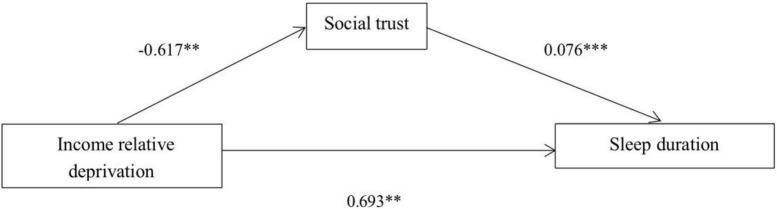
In recent years, the rapid development of China's economy has brought about a serious polarization between rich and poor, which makes people have to bear the impact of social changes on their physical and mental health while enjoying the benefits of social development. It is difficult to maintain normal sleep duration (7-9 h), which has gradually become a social phenomenon. Based on the China Family Panel Studies (CFPS2018), this study explored the relationship between relative income deprivation and sleep duration at the micro-level. This paper empirically tests that the probability of normal sleep duration (7-9 h) decreases by 22.8% for each unit of income relative deprivation. This conclusion is significant at 0.05 level. On this basis, the instrumental variable method is used to overcome the endogenous problem, and a more accurate conclusion is obtained. After the robustness test and heterogeneity analysis of the model, a mediation model is constructed through Mplus: relative income deprivation - social trust - sleep duration. Social trust is considered as a mediation variable. This study believes that in Chinese society, the relative deprivation of individual income will affect their sleep duration by changing their social trust. Therefore, increasing the income of low-income groups, narrowing the gap between rich and poor, alleviating social conflicts, and promoting interpersonal trust are important means to ensure that social members can have normal sleep duration.
近年来,中国经济的快速发展带来了严重的贫富两极分化,这使得人们在享受社会发展成果的同时,不得不承受社会变革对其身心健康的冲击。难以维持正常睡眠时间(7 - 9小时)逐渐成为一种社会现象。基于中国家庭追踪调查(CFPS2018),本研究在微观层面探讨了相对收入剥夺与睡眠时间之间的关系。本文实证检验得出,相对收入剥夺每增加一个单位,正常睡眠时间(7 - 9小时)的概率降低22.8%。这一结论在0.05水平上具有显著性。在此基础上,使用工具变量法克服内生性问题,得出了更准确的结论。经过模型的稳健性检验和异质性分析后,通过Mplus构建中介模型:相对收入剥夺 - 社会信任 - 睡眠时间。将社会信任视为中介变量。本研究认为,在中国社会,个人收入的相对剥夺会通过改变其社会信任来影响睡眠时间。因此,提高低收入群体的收入、缩小贫富差距、缓解社会矛盾、促进人际信任是确保社会成员能够拥有正常睡眠时间的重要手段。
 Zotero 插件