
IgA肾病中的肠-肾轴:对系膜细胞代谢和炎症的作用
Gut-kidney axis in IgA nephropathy: Role on mesangial cell metabolism and inflammation.
作者信息
Luvizotto Mateus Justi, Menezes-Silva Luísa, Woronik Viktoria, Monteiro Renato C, Câmara Niels Olsen Saraiva
机构信息
Department of Nephrology, Faculty of Medicine, University of Sao Paulo, São Paulo, Brazil.
Laboratory of Transplantation Immunobiology, Institute of Biomedical Sciences, University of Sao Paulo, São Paulo, Brazil.
出版信息
Front Cell Dev Biol. 2022 Nov 17;10:993716. doi: 10.3389/fcell.2022.993716. eCollection 2022.
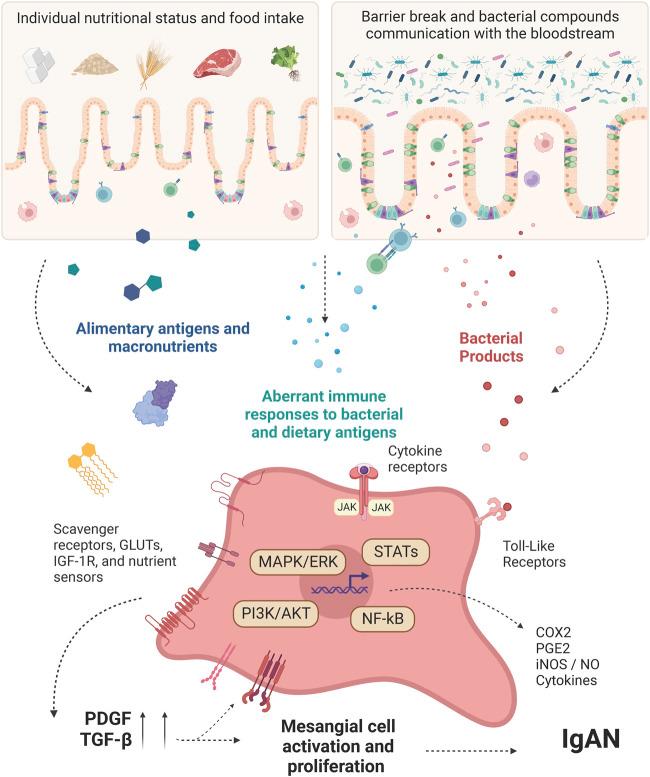
IgA Nephropathy (IgAN) is the commonest primary glomerular disease around the world and represents a significant cause of end-stage renal disease. IgAN is characterized by mesangial deposition of IgA-immune complexes and mesangial expansion. The pathophysiological process includes an abnormally glycosylated IgA1, which is an antigenic target. Autoantibodies specifically recognize galactose-deficient IgA1 forming immune complexes that are amplified in size by the soluble IgA Fc receptor CD89 leading to deposition in the mesangium through interaction with non-classical IgA receptors. The local production of cytokines promotes local inflammation and complement system activation, besides the stimulation of mesangial proliferation. The spectrum of clinical manifestations is quite variable from asymptomatic microscopic hematuria to rapidly progressive glomerulonephritis. Despite all the advances, the pathophysiology of the disease is still not fully elucidated. The mucosal immune system is quoted to be a factor in triggering IgAN and a "gut-kidney axis" is proposed in its development. Furthermore, many recent studies have demonstrated that food intake interferes directly with disease prognosis. In this review, we will discuss how mucosal immunity, microbiota, and nutritional status could be interfering directly with the activation of intrinsic pathways of the mesangial cells, directly resulting in changes in their function, inflammation and development of IgAN.
IgA肾病(IgAN)是全球最常见的原发性肾小球疾病,也是终末期肾病的重要病因。IgA肾病的特征是IgA免疫复合物在系膜沉积以及系膜扩张。其病理生理过程包括异常糖基化的IgA1,它是一种抗原靶点。自身抗体特异性识别缺乏半乳糖的IgA1,形成免疫复合物,该复合物通过可溶性IgA Fc受体CD89增大尺寸,进而通过与非经典IgA受体相互作用导致在系膜沉积。细胞因子的局部产生除了刺激系膜增生外,还促进局部炎症和补体系统激活。临床表现范围从无症状性镜下血尿到快速进展性肾小球肾炎,差异很大。尽管取得了所有进展,但该疾病的病理生理学仍未完全阐明。黏膜免疫系统被认为是触发IgA肾病的一个因素,并且在其发病过程中提出了“肠-肾轴”。此外,许多近期研究表明食物摄入直接影响疾病预后。在本综述中,我们将讨论黏膜免疫、微生物群和营养状况如何直接干扰系膜细胞内在途径的激活,直接导致其功能、炎症和IgA肾病发展的变化。
 Zotero 插件