
人工智能和机器学习在癌症预测、诊断及预后中的作用。
Role of Artificial Intelligence and Machine Learning in Prediction, Diagnosis, and Prognosis of Cancer.
作者信息
Gaur Kritika, Jagtap Miheer M
机构信息
Pathology, Jawaharlal Nehru Medical College, Datta Meghe Institute of Medical Sciences, Wardha, IND.
出版信息
Cureus. 2022 Nov 2;14(11):e31008. doi: 10.7759/cureus.31008. eCollection 2022 Nov.
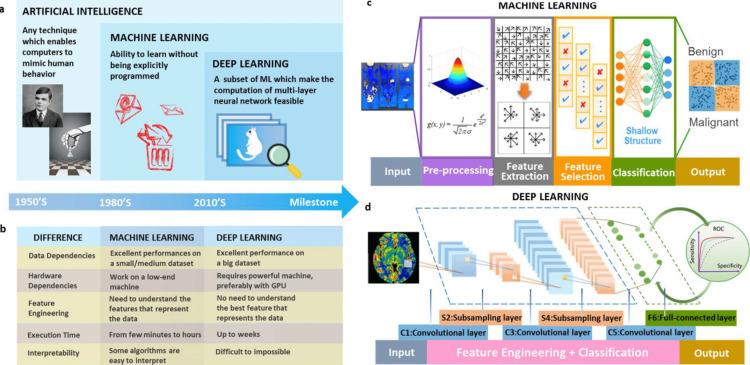
Cancer is one of the most devastating, fatal, dangerous, and unpredictable ailments. To reduce the risk of fatality in this disease, we need some ways to predict the disease, diagnose it faster and precisely, and predict the prognosis accurately. The incorporation of artificial intelligence (AI), machine learning (ML), and deep learning (DL) algorithms into the healthcare system has already proven to work wonders for patients. Artificial intelligence is a simulation of intelligence that uses data, rules, and information programmed in it to make predictions. The science of machine learning (ML) uses data to enhance performance in a variety of activities and tasks. A bigger family of machine learning techniques built on artificial neural networks and representation learning is deep learning (DL). To clarify, we require AI, ML, and DL to predict cancer risk, survival chances, cancer recurrence, cancer diagnosis, and cancer prognosis. All of these are required to improve patient's quality of life, increase their survival rates, decrease anxiety and fear to some extent, and make a proper personalized treatment plan for the suffering patient. The survival rates of people with diffuse large B-cell lymphoma (DLBCL) can be forecasted. Both solid and non-solid tumors can be diagnosed precisely with the help of AI and ML algorithms. The prognosis of the disease can also be forecasted with AI and its approaches like deep learning. This improvement in cancer care is a turning point in advanced healthcare and will deeply impact patient's life for good.
癌症是最具毁灭性、致命性、危险性且不可预测的疾病之一。为降低这种疾病的致死风险,我们需要一些方法来预测疾病、更快更精确地诊断疾病,并准确预测预后。将人工智能(AI)、机器学习(ML)和深度学习(DL)算法融入医疗保健系统已被证明对患者有奇效。人工智能是一种智能模拟,它利用其中编程的数据、规则和信息进行预测。机器学习(ML)科学利用数据来提高各种活动和任务的性能。深度学习(DL)是基于人工神经网络和表征学习构建的更大的机器学习技术家族。需要说明的是,我们需要人工智能、机器学习和深度学习来预测癌症风险、生存几率、癌症复发、癌症诊断和癌症预后。所有这些对于提高患者的生活质量、提高他们的生存率、在一定程度上减轻焦虑和恐惧以及为患病患者制定合适的个性化治疗方案都是必要的。弥漫性大B细胞淋巴瘤(DLBCL)患者的生存率可以被预测。借助人工智能和机器学习算法,可以精确诊断实体瘤和非实体瘤。疾病的预后也可以通过人工智能及其深度学习等方法进行预测。癌症护理方面的这种改善是先进医疗保健的一个转折点,将对患者的生活产生深远的积极影响。
 Zotero 插件