
MGnify:2023 年的微生物组序列数据分析资源。
MGnify: the microbiome sequence data analysis resource in 2023.
机构信息
European Molecular Biology Laboratory, European Bioinformatics Institute (EMBL-EBI), Wellcome Genome Campus, Hinxton, Cambridge, UK.
School of Engineering, Newcastle University, Newcastle upon Tyne, UK.
出版信息
Nucleic Acids Res. 2023 Jan 6;51(D1):D753-D759. doi: 10.1093/nar/gkac1080.
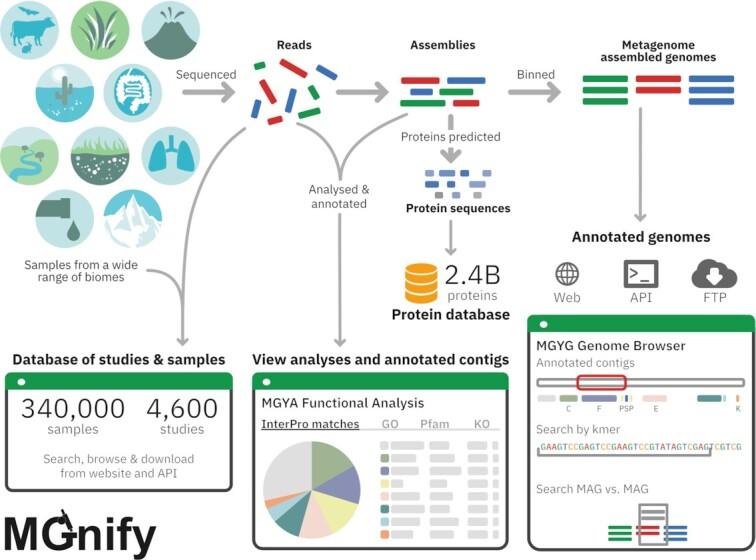
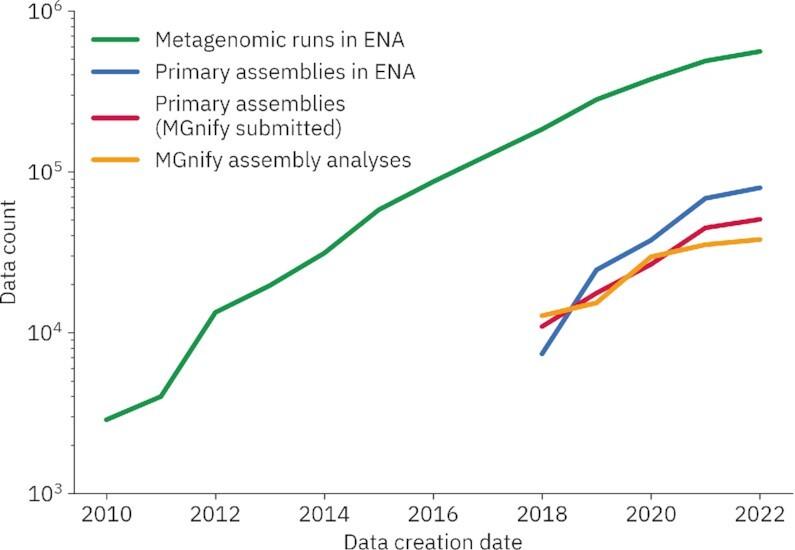
The MGnify platform (https://www.ebi.ac.uk/metagenomics) facilitates the assembly, analysis and archiving of microbiome-derived nucleic acid sequences. The platform provides access to taxonomic assignments and functional annotations for nearly half a million analyses covering metabarcoding, metatranscriptomic, and metagenomic datasets, which are derived from a wide range of different environments. Over the past 3 years, MGnify has not only grown in terms of the number of datasets contained but also increased the breadth of analyses provided, such as the analysis of long-read sequences. The MGnify protein database now exceeds 2.4 billion non-redundant sequences predicted from metagenomic assemblies. This collection is now organised into a relational database making it possible to understand the genomic context of the protein through navigation back to the source assembly and sample metadata, marking a major improvement. To extend beyond the functional annotations already provided in MGnify, we have applied deep learning-based annotation methods. The technology underlying MGnify's Application Programming Interface (API) and website has been upgraded, and we have enabled the ability to perform downstream analysis of the MGnify data through the introduction of a coupled Jupyter Lab environment.
MGnify 平台(https://www.ebi.ac.uk/metagenomics)促进了微生物组衍生核酸序列的组装、分析和归档。该平台提供了近五十万次分析的分类分配和功能注释,这些分析涵盖了代谢组学、宏转录组学和宏基因组学数据集,这些数据集来自于广泛不同的环境。在过去的 3 年中,MGnify 不仅在包含的数据集数量上有所增长,而且还增加了提供的分析广度,例如长读序列的分析。MGnify 蛋白质数据库现在包含超过 24 亿个非冗余序列,这些序列是从宏基因组组装中预测出来的。该集合现在被组织成一个关系数据库,通过导航回源组装和样本元数据,可以了解蛋白质的基因组背景,这是一个重大改进。为了扩展 MGnify 中已经提供的功能注释,我们应用了基于深度学习的注释方法。MGnify 的应用程序编程接口 (API) 和网站的基础技术已经升级,并且我们通过引入耦合的 Jupyter Lab 环境,使对 MGnify 数据进行下游分析的能力成为可能。



 Zotero 插件