
强制性运动疗法对脑卒中后患者下肢运动功能障碍的影响:一项系统评价与Meta分析
Effect of constraint-induced movement therapy on lower extremity motor dysfunction in post-stroke patients: A systematic review and meta-analysis.
作者信息
Zhou Mingze, Tu Yang, Cui Jiarui, Gao Ping, Yi Ting, Wang Jun, Hao Qinghong, Li Hui, Zhu Tianmin
机构信息
School of Health Preservation and Rehabilitation, Chengdu University of Traditional Chinese Medicine, Chengdu, China.
School of Preclinical Medicine, Chengdu University, Chengdu, China.
出版信息
Front Neurol. 2022 Nov 21;13:1028206. doi: 10.3389/fneur.2022.1028206. eCollection 2022.
OBJECTIVE
Constraint-induced movement therapy (CIMT) is a common treatment for upper extremity motor dysfunction after a stroke. However, whether it can effectively improve lower extremity motor function in stroke patients remains controversial. This systematic review comprehensively studies the current evidence and evaluates the effectiveness of CIMT in the treatment of post-stroke lower extremity motor dysfunction.
METHODS
We comprehensively searched randomized controlled trials related to this study in eight electronic databases (PubMed, Embase, The Cochrane Library, Web of Science, CBM, CNKI, WAN FANG, and VIP). We evaluated CIMT effectiveness against post-stroke lower extremity motor dysfunction based on the mean difference and corresponding 95% confidence interval (95% CI). We assessed methodological quality based on the Cochrane Bias Risk Assessment Tool. After extracting the general information, mean, and standard deviation of the included studies, we conducted a meta-analysis using RevMan 5.3 and Stata 16.0. The primary indicator was the Fugl-Meyer Assessment scale on lower limbs (FMA-L). The secondary indicators were the Berg balance scale (BBS), 10-meter walk test (10MWT), gait speed (GS), 6-min walk test (6MWT), functional ambulation category scale (FAC), timed up and go test (TUGT), Brunnstrom stage of lower limb function, weight-bearing, modified Barthel index (MBI), functional independence measure (FIM), stroke-specific quality of life questionnaire (SSQOL), World Health Organization quality of life assessment (WHOQOL), and National Institute of Health stroke scale (NIHSS).
RESULTS
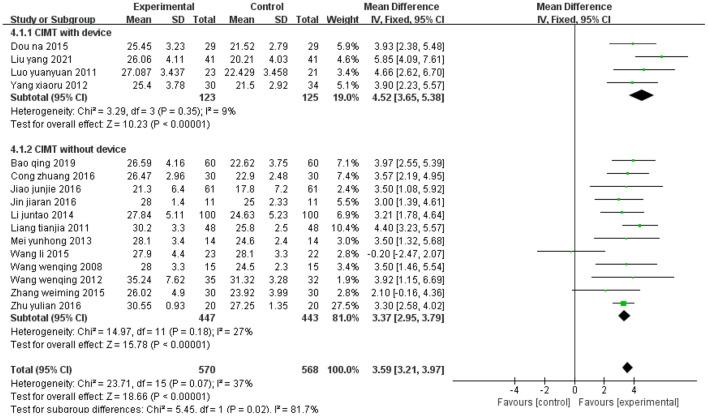
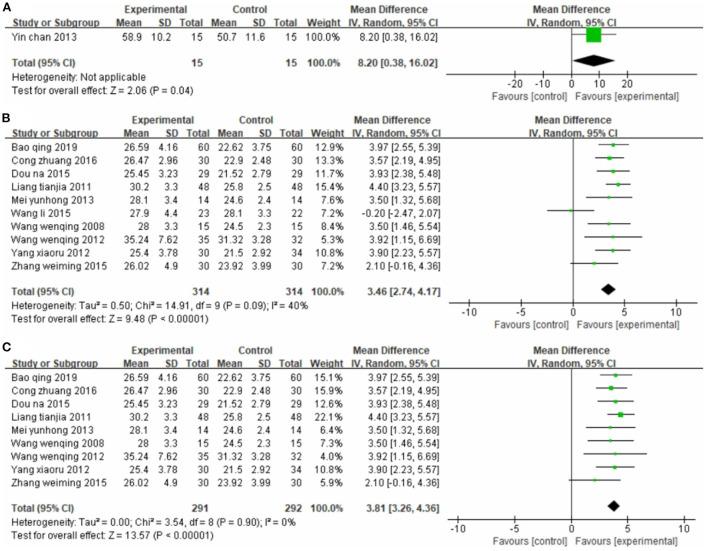
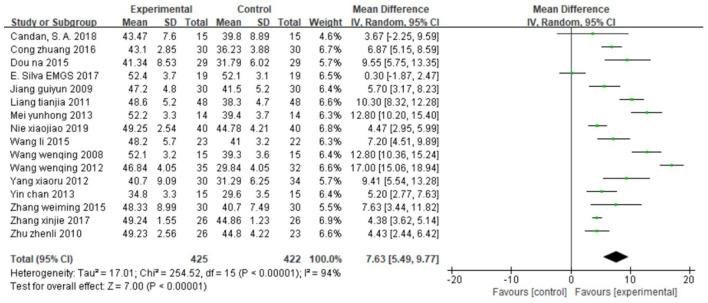
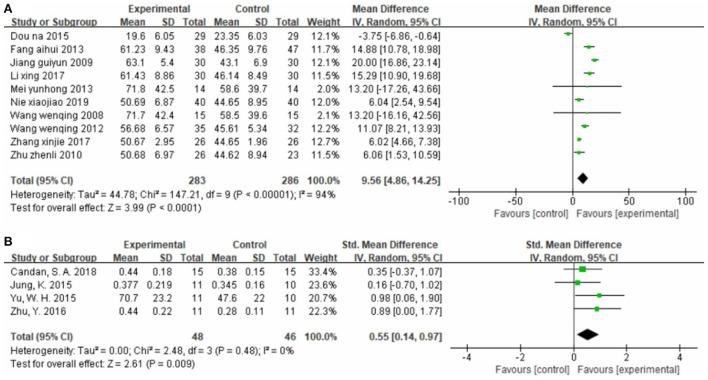
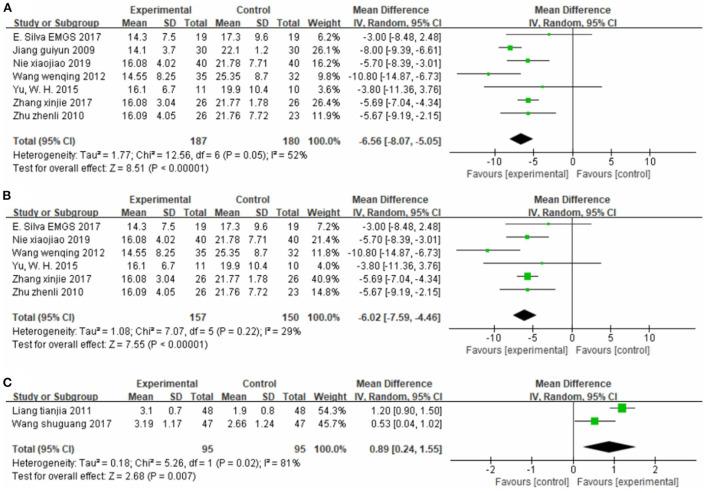
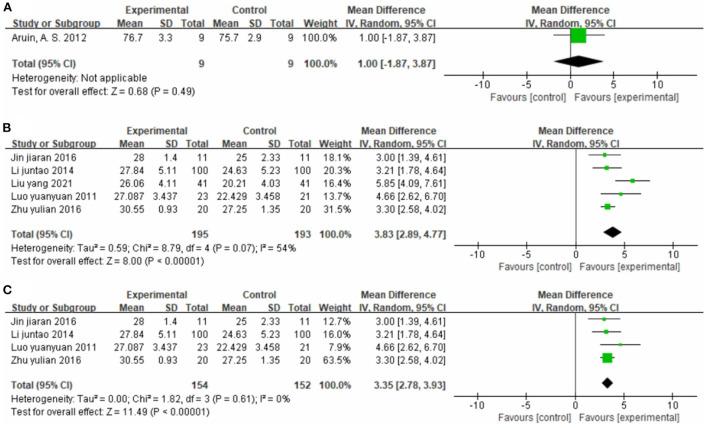
We initially identified 343 relevant studies. Among them, 34 (totaling 2,008 patients) met the inclusion criteria. We found that patients treated with CIMT had significantly better primary indicator (FMA-L) scores than those not treated with CIMT. The mean differences were 3.46 (95% CI 2.74-4.17, P < 0.01, I2 = 40%) between CIMT-treated and conventional physiotherapy-treated patients, 3.83 (95% CI 2.89-4.77, P < 0.01, I2 = 54%) between patients treated with CIMT plus conventional physiotherapy and patients treated only with conventional physiotherapy, and 3.50 (95% CI 1.08-5.92, P < 0.01) between patients treated with CIMT plus western medicine therapy and those treated only with western medicine therapy. The secondary indicators followed the same trend. The subgroup analysis showed that lower extremity CIMT with device seemed to yield a higher mean difference in FMA-L scores than lower extremity CIMT without device (4.52, 95% CI = 3.65-5.38, < 0.01 and 3.37, 95% CI = 2.95-3.79, < 0.01, respectively).
CONCLUSION
CIMT effectively improves lower extremity motor dysfunction in post-stroke patients; however, the eligible studies were highly heterogeneous.: https://www.crd.york.ac.uk/prospero/display_record.php?RecordID=277466.
目的
强制性运动疗法(CIMT)是中风后上肢运动功能障碍的常见治疗方法。然而,它是否能有效改善中风患者的下肢运动功能仍存在争议。本系统评价全面研究当前证据,并评估CIMT治疗中风后下肢运动功能障碍的有效性。
方法
我们在八个电子数据库(PubMed、Embase、Cochrane图书馆、Web of Science、CBM、CNKI、万方和维普)中全面检索与本研究相关的随机对照试验。我们基于平均差和相应的95%置信区间(95%CI)评估CIMT对中风后下肢运动功能障碍的有效性。我们根据Cochrane偏倚风险评估工具评估方法学质量。在提取纳入研究的一般信息、均值和标准差后,我们使用RevMan 5.3和Stata 16.0进行荟萃分析。主要指标是下肢Fugl-Meyer评估量表(FMA-L)。次要指标包括Berg平衡量表(BBS)、10米步行试验(10MWT)、步速(GS)、6分钟步行试验(6MWT)、功能性步行分类量表(FAC)、计时起立行走试验(TUGT)、下肢功能Brunnstrom分期、负重、改良Barthel指数(MBI)、功能独立性测量(FIM)、中风特异性生活质量问卷(SSQOL)、世界卫生组织生活质量评估(WHOQOL)和美国国立卫生研究院卒中量表(NIHSS)。
结果
我们初步识别出343项相关研究。其中,34项(共2008例患者)符合纳入标准。我们发现,接受CIMT治疗的患者的主要指标(FMA-L)得分显著高于未接受CIMT治疗的患者。接受CIMT治疗的患者与接受传统物理治疗的患者之间的平均差为3.46(95%CI 2.74 - 4.17,P < 0.01,I² = 40%),接受CIMT联合传统物理治疗的患者与仅接受传统物理治疗的患者之间的平均差为3.83(95%CI 2.89 - 4.77,P < 0.01,I² = 54%),接受CIMT联合西药治疗的患者与仅接受西药治疗的患者之间的平均差为3.50(95%CI 1.08 - 5.92,P < 0.01)。次要指标也呈现相同趋势。亚组分析表明,使用设备的下肢CIMT在FMA-L得分上的平均差似乎高于不使用设备的下肢CIMT(分别为4.52,95%CI = 3.65 - 5.38,P < 0.01和3.37,95%CI = 2.95 - 3.79,P < 0.01)。
结论
CIMT可有效改善中风后患者的下肢运动功能障碍;然而,符合条件的研究具有高度异质性。:https://www.crd.york.ac.uk/prospero/display_record.php?RecordID=277466





 Zotero 插件