
奥比妥珠单抗联合苯丁酸氮芥与伊布替尼治疗既往未治疗的无TP53缺失的慢性淋巴细胞白血病患者:一项真实世界的慢性淋巴细胞白血病临床研究。
Obinutuzumab plus chlorambucil versus ibrutinib in previously untreated chronic lymphocytic leukemia patients without TP53 disruptions: A real-life CLL campus study.
作者信息
Visentin Andrea, Mauro Francesca Romana, Catania Gioachino, Fresa Alberto, Vitale Candida, Sanna Alessandro, Mattiello Veronica, Cibien Francesca, Sportoletti Paolo, Gentile Massimo, Rigolin Gian Matteo, Quaglia Francesca Maria, Murru Roberta, Gozzetti Alessandro, Molica Stefano, Marchetti Monia, Pravato Stefano, Angotzi Francesco, Cellini Alessandro, Scarfò Lydia, Reda Gianluigi, Coscia Marta, Laurenti Luca, Ghia Paolo, Foà Robin, Cuneo Antonio, Trentin Livio
机构信息
Hematology and Clinical Immunology Unit, Department of Medicine, University of Padua, Padova, Italy.
Veneto Institute of Molecular Medicine, Padua, Italy.
出版信息
Front Oncol. 2022 Nov 21;12:1033413. doi: 10.3389/fonc.2022.1033413. eCollection 2022.
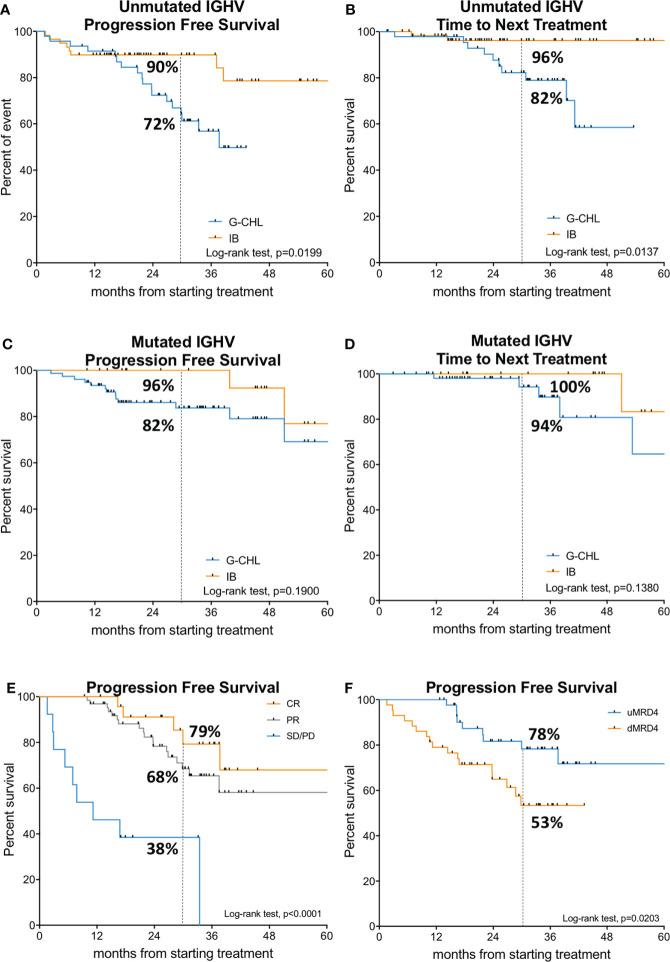
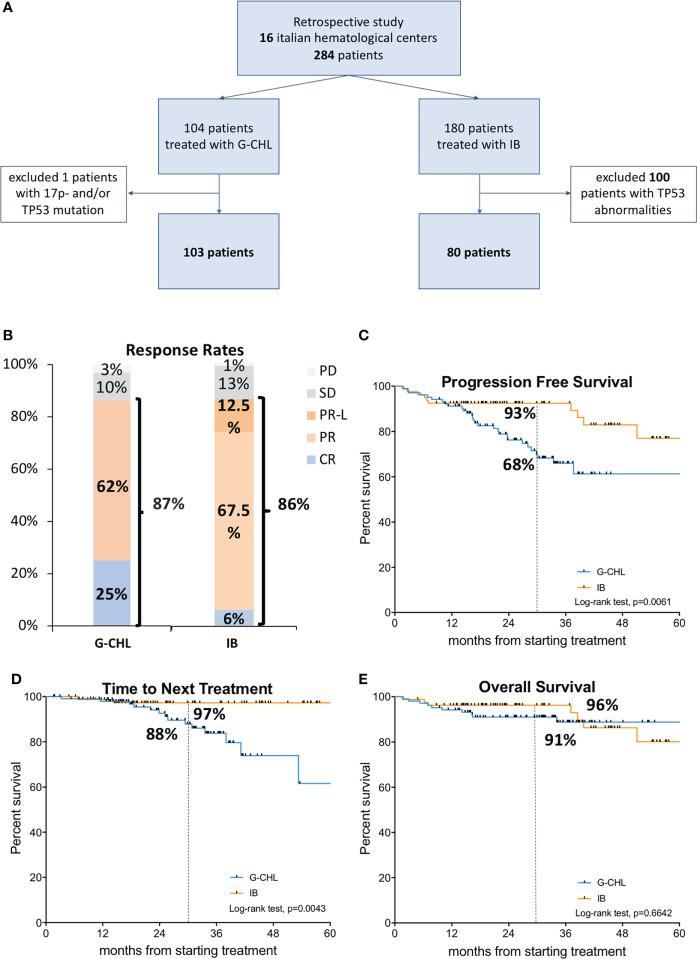
One of the main issues in the treatment of patients with chronic lymphocytic leukemia (CLL) deals with the choice between continuous or fixed-duration therapy. Continuous ibrutinib (IB), the first-in-class BTK inhibitor, and obinutuzumab-chlorambucil (G-CHL) are commonly used therapies for elderly and/or comorbid patients. No head-to-head comparison has been carried out. Within the Italian campus CLL network, we performed a retrospective study on CLL patients without TP53 disruption treated with IB or G-CHL as first-line therapy. Patients in the G-CHL arm had a higher CIRS score and the worst renal function. The overall response rates between the G-CHL and IB arms were similar, but more complete remissions (CRs) were achieved with G-CHL ( = 0.0029). After a median follow-up of 30 months, the progression-free survival (PFS, = 0.0061) and time to next treatment (TTNT, = 0.0043), but not overall survival (OS, = 0.6642), were better with IB than with G-CHL. Similar results were found after propensity score matching and multivariate analysis. While PFS and TTNT were longer with IB than with G-CHL in IGHV unmutated patients ( = 0.0190 and 0.0137), they were superimposable for IGHV mutated patients ( = 0.1900 and 0.1380). In the G-CHL arm, the depth of response (79% . 68% . 38% for CR, PR and SD/PD; < 0.0001) and measurable residual disease (MRD) influenced PFS (78% . 53% for undetectable MRD . detectable MRD, = 0.0203). Hematological toxicities were common in the G-CHL arm, while IB was associated with higher costs. Although continuous IB provides better disease control in CLL, IGHV mutated patients and those achieving an undetectable MRD show a marked clinical and economic benefit from a fixed-duration obinutuzumab-based treatment.
慢性淋巴细胞白血病(CLL)患者治疗中的一个主要问题涉及持续治疗或固定疗程治疗之间的选择。第一代布鲁顿酪氨酸激酶(BTK)抑制剂伊布替尼(IB)持续治疗以及奥妥珠单抗-苯丁酸氮芥(G-CHL)是老年和/或合并症患者常用的治疗方法。尚未进行直接比较。在意大利CLL研究网络中,我们对未发生TP53基因破坏且接受IB或G-CHL作为一线治疗的CLL患者进行了一项回顾性研究。G-CHL组的患者CIRS评分更高,肾功能更差。G-CHL组和IB组的总体缓解率相似,但G-CHL组实现了更多的完全缓解(CR)(P = 0.0029)。中位随访30个月后,IB组的无进展生存期(PFS,P = 0.0061)和至下次治疗时间(TTNT,P = 0.0043)优于G-CHL组,但总生存期(OS,P = 0.6642)两组相似。倾向评分匹配和多变量分析后发现了类似结果。在未发生IGHV突变的患者中,IB组的PFS和TTNT长于G-CHL组(P = 0.0190和0.0137),而在IGHV突变的患者中两者相当(P = 0.1900和0.1380)。在G-CHL组中,缓解深度(CR、PR和SD/PD分别为79%、68%、38%;P < 0.0001)和可测量残留病(MRD)影响PFS(MRD不可检测组和可检测组分别为78%、53%,P = 0.0203)。血液学毒性在G-CHL组很常见,而IB治疗费用更高。尽管IB持续治疗在CLL中能提供更好的疾病控制,但IGHV突变患者以及那些实现MRD不可检测的患者从基于奥妥珠单抗的固定疗程治疗中显示出显著的临床和经济效益。
 Zotero 插件