
遗传关联在西班牙裔社区健康研究/拉丁裔研究中的睡眠特征和认知老化结果之间。
Genetic associations between sleep traits and cognitive ageing outcomes in the Hispanic Community Health Study/Study of Latinos.
机构信息
Division of Sleep and Circadian Disorders, Department of Medicine, Brigham and Women's Hospital, Boston, MA, USA; Department of Respiratory Medicine, Xiangya Hospital, Central South University, Changsha, Hunan, China.
Division of Sleep and Circadian Disorders, Department of Medicine, Brigham and Women's Hospital, Boston, MA, USA.
出版信息
EBioMedicine. 2023 Jan;87:104393. doi: 10.1016/j.ebiom.2022.104393. Epub 2022 Dec 6.
BACKGROUND
Sleep phenotypes have been reported to be associated with cognitive ageing outcomes. However, there is limited research using genetic variants as proxies for sleep traits to study their associations. We estimated associations between Polygenic Risk Scores (PRSs) for sleep duration, insomnia, daytime sleepiness, and obstructive sleep apnoea (OSA) and measures of cogntive ageing in Hispanic/Latino adults.
METHODS
We used summary statistics from published genome-wide association studies to construct PRSs representing the genetic basis of each sleep trait, then we studied the association of the PRSs of the sleep phenotypes with cognitive outcomes in the Hispanic Community Healthy Study/Study of Latinos. The primary model adjusted for age, sex, study centre, and measures of genetic ancestry. Associations are highlighted if their p-value <0.05.
FINDINGS
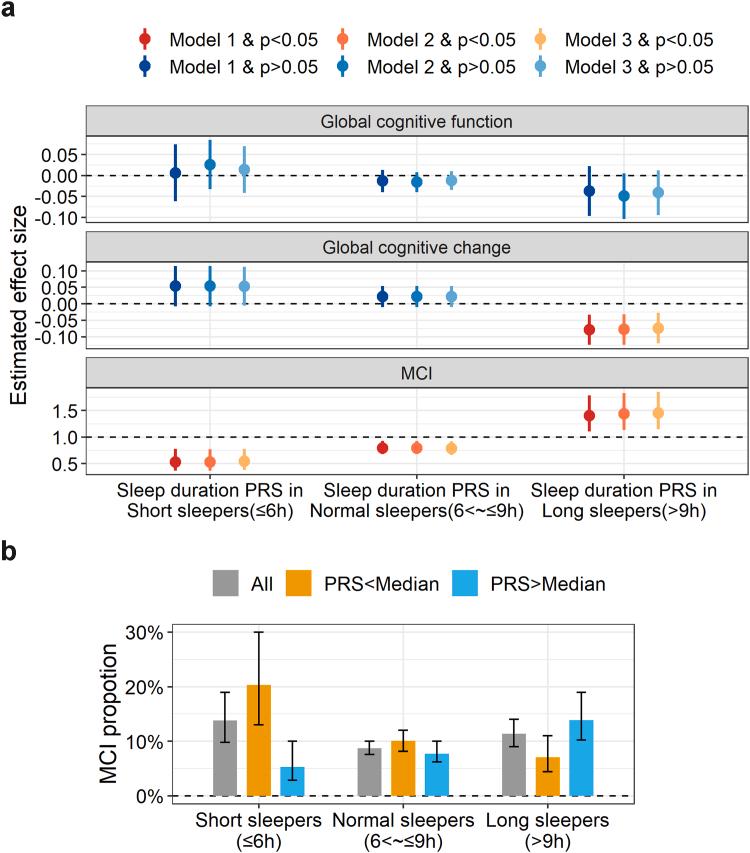
Higher PRS for insomnia was associated with lower global cognitive function and higher risk of mild cognitive impairment (MCI) (OR = 1.20, 95% CI [1.06, 1.36]). Higher PRS for daytime sleepiness was also associated with increased MCI risk (OR = 1.14, 95% CI [1.02, 1.28]). Sleep duration PRS was associated with reduced MCI risk among short and normal sleepers, while among long sleepers it was associated with reduced global cognitive function and with increased MCI risk (OR = 1.40, 95% CI [1.10, 1.78]). Furthermore, adjustment of analyses for the measured sleep phenotypes and APOE-ε4 allele had minor effects on the PRS associations with the cognitive outcomes.
INTERPRETATION
Genetic measures underlying insomnia, daytime sleepiness, and sleep duration are associated with MCI risk. Genetic and self-reported sleep duration interact in their effect on MCI.
FUNDING
Described in Acknowledgments.
背景
睡眠表型与认知衰老结果相关。然而,使用遗传变异作为睡眠特征的替代物来研究其相关性的研究有限。我们评估了睡眠时间、失眠、日间嗜睡和阻塞性睡眠呼吸暂停 (OSA) 的多基因风险评分 (PRS) 与西班牙裔/拉丁裔成年人认知衰老指标之间的相关性。
方法
我们使用已发表的全基因组关联研究的汇总统计数据来构建代表每种睡眠特征遗传基础的 PRS,然后我们研究了睡眠表型的 PRS 与西班牙裔社区健康研究/拉丁裔研究中的认知结果之间的关联。主要模型调整了年龄、性别、研究中心和遗传祖先的衡量标准。如果其 p 值<0.05,则突出显示关联。
结果
更高的失眠 PRS 与较低的整体认知功能和更高的轻度认知障碍 (MCI) 风险相关(OR=1.20,95%CI [1.06,1.36])。更高的日间嗜睡 PRS 也与增加的 MCI 风险相关(OR=1.14,95%CI [1.02,1.28])。对于短睡者和正常睡眠者,睡眠时间 PRS 与降低 MCI 风险相关,而对于长睡者,它与降低整体认知功能和增加 MCI 风险相关(OR=1.40,95%CI [1.10,1.78])。此外,对认知结果进行分析时,调整测量的睡眠表型和 APOE-ε4 等位基因对 PRS 与认知结果的相关性影响较小。
结论
失眠、日间嗜睡和睡眠时间的遗传指标与 MCI 风险相关。遗传和自我报告的睡眠时间在其对 MCI 的影响上存在相互作用。
资金
如致谢中所述。

 Zotero 插件