
基于细胞重编程的心脏再生修复方法的研究进展。
Advances in Cellular Reprogramming-Based Approaches for Heart Regenerative Repair.
机构信息
Department of Pathology & Laboratory Medicine, College of Medicine, University of Cincinnati, Cincinnati, OH 45221, USA.
Department of Internal Medicine, College of Medicine, University of Cincinnati, Cincinnati, OH 45221, USA.
出版信息
Cells. 2022 Dec 3;11(23):3914. doi: 10.3390/cells11233914.
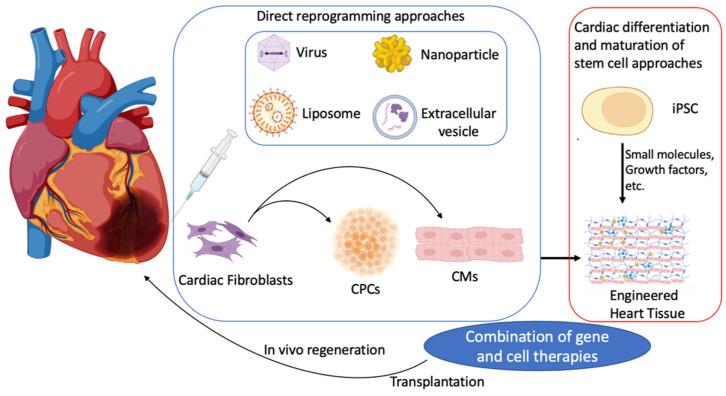
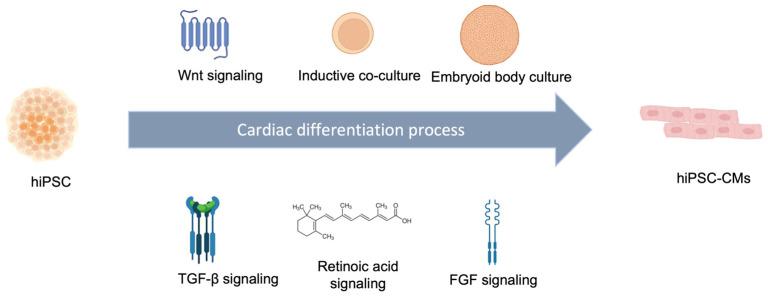
Continuous loss of cardiomyocytes (CMs) is one of the fundamental characteristics of many heart diseases, which eventually can lead to heart failure. Due to the limited proliferation ability of human adult CMs, treatment efficacy has been limited in terms of fully repairing damaged hearts. It has been shown that cell lineage conversion can be achieved by using cell reprogramming approaches, including human induced pluripotent stem cells (hiPSCs), providing a promising therapeutic for regenerative heart medicine. Recent studies using advanced cellular reprogramming-based techniques have also contributed some new strategies for regenerative heart repair. In this review, hiPSC-derived cell therapeutic methods are introduced, and the clinical setting challenges (maturation, engraftment, immune response, scalability, and tumorigenicity), with potential solutions, are discussed. Inspired by the iPSC reprogramming, the approaches of direct cell lineage conversion are merging, such as induced cardiomyocyte-like cells (iCMs) and induced cardiac progenitor cells (iCPCs) derived from fibroblasts, without induction of pluripotency. The studies of cellular and molecular pathways also reveal that epigenetic resetting is the essential mechanism of reprogramming and lineage conversion. Therefore, CRISPR techniques that can be repurposed for genomic or epigenetic editing become attractive approaches for cellular reprogramming. In addition, viral and non-viral delivery strategies that are utilized to achieve CM reprogramming will be introduced, and the therapeutic effects of iCMs or iCPCs on myocardial infarction will be compared. After the improvement of reprogramming efficiency by developing new techniques, reprogrammed iCPCs or iCMs will provide an alternative to hiPSC-based approaches for regenerative heart therapies, heart disease modeling, and new drug screening.
心肌细胞(CMs)的持续丢失是许多心脏病的基本特征之一,这最终会导致心力衰竭。由于人类成年 CMs 的增殖能力有限,因此在充分修复受损心脏方面,治疗效果受到限制。已经表明,可以通过使用细胞重编程方法(包括人诱导多能干细胞(hiPSCs))来实现细胞谱系转换,为再生心脏医学提供了有前途的治疗方法。最近使用先进的基于细胞重编程的技术的研究也为再生心脏修复提供了一些新策略。在这篇综述中,介绍了 hiPSC 衍生的细胞治疗方法,并讨论了临床设置挑战(成熟度、植入、免疫反应、可扩展性和致瘤性)及其潜在解决方案。受 hiPSC 重编程的启发,直接细胞谱系转换的方法正在融合,例如源自成纤维细胞的诱导心肌样细胞(iCMs)和诱导心肌祖细胞(iCPCs),而无需诱导多能性。细胞和分子途径的研究还表明,表观遗传重置是重编程和谱系转换的必要机制。因此,可重新用于基因组或表观遗传编辑的 CRISPR 技术成为细胞重编程的有吸引力的方法。此外,将介绍用于实现 CM 重编程的病毒和非病毒传递策略,并比较 iCMs 或 iCPCs 对心肌梗死的治疗效果。通过开发新技术提高重编程效率后,重编程的 iCPCs 或 iCMs 将为基于 hiPSC 的再生心脏疗法、心脏病建模和新药筛选提供替代方法。


 Zotero 插件