
特定领域体力活动与抑郁症状的关联:基于人群的研究。
Association of domain-specific physical activity with depressive symptoms: A population-based study.
机构信息
Human Phenome Institute, Zhangjiang Fudan International Innovation Centre, Fudan University, Shanghai, China.
Artificial Intelligence Innovation and Incubation Institute, Fudan University, Shanghai, China.
出版信息
Eur Psychiatry. 2022 Dec 12;66(1):e5. doi: 10.1192/j.eurpsy.2022.2350.
BACKGROUND
It remains unclear whether all physical activity (PA) domains (e.g., occupation-related PA [OPA], transportation-related PA [TPA], and leisure-time PA [LTPA]) have equivalent beneficial relationships. We aimed to investigate the associations of OPA, TPA, and LTPA with depressive symptoms in adults.
METHODS
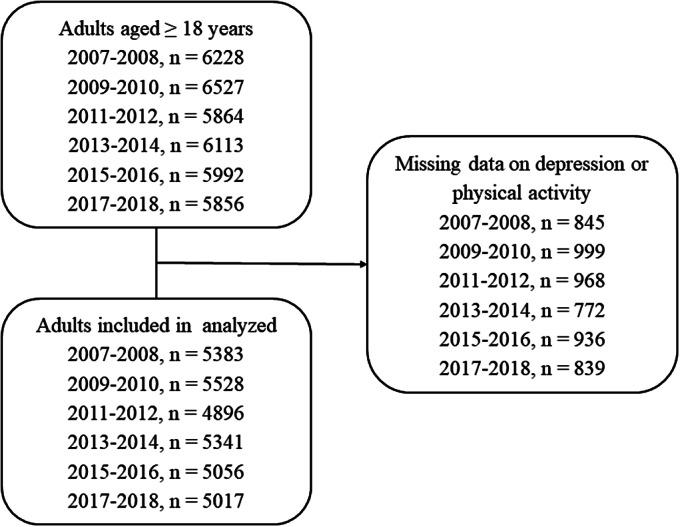
We included and analyzed 31,221 participants (aged ≥18 years) from the cross-sectional 2007-2018 U.S. National Health and Nutrition Examination Survey (NHANES). The PA domains were assessed by a self-report questionnaire and categorized based on the PA guidelines. Depressive symptoms were measured by the nine-item Patient Health Questionnaire.
RESULTS
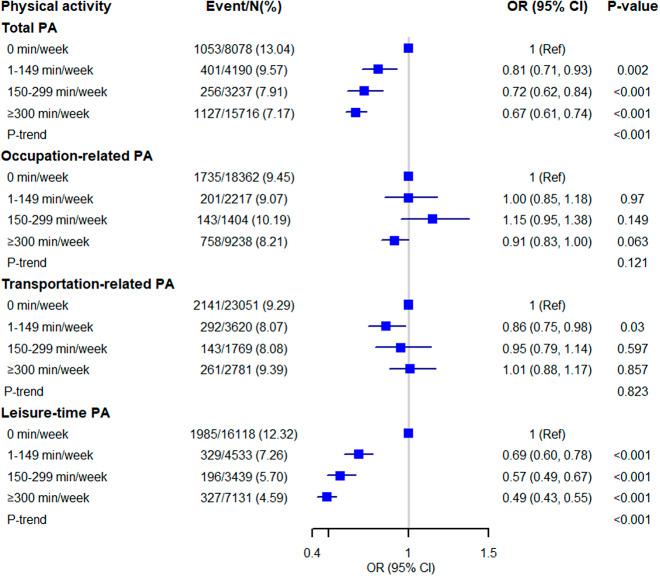
Participants achieving PA guidelines (≥150 min/week) were 26% (odds ratio [OR] 0.74, 95% confidence interval [CI] 0.68-0.80) and 43% (OR 0.57, 95% CI 0.51-0.62) less likely to have depressive symptoms depending on total PA and LTPA, respectively, while OPA or TPA did not demonstrate lower risks of depressive symptoms. LTPA at levels of 1-149, 150-299, and ≥300 min/week was associated with 31% (OR 0.69, 95% CI 0.60-0.78), 43% (OR 0.57, 95% CI 0.49-0.67), and 51% (OR 0.49, 95% CI 0.43-0.55) lower odds of depressive symptoms, respectively.
CONCLUSION
LTPA, but not OPA or TPA, was associated with a lower risk of depressive symptoms at any amount, suggesting that significant mental health would benefit from increased PA, even at levels below the recommendation.
背景
目前尚不清楚所有身体活动(PA)领域(例如,与职业相关的 PA[OPA]、与交通相关的 PA[TPA]和休闲时间的 PA[LTPA])是否具有同等的有益关系。我们旨在研究 OPA、TPA 和 LTPA 与成年人抑郁症状的关联。
方法
我们纳入并分析了来自 2007 年至 2018 年美国国家健康和营养检查调查(NHANES)的 31221 名年龄≥18 岁的横断面研究参与者。PA 领域通过自我报告问卷进行评估,并根据 PA 指南进行分类。抑郁症状通过 9 项患者健康问卷进行测量。
结果
根据总 PA 和 LTPA,分别达到 PA 指南(≥150 分钟/周)的参与者患抑郁症状的可能性分别降低 26%(比值比[OR]0.74,95%置信区间[CI]0.68-0.80)和 43%(OR 0.57,95% CI 0.51-0.62),而 OPA 或 TPA 并没有显示出较低的抑郁症状风险。每周 1-149、150-299 和≥300 分钟的 LTPA 与 31%(OR 0.69,95% CI 0.60-0.78)、43%(OR 0.57,95% CI 0.49-0.67)和 51%(OR 0.49,95% CI 0.43-0.55)的抑郁症状发生风险降低相关。
结论
LTPA 与抑郁症状风险降低相关,而 OPA 或 TPA 则不然,这表明任何数量的 PA 都会显著改善心理健康,即使在低于推荐水平的情况下也是如此。

 Zotero 插件