
奥沙利铂、氟尿嘧啶和亚叶酸肝动脉灌注与索拉非尼治疗经动脉化疗栓塞治疗后复发的肝细胞癌的比较:两项前瞻性试验的回顾性亚组分析。
Hepatic Arterial Infusion of Oxaliplatin, Fluorouracil, and Leucovorin Versus Sorafenib for Hepatocellular Carcinoma Refractory to Transarterial Chemoembolization: Retrospective Subgroup Analysis of 2 Prospective Trials.
机构信息
Department of Hepatobiliary Oncology, 71067Sun Yat-sen University Cancer Center, State Key Laboratory of Oncology in South China, Collaborative Innovation Center for Cancer Medicine, Guangzhou, China.
Department of Pathology, 71067Sun Yat-sen University Cancer Center, Guangzhou, China.
出版信息
Technol Cancer Res Treat. 2022 Jan-Dec;21:15330338221117389. doi: 10.1177/15330338221117389.
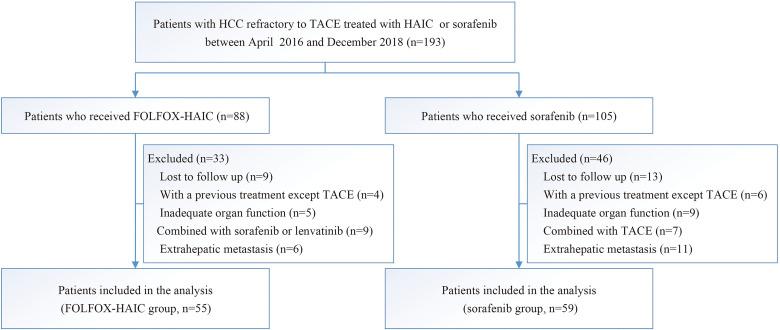
Sorafenib is recommended for patients with hepatocellular carcinoma refractory to transarterial chemoembolization but with unsatisfactory overall survival and tumor response rate. Previously published studies showed hepatic arterial infusion chemotherapy of oxaliplatin, fluorouracil, and leucovorin was an effective and safe treatment. The aims of this study were to compare the clinical efficacy and safety of oxaliplatin, fluorouracil, and leucovorin-based hepatic arterial infusion chemotherapy with sorafenib in patients with hepatocellular carcinoma refractory to transarterial chemoembolization. This was a retrospective subgroup analysis of 2 prospective clinical trials, including 114 patients with hepatocellular carcinoma who were confirmed to be transarterial chemoembolization refractoriness. Of these, 55 patients received hepatic arterial infusion chemotherapy of fluorouracil, and leucovorin (FOLFOX-HAIC group, oxaliplatin 85 or 130 mg/m, leucovorin 400 mg/m, fluorouracil bolus 400 mg/m, and 2400 mg/m for 23 or 46 h, every 3 weeks), and 59 patients were treated with sorafenib (sorafenib group, 400 mg sorafenib twice daily). Overall survival, progression-free survival, objective response rate, and treatment-related adverse events were compared between the 2 groups. The FOLFOX-HAIC group showed a longer overall survival (17.1 months [95% confidence interval 13.4-20.8] vs 9.1 months [95% confidence interval 7.5-10.6]; hazard ratio 0.35 [95% confidence interval 0.23-0.53]; < .001), a higher objective response rate (RECIST: 18 [32.7%] vs 1 [1.7%], < .001), and a longer progression-free survival (7.6 months [95% confidence interval 5.6-9.6] vs 3.9 months [95% confidence interval 2.3-5.4]; hazard ratio 0.49 [95% confidence interval 0.33-0.72]; < .001) than the sorafenib group. The safety results suggested that both oxaliplatin, fluorouracil, and leucovorin-based hepatic arterial infusion chemotherapy and sorafenib had acceptable treatment-related toxic effects. No significant difference was observed in the overall occurrence of any grade, grade 3/4, or serious adverse events between the 2 groups. Oxaliplatin, fluorouracil, and leucovorin-based hepatic arterial infusion chemotherapy might be a better choice than sorafenib for patients with hepatocellular carcinoma refractory to transarterial chemoembolization.
索拉非尼被推荐用于经动脉化疗栓塞治疗后复发的肝细胞癌患者,但总体生存和肿瘤反应率并不理想。以前发表的研究表明,奥沙利铂、氟尿嘧啶和亚叶酸钙的肝动脉灌注化疗是一种有效且安全的治疗方法。本研究旨在比较经动脉化疗栓塞治疗后复发的肝细胞癌患者接受奥沙利铂、氟尿嘧啶和亚叶酸钙肝动脉灌注化疗与索拉非尼治疗的临床疗效和安全性。 这是两项前瞻性临床试验的回顾性亚组分析,共纳入 114 例经动脉化疗栓塞治疗后复发的肝细胞癌患者。其中 55 例患者接受氟尿嘧啶和亚叶酸钙肝动脉灌注化疗(FOLFOX-HAIC 组,奥沙利铂 85 或 130mg/m2,亚叶酸钙 400mg/m2,氟尿嘧啶推注 400mg/m2,2400mg/m2,持续 23 或 46 小时,每 3 周 1 次),59 例患者接受索拉非尼治疗(索拉非尼组,400mg 索拉非尼,每日 2 次)。比较两组患者的总生存期、无进展生存期、客观缓解率和治疗相关不良反应。 FOLFOX-HAIC 组总生存期更长(17.1 个月[95%可信区间 13.4-20.8]比 9.1 个月[95%可信区间 7.5-10.6];风险比 0.35[95%可信区间 0.23-0.53];<0.001),客观缓解率更高(RECIST:18[32.7%]比 1[1.7%];<0.001),无进展生存期更长(7.6 个月[95%可信区间 5.6-9.6]比 3.9 个月[95%可信区间 2.3-5.4];风险比 0.49[95%可信区间 0.33-0.72];<0.001)。与索拉非尼组相比,奥沙利铂、氟尿嘧啶和亚叶酸钙肝动脉灌注化疗和索拉非尼的安全性结果均提示可接受的治疗相关毒性。两组患者的任何级别、3/4 级或严重不良事件的总发生率、3/4 级或严重不良事件的发生率均无显著差异。 对于经动脉化疗栓塞治疗后复发的肝细胞癌患者,奥沙利铂、氟尿嘧啶和亚叶酸钙肝动脉灌注化疗可能是比索拉非尼更好的选择。

 Zotero 插件