
脂质相关代谢物与年龄相关性黄斑变性之间的关系因补体基因型而异。
Relationships between Lipid-Related Metabolites and Age-Related Macular Degeneration Vary with Complement Genotype.
作者信息
Sim Ralene Zi Hui, Tham Yih-Chung, Betzler Bjorn Kaijun, Zhou Lei, Wang Xiaomeng, Sabanayagam Charumathi, Cheung Gemmy Chiu Ming, Wong Tien Yin, Cheng Ching-Yu, Nusinovici Simon
机构信息
Singapore Eye Research Institute, Singapore National Eye Centre, Singapore.
Ophthalmology & Visual Sciences Academic Clinical Program (Eye ACP), Duke-NUS Medical School, Singapore.
出版信息
Ophthalmol Sci. 2022 Aug 12;2(4):100211. doi: 10.1016/j.xops.2022.100211. eCollection 2022 Dec.
OBJECTIVE
Lipid dysregulation and complement system (CS) activation are 2 important pathophysiology pathways for age-related macular degeneration (AMD). We hypothesized that the relationship between lipids and AMD may also differ according to CS genotype profile. Thus, the objective was to investigate the relationships between lipid-related metabolites and AMD according to CS genotypes.
DESIGN
Population-based cross-sectional study.
PARTICIPANTS
A total of 6947 participants from Singapore Epidemiology of Eye Diseases study with complete relevant data were included.
METHODS
We investigated a total of 32 blood lipid-related metabolites from nuclear magnetic resonance metabolomics data including lipoproteins and their subclasses, cholesterols, glycerides, and phospholipids, as well as 4 CS single nucleotide polymorphisms (SNPs): rs10922109 (complement factor H), rs10033900 (complement factor I), rs116503776 (C2-CFB-SKIV2L), and rs2230199 (C3). We first investigated the associations between AMD and the 32 lipid-related metabolites using multivariable logistic regression models. Then, to investigate whether the effect of lipid-related metabolites on AMD differ according to the CS SNPs, we tested the possible interactions between the CS SNPs and the lipid-related metabolites.
MAIN OUTCOME MEASURES
Age-related macular degeneration was defined using the Wisconsin grading system.
RESULTS
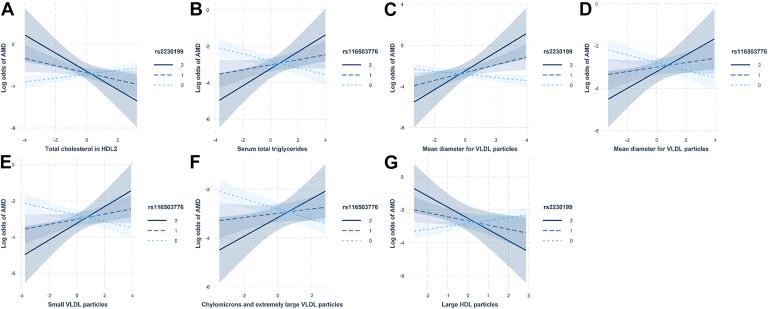
Among the 6947 participants, the prevalence of AMD was 6.1%, and the mean age was 58.3 years. First, higher levels of cholesterol in high-density lipoprotein (HDL) and medium and large HDL particles were associated with an increased risk of AMD, and higher levels of serum total triglycerides (TG) and several very-low-density lipoprotein subclass particles were associated with a decreased risk of AMD. Second, these lipids had significant interaction effects on AMD with 2 CS SNPs: rs2230199 and rs116503776 (after correction for multiple testing). For rs2230199, in individuals without risk allele, higher total cholesterol in HDL2 was associated with an increased AMD risk (odds ratio [OR] per standard deviation increase, 1.20; 95% confidence interval (CI), 1.06-1.37; = 0.005), whereas, in individuals with at least 1 risk allele, higher levels of these particles were associated with a decreased AMD risk (OR, 0.69; 95% CI, 0.45-1.05; = 0.079). Conversely, for rs116503776, in individuals without risk allele, higher serum total TG were associated with a decreased AMD risk (OR, 0.84; 95% CI, 0.74-0.95; = 0.005), whereas, in individuals with 2 risk alleles, higher levels of these particles were associated with an increased risk of AMD (OR, 2.3, 95% CI, 0.99-5.39, = 0.054).
CONCLUSIONS
Lipid-related metabolites exhibit opposite directions of effects on AMD according to CS genotypes. This indicates that lipid metabolism and CS may have synergistic interplay in the AMD pathogenesis.
目的
脂质代谢失调和补体系统(CS)激活是年龄相关性黄斑变性(AMD)的两个重要病理生理途径。我们推测,脂质与AMD之间的关系可能也因CS基因型谱而异。因此,目的是根据CS基因型研究脂质相关代谢物与AMD之间的关系。
设计
基于人群的横断面研究。
参与者
纳入了新加坡眼病流行病学研究中的6947名具有完整相关数据的参与者。
方法
我们从核磁共振代谢组学数据中研究了总共32种血脂相关代谢物,包括脂蛋白及其亚类、胆固醇、甘油酯和磷脂,以及4个CS单核苷酸多态性(SNP):rs10922109(补体因子H)、rs10033900(补体因子I)、rs116503776(C2-CFB-SKIV2L)和rs2230199(C3)。我们首先使用多变量逻辑回归模型研究AMD与32种脂质相关代谢物之间的关联。然后,为了研究脂质相关代谢物对AMD的影响是否因CS SNP而异,我们测试了CS SNP与脂质相关代谢物之间可能的相互作用。
主要观察指标
使用威斯康星分级系统定义年龄相关性黄斑变性。
结果
在6947名参与者中,AMD的患病率为6.1%,平均年龄为58.3岁。首先,高密度脂蛋白(HDL)以及中等和大型HDL颗粒中较高水平的胆固醇与AMD风险增加相关,而血清总甘油三酯(TG)和几种极低密度脂蛋白亚类颗粒的较高水平与AMD风险降低相关。其次,这些脂质与2个CS SNP(rs2230199和rs116503776,经过多重检验校正)对AMD有显著的相互作用。对于rs2230199,在没有风险等位基因的个体中,HDL2中较高的总胆固醇与AMD风险增加相关(每标准差增加的比值比[OR]为1.20;95%置信区间[CI]为1.06-1.37;P=0.005),而在至少有1个风险等位基因的个体中,这些颗粒的较高水平与AMD风险降低相关(OR为0.69;95%CI为0.45-1.05;P=0.079)。相反,对于rs116503776,在没有风险等位基因的个体中,较高的血清总TG与AMD风险降低相关(OR为0.84;95%CI为0.74-0.95;P=0.005),而在有2个风险等位基因的个体中,这些颗粒的较高水平与AMD风险增加相关(OR为2.3,95%CI为0.99-5.39,P=0.054)。
结论
脂质相关代谢物根据CS基因型对AMD表现出相反的作用方向。这表明脂质代谢和CS可能在AMD发病机制中具有协同相互作用。


 Zotero 插件