
约旦卵巢癌患者种系突变的流行情况及其临床意义。约旦探索性癌症遗传学(Jo-ECAG)卵巢研究。
Prevalence and clinical implications of germline mutations among Jordanian patients with ovarian cancer. The Jordanian exploratory cancer genetics (Jo-ECAG) ovarian study.
机构信息
Department of Internal Medicine, King Hussein Cancer Center, Amman, Jordan.
Department of Internal Medicine, the University of Jordan, Amman, Jordan.
出版信息
Mol Genet Genomic Med. 2023 Apr;11(4):e2125. doi: 10.1002/mgg3.2125. Epub 2022 Dec 19.
BACKGROUND
Ovarian cancer is one of the most common gynecological malignancies. Due to the absence of effective screening methods, ovarian cancer is usually diagnosed at late stages. Patients with pathogenic and likely-pathogenic germline variants (PGVs) in BRCA1 or BRCA2 harbor elevated risk of developing both ovarian and breast cancers. Identifying PGVs may help in both cancer prevention and active disease treatment. Worldwide prevalence of PGVs varies and the matter is poorly addressed among Arab patients.
METHODS
Patients with epithelial ovarian, fallopian tube or primary peritoneal cancers were offered the universal 20 or 84-multi-gene panel testing as per standard guidelines. Cascade family screening was also offered to all first and second-degree relatives of PGV positive patients. Genetic testing was done at a referral lab using a next generation sequencing (NGS)-based platform.
RESULTS
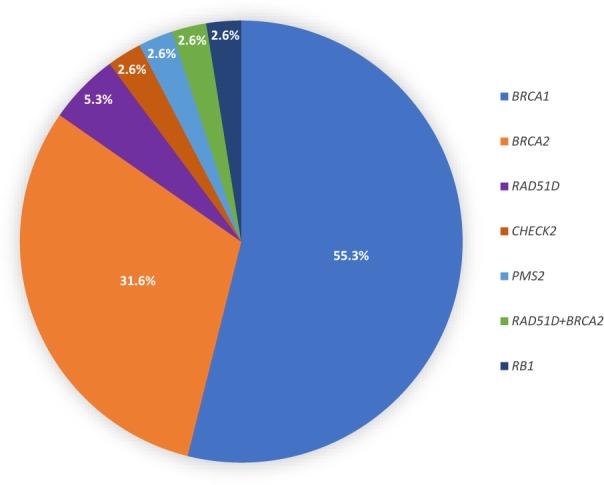
During the study period, 152 patients, median age (range): 50 (18-79) years old, were tested. The majority (n = 100, 65.8%) had high-grade serous carcinoma, and 106 patients (69.7%) had metastatic disease at presentation. In total, 38 (25.0%) had PGVs, while 47 (30.9%) others had variants of uncertain significance (VUS). PGVs were mostly in BRCA1 (n = 21, 13.8%) and in BRCA2 (n = 12, 7.9%), while 6 (3.9%) others had PGVs in non-BRCA1/2 genes. PGV rates were significantly higher among 15 patients with a positive family history of ovarian cancer (60.0%, p = .022) and among 52 patients with a positive family history of breast cancer (40.4%, p = .017).
CONCLUSIONS
PGVs are common among Jordanian women with ovarian cancer, and mostly occur in BRCA1/2. Given its clinical impact on disease prevention and precision therapy, universal testing should be routinely offered.
背景
卵巢癌是最常见的妇科恶性肿瘤之一。由于缺乏有效的筛查方法,卵巢癌通常在晚期才被诊断出来。携带 BRCA1 或 BRCA2 种系致病性和可能致病性变异(PGVs)的患者患卵巢癌和乳腺癌的风险增加。鉴定 PGVs 有助于预防癌症和积极治疗疾病。全球 PGVs 的患病率不同,在阿拉伯患者中这一问题也未得到充分解决。
方法
根据标准指南,为上皮性卵巢癌、输卵管癌或原发性腹膜癌患者提供通用的 20 或 84 个多基因面板检测。还为所有 PGV 阳性患者的一级和二级亲属提供了级联家族筛查。遗传检测在一个转诊实验室进行,使用基于下一代测序(NGS)的平台。
结果
在研究期间,共对 152 名中位年龄(范围)为 50 岁(18-79 岁)的患者进行了检测。大多数(n=100,65.8%)为高级别浆液性癌,106 名患者(69.7%)在就诊时已有转移疾病。共有 38 名(25.0%)患者携带 PGVs,而另外 47 名(30.9%)患者携带意义不明的变异(VUS)。PGVs 主要在 BRCA1(n=21,13.8%)和 BRCA2(n=12,7.9%)中,而其他 6 名(3.9%)患者在非 BRCA1/2 基因中有 PGVs。在 15 名有卵巢癌阳性家族史的患者(60.0%,p=0.022)和 52 名有乳腺癌阳性家族史的患者(40.4%,p=0.017)中,PGVs 发生率显著更高。
结论
PGVs 在约旦卵巢癌女性中很常见,主要发生在 BRCA1/2 中。鉴于其对疾病预防和精准治疗的临床影响,应常规提供通用检测。

 Zotero 插件