
癌症与放射敏感性综合征:细胞核 ATM 激酶活性受损是首要动因吗?
Cancer and Radiosensitivity Syndromes: Is Impaired Nuclear ATM Kinase Activity the Primum Movens?
作者信息
El Nachef Laura, Berthel Elise, Ferlazzo Mélanie L, Le Reun Eymeric, Al-Choboq Joelle, Restier-Verlet Juliette, Granzotto Adeline, Sonzogni Laurène, Bourguignon Michel, Foray Nicolas
机构信息
Inserm, U1296 Unit, Radiation: Defense, Health and Environment, Centre Léon-Bérard, 69008 Lyon, France.
Department of Biophysics and Nuclear Medicine, Université Paris Saclay (UVSQ), 78035 Versailles, France.
出版信息
Cancers (Basel). 2022 Dec 13;14(24):6141. doi: 10.3390/cancers14246141.
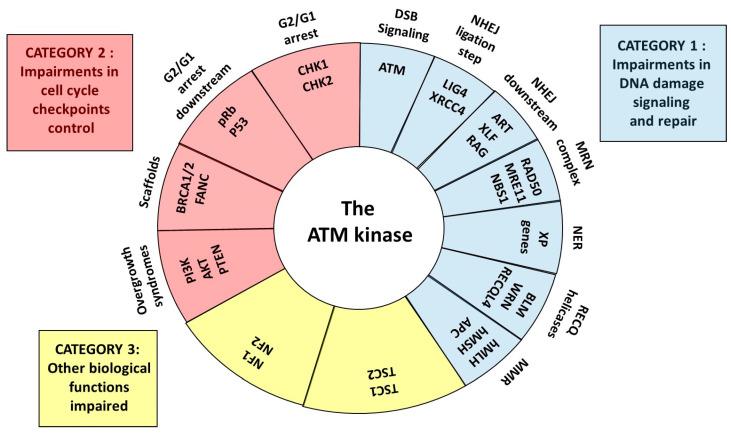
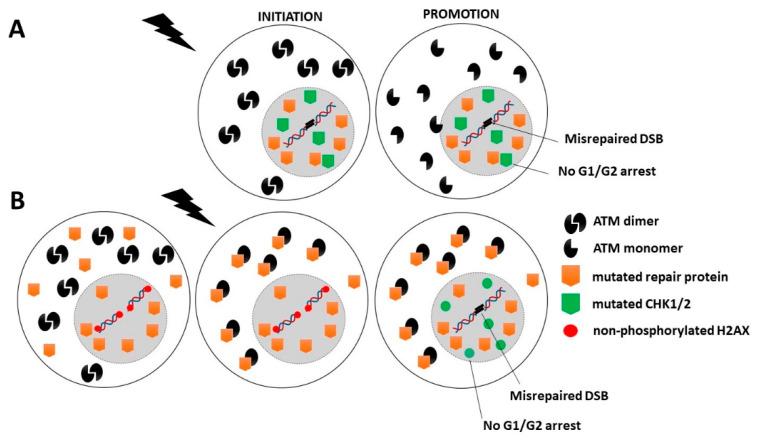
There are a number of genetic syndromes associated with both high cancer risk and clinical radiosensitivity. However, the link between these two notions remains unknown. Particularly, some cancer syndromes are caused by mutations in genes involved in DNA damage signaling and repair. How are the DNA sequence errors propagated and amplified to cause cell transformation? Conversely, some cancer syndromes are caused by mutations in genes involved in cell cycle checkpoint control. How is misrepaired DNA damage produced? Lastly, certain genes, considered as tumor suppressors, are not involved in DNA damage signaling and repair or in cell cycle checkpoint control. The mechanistic model based on radiation-induced nucleoshuttling of the ATM kinase (RIANS), a major actor of the response to ionizing radiation, may help in providing a unified explanation of the link between cancer proneness and radiosensitivity. In the frame of this model, a given protein may ensure its own specific function but may also play additional biological role(s) as an ATM phosphorylation substrate in cytoplasm. It appears that the mutated proteins that cause the major cancer and radiosensitivity syndromes are all ATM phosphorylation substrates, and they generally localize in the cytoplasm when mutated. The relevance of the RIANS model is discussed by considering different categories of the cancer syndromes.
有许多遗传综合征与高癌症风险和临床放射敏感性相关。然而,这两个概念之间的联系仍然未知。特别是,一些癌症综合征是由参与DNA损伤信号传导和修复的基因突变引起的。DNA序列错误是如何传播和放大从而导致细胞转化的?相反,一些癌症综合征是由参与细胞周期检查点控制的基因突变引起的。错误修复的DNA损伤是如何产生的?最后,某些被认为是肿瘤抑制因子的基因,并不参与DNA损伤信号传导和修复或细胞周期检查点控制。基于辐射诱导的ATM激酶核穿梭(RIANS)的机制模型,ATM激酶是对电离辐射反应的主要参与者,可能有助于为癌症易感性和放射敏感性之间的联系提供统一的解释。在这个模型的框架内,一种给定的蛋白质可能确保其自身的特定功能,但也可能作为细胞质中的ATM磷酸化底物发挥额外的生物学作用。似乎导致主要癌症和放射敏感性综合征的突变蛋白都是ATM磷酸化底物,并且它们在突变时通常定位于细胞质中。通过考虑不同类别的癌症综合征来讨论RIANS模型的相关性。


 Zotero 插件