
氯氮平抑制人星形胶质细胞中细胞因子的基因表达和产生,并上调环氧化酶2信使核糖核酸
Clozapine Suppresses the Gene Expression and the Production of Cytokines and Up-Regulates Cyclooxygenase 2 mRNA in Human Astroglial Cells.
作者信息
Yuhas Yael, Ashkenazi Shai, Berent Eva, Weizman Abraham
机构信息
Laboratory of Pediatric Infectious Diseases, Felsenstein Medical Research Center, Sackler Faculty of Medicine, Tel Aviv University, Petach Tikva 4941492, Israel.
Laboratory of Molecular and Biological Psychiatry, Felsenstein Medical Research Center, Petach Tikva 4941492, Israel.
出版信息
Brain Sci. 2022 Dec 12;12(12):1703. doi: 10.3390/brainsci12121703.
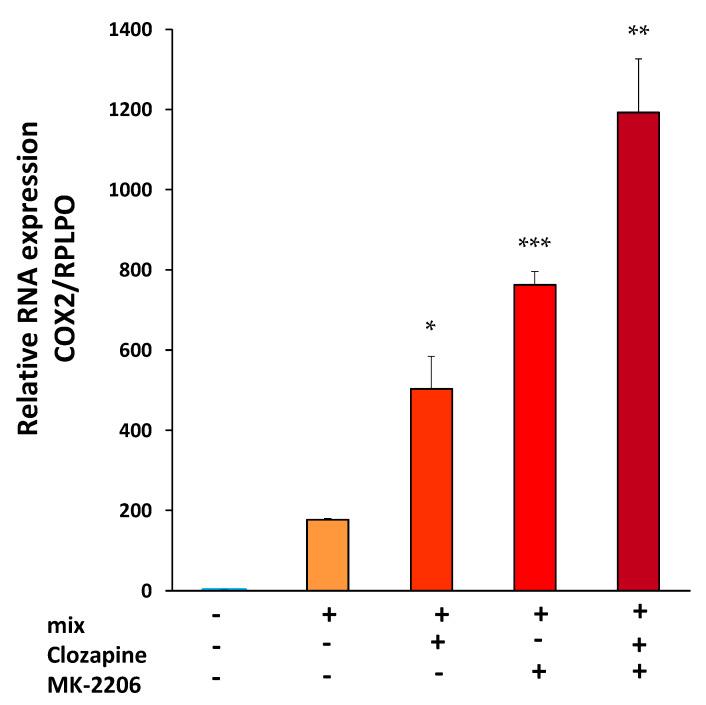
Schizophrenia (SCZ) is a chronic neurodevelopmental psychotic disorder. The immune system and neuroinflammation seem to play a central role in the pathophysiology of SCZ. Clozapine is an effective atypical antipsychotic used for treatment-resistant SCZ. Life-threatening side effects, such as myocarditis, limit its use. We investigated the immunomodulatory effects of clozapine in an astroglial model of neuroinflammation. We thus assessed the effect of clozapine on the production of inflammatory mediators in human-derived astroglial (A172) cells, stimulated with a cytokine mix (TNFα, IL-1β, IFNγ). RT-PCR and ELISA analyses demonstrated that clozapine suppressed gene expression and production of TNFα, IL-1β and IL-8 and increased COX2 mRNA 24 h after stimulation. Clozapine inhibited Akt phosphorylation induced by the cytokine mix at 10 min and 40 min, as assessed by Western blot analysis with anti-pT308Akt antibody. Pretreatment with the Akt inhibitor MK-2206 increased COX2 gene expression in cytokine-stimulated cells, suggesting that Akt inhibition may be involved in COX2 gene expression upregulation. Clozapine may possess dual beneficial effects: inhibiting astroglial production of proinflammatory cytokines, thus attenuating neuroinflammation, and upregulating COX2 expression that may be relevant to improvement of neural functioning while accounting for some of its detrimental effects. Patients with TRS and neuroinflammatory markers may benefit particularly from clozapine treatment.
精神分裂症(SCZ)是一种慢性神经发育性精神障碍。免疫系统和神经炎症似乎在SCZ的病理生理学中起着核心作用。氯氮平是一种用于治疗难治性SCZ的有效非典型抗精神病药物。诸如心肌炎等危及生命的副作用限制了其使用。我们在神经炎症的星形胶质细胞模型中研究了氯氮平的免疫调节作用。因此,我们评估了氯氮平对人源星形胶质细胞(A172)中炎症介质产生的影响,该细胞用细胞因子混合物(TNFα、IL-1β、IFNγ)刺激。RT-PCR和ELISA分析表明,氯氮平在刺激后24小时抑制了TNFα、IL-1β和IL-8的基因表达和产生,并增加了COX2 mRNA。通过用抗pT308Akt抗体进行蛋白质印迹分析评估,氯氮平在10分钟和40分钟时抑制了细胞因子混合物诱导的Akt磷酸化。用Akt抑制剂MK-2206预处理可增加细胞因子刺激细胞中COX2基因的表达,这表明Akt抑制可能参与了COX2基因表达的上调。氯氮平可能具有双重有益作用:抑制星形胶质细胞促炎细胞因子的产生,从而减轻神经炎症,并上调可能与神经功能改善相关的COX2表达,同时解释其一些有害作用。患有难治性精神分裂症和神经炎症标志物的患者可能特别受益于氯氮平治疗。


 Zotero 插件