
深入研究长新冠:分析 COVID-19 后急性后遗症的症状群和风险因素,以为临床护理提供信息。
Deep Dive into the Long Haul: Analysis of Symptom Clusters and Risk Factors for Post-Acute Sequelae of COVID-19 to Inform Clinical Care.
机构信息
Department of Surgery, School of Medicine, University of California San Diego, La Jolla, CA 92093, USA.
Division of Biomedical Informatics, Department of Medicine, School of Medicine, University of California San Diego, La Jolla, CA 92093, USA.
出版信息
Int J Environ Res Public Health. 2022 Dec 15;19(24):16841. doi: 10.3390/ijerph192416841.
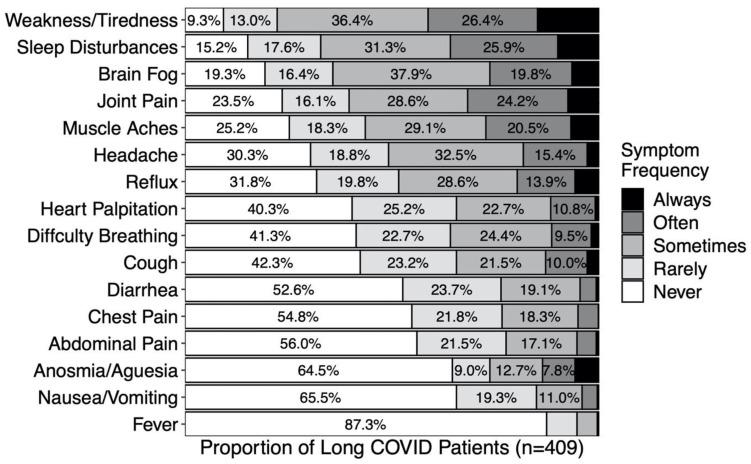
Long COVID is a chronic condition characterized by symptoms such as fatigue, dyspnea, and cognitive impairment that persist or relapse months after an acute infection with the SARS-CoV-2 virus. Many distinct symptoms have been attributed to Long COVID; however, little is known about the potential clustering of these symptoms and risk factors that may predispose patients to certain clusters. In this study, an electronic survey was sent to patients in the UC San Diego Health (UCSDH) system who tested positive for COVID-19, querying if patients were experiencing symptoms consistent with Long COVID. Based on survey results, along with patient demographics reported in the electronic health record (EHR), linear and logistic regression models were used to examine putative risk factors, and exploratory factor analysis was performed to determine symptom clusters. Among 999 survey respondents, increased odds of Long COVID (n = 421; 42%) and greater Long COVID symptom burden were associated with female sex ( = 1.73, 99% CI: 1.16-2.58; β = 0.48, 0.22-0.75), COVID-19 hospitalization ( = 4.51, 2.50-8.43; β = 0.48, 0.17-0.78), and poorer pre-COVID self-rated health ( = 0.75, 0.57-0.97; β = -0.19, -0.32--0.07). Over one-fifth of Long COVID patients screened positive for depression and/or anxiety, the latter of which was associated with younger age ( = 0.96, 0.94-0.99). Factor analysis of 16 self-reported symptoms suggested five symptom clusters-gastrointestinal (GI), musculoskeletal (MSK), neurocognitive (NC), airway (AW), and cardiopulmonary (CP), with older age (β = 0.21, 0.11-0.30) and mixed race (β = 0.27, 0.04-0.51) being associated with greater MSK symptom burden. Greater NC symptom burden was associated with increased odds of depression ( = 5.86, 2.71-13.8) and anxiety ( = 2.83, 1.36-6.14). These results can inform clinicians in identifying patients at increased risk for Long COVID-related medical issues, particularly neurocognitive symptoms and symptom clusters, as well as informing health systems to manage operational expectations on a population-health level.
长新冠是一种慢性疾病,其特征是在感染 SARS-CoV-2 病毒后数月出现疲劳、呼吸困难和认知障碍等症状持续或复发。许多不同的症状被归因于长新冠;然而,人们对这些症状的潜在聚类以及可能使患者易患某些聚类的风险因素知之甚少。在这项研究中,向加州大学圣地亚哥分校健康系统 (UCSDH) 中检测出 COVID-19 呈阳性的患者发送了一份电子调查,询问患者是否出现与长新冠一致的症状。根据调查结果,以及电子健康记录 (EHR) 中报告的患者人口统计学数据,使用线性和逻辑回归模型来检查潜在的风险因素,并进行探索性因素分析以确定症状聚类。在 999 名调查受访者中,长新冠(n = 421;42%)和更大的长新冠症状负担与女性( = 1.73,99%CI:1.16-2.58;β = 0.48,0.22-0.75)、COVID-19 住院治疗( = 4.51,2.50-8.43;β = 0.48,0.17-0.78)和较差的 COVID-19 前自我评估健康状况( = 0.75,0.57-0.97;β = -0.19,-0.32--0.07)有关。超过五分之一的长新冠患者筛查出抑郁和/或焦虑,后者与年龄较小有关( = 0.96,0.94-0.99)。对 16 种自我报告症状的因子分析表明存在五个症状聚类-胃肠道 (GI)、肌肉骨骼 (MSK)、神经认知 (NC)、气道 (AW) 和心肺 (CP),年龄较大(β = 0.21,0.11-0.30)和混合种族(β = 0.27,0.04-0.51)与更大的 MSK 症状负担有关。更大的 NC 症状负担与抑郁( = 5.86,2.71-13.8)和焦虑( = 2.83,1.36-6.14)的几率增加有关。这些结果可以为临床医生提供帮助,帮助他们识别出患有长新冠相关医疗问题(特别是神经认知症状和症状聚类)风险增加的患者,并为卫生系统提供管理人群健康水平上的运营预期的信息。

 Zotero 插件