
表明甲基苯丙胺使用者对线索存在偏向的直接和间接注意力测量方法。
Direct and Indirect Measures of Attention Indicating a Bias Toward Cues in Methamphetamine Users.
作者信息
Mirtorabi Seyed Davood, Saleki Sharif, Rahmanian Mohammad Sadegh, Hadizadeh Hadi, Rostami Reza, Yoonessi Ali
机构信息
Department of Neurosciences and Addiction Studies, School of Advanced Technologies in Medicine, Tehran University of Medical Sciences, Tehran, Iran.
Brain and Behavior Studies Laboratory, Tehran University of Medical Sciences, Iran.
出版信息
Basic Clin Neurosci. 2022 Jul-Aug;13(4):455-463. doi: 10.32598/bcn.12.6.1589.1. Epub 2022 Jul 1.
INTRODUCTION
This study aims to investigate the attentional bias toward drug-related stimuli along with subjective craving after encountering such stimuli in methamphetamine users. Studies of cue reactivity have confirmed a bias in attention and gaze toward drug-related stimuli for most substances; however, methamphetamine drugs are less studied through a direct measure, such as eye tracking.
METHODS
A total of 30 male subjects in the case group (methamphetamine users) and 36 subjects in the control group (no prior drug use) participated in this study. The participant's eye movement data were collected while they were viewing pairs of drug-related and non-drug images in a dot-probe paradigm. Craving was assessed via a self-report questionnaire on a scale of 0 to 10 before and after the psychophysical task.
RESULTS
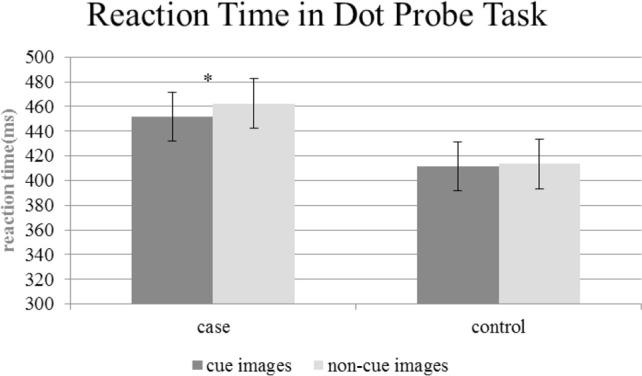
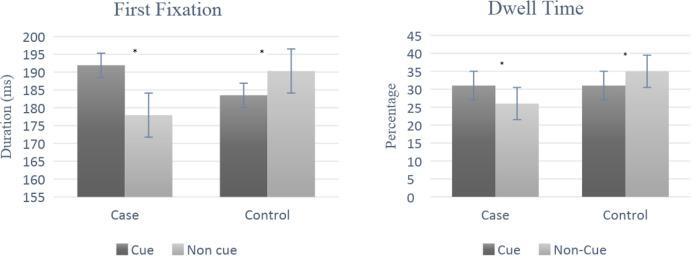
The analysis of eye-movement data showed a meaningful gaze bias toward cue images (drug-related) in the case group. Additionally, the gaze duration on cue images was significantly higher in the case group, in contrast to the control group. The same effect was observed in analyzing the dot-probe task; that is, the mean reaction time to a probe that replaced a cue image was significantly lower. The mean of the first-fixation measure in the control group was not significantly higher than chance; however, the percentage of the first-fixation on cue images in the drug users was meaningfully biased. Reported craving was significantly greater after performing the task compared to before.
CONCLUSION
Our results indicated an attentional bias toward drug-related cues in methamphetamine users as well as subjective craving after encountering such cues.
HIGHLIGHTS
The gaze duration on cue images was significantly higher in methamphetamine users.The mean reaction time to a probe that replaced a cue image was significantly lower in methamphetamine users compared to the control group.The mean of the first-fixation measure in the case group was significantly better than chance.Craving was reported to be significantly greater after performing the task.
PLAIN LANGUAGE SUMMARY
Substance users tend to focus on the stimuli associated with substances. This is known as attention bias. Attention bias leads to increased craving. Attention bias for various substances has been previously reported; however, methamphetamine attention bias has not been evaluated so far. In this study, we measured the attention bias toward stimuli related to methamphetamine in methamphetamine users and control subjects with direct (eye tracking) and indirect (dot probe paradigm) methods. In addition, we measured the number of cravings in the case group. Our results confirmed the bias in attention toward methamphetamine-related stimuli in the case group compared to the control group.
引言
本研究旨在调查甲基苯丙胺使用者在接触与毒品相关的刺激后,对这类刺激的注意偏向以及主观渴望程度。线索反应性研究已证实,大多数物质在注意力和注视方面存在对与毒品相关刺激的偏向;然而,甲基苯丙胺类药物通过眼动追踪等直接测量方法的研究较少。
方法
病例组(甲基苯丙胺使用者)共30名男性受试者,对照组(无吸毒史)共36名受试者参与了本研究。在点探测范式中,当参与者观看与毒品相关和非毒品的图像对时,收集他们的眼动数据。在心理物理学任务前后,通过0至10分的自我报告问卷评估渴望程度。
结果
眼动数据分析显示,病例组对线索图像(与毒品相关)存在显著的注视偏向。此外,病例组对线索图像的注视持续时间明显高于对照组。在分析点探测任务时也观察到了同样的效果,即对替代线索图像的探测刺激的平均反应时间明显更短。对照组的首次注视测量平均值并不显著高于随机水平;然而,吸毒者对线索图像的首次注视百分比存在显著偏向。与任务前相比,任务后报告的渴望程度明显更高。
结论
我们的结果表明,甲基苯丙胺使用者对与毒品相关的线索存在注意偏向,并且在接触此类线索后会产生主观渴望。
要点
甲基苯丙胺使用者对线索图像的注视持续时间明显更高。与对照组相比,甲基苯丙胺使用者对替代线索图像的探测刺激的平均反应时间明显更短。病例组的首次注视测量平均值明显优于随机水平。报告显示任务后渴望程度明显更高。
通俗易懂的总结
物质使用者倾向于关注与物质相关的刺激。这被称为注意偏向。注意偏向会导致渴望增加。此前已报道过对各种物质的注意偏向;然而,到目前为止尚未评估甲基苯丙胺的注意偏向。在本研究中,我们用直接(眼动追踪)和间接(点探测范式)方法测量了甲基苯丙胺使用者和对照受试者对与甲基苯丙胺相关刺激的注意偏向。此外,我们测量了病例组的渴望次数。我们的结果证实,与对照组相比,病例组对与甲基苯丙胺相关刺激的注意存在偏向。


 Zotero 插件