
与非发作性嗜睡症 1 型患者的兄弟姐妹相比,H1N1(Pandemrix)疫苗接种后的发作性睡病 1 型患者在睡眠期间肌肉活动增加,且 RBD 症状更多。
Increased muscle activity during sleep and more RBD symptoms in H1N1-(Pandemrix)-vaccinated narcolepsy type 1 patients compared with their non-narcoleptic siblings.
机构信息
Department of Rare Disorders, Norwegian Centre of Expertise for Neurodevelopmental Disorders and Hypersomnias (NevSom), Oslo University Hospital, Oslo, Norway.
Institute of Clinical Medicine, University of Oslo, Oslo, Norway.
出版信息
Sleep. 2023 Mar 9;46(3). doi: 10.1093/sleep/zsac316.
STUDY OBJECTIVES
Narcolepsy type 1 (NT1) is characterized by unstable sleep-wake and muscle tonus regulation during sleep. We characterized dream enactment and muscle activity during sleep in a cohort of post-H1N1 NT1 patients and their siblings, and analyzed whether clinical phenotypic characteristics and major risk factors are associated with increased muscle activity.
METHODS
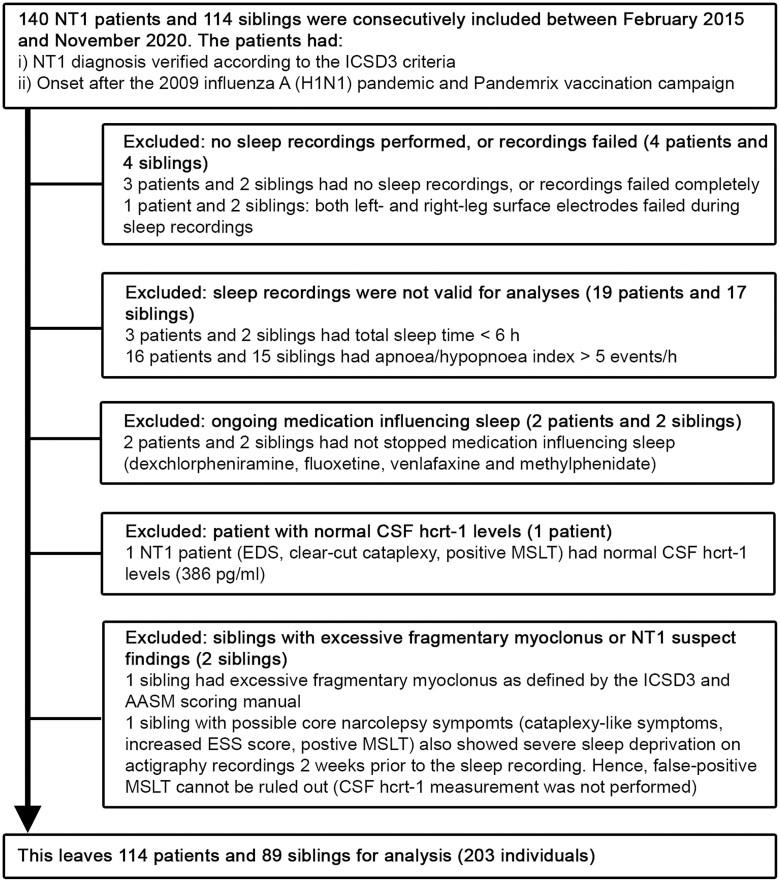
RBD symptoms and polysomnography m. tibialis anterior electromyographical signals [long (0.5-15 s); short (0.1-0.49 s)] were compared between 114 post-H1N1 NT1 patients and 89 non-narcoleptic siblings. Association sub-analyses with RBD symptoms, narcoleptic symptoms, CSF hypocretin-1 levels, and major risk factors [H1N1-(Pandemrix)-vaccination, HLA-DQB1*06:02-positivity] were performed.
RESULTS
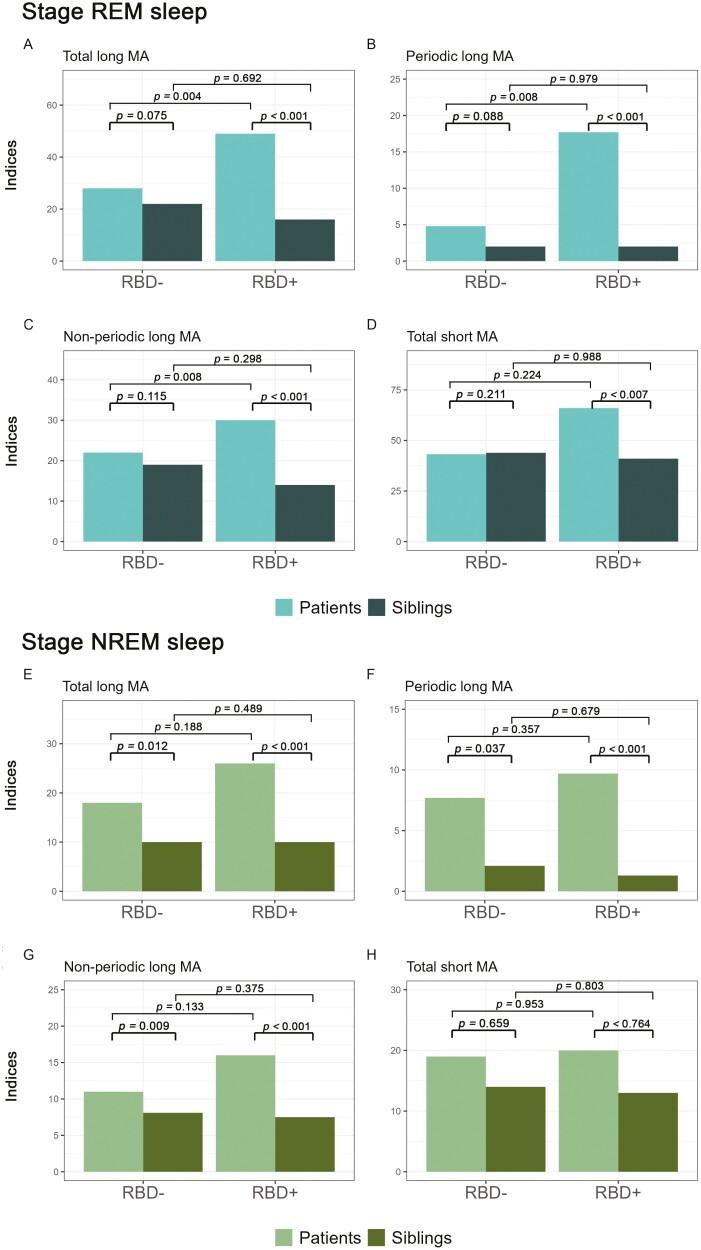
RBD symptoms, REM and NREM long muscle activity indices and REM short muscle activity index were significantly higher in NT1 patients than siblings (all p < 0.001). Patients with undetectable CSF hypocretin-1 levels (<40 pg/ml) had significantly more NREM periodic long muscle activity than patients with low but detectable levels (40-150 pg/ml) (p = 0.047). In siblings, REM and NREM sleep muscle activity indices were not associated with RBD symptoms, other narcolepsy symptoms, or HLA-DQB1*06:02-positivity. H1N1-(Pandemrix)-vaccination status did not predict muscle activity indices in patients or siblings.
CONCLUSION
Increased REM and NREM muscle activity and more RBD symptoms is characteristic of NT1, and muscle activity severity is predicted by hypocretin deficiency severity but not by H1N1-(Pandemrix)-vaccination status. In the patients' non-narcoleptic siblings, neither RBD symptoms, core narcoleptic symptoms, nor the major NT1 risk factors is associated with muscle activity during sleep, hence not indicative of a phenotypic continuum.
研究目的
1 型发作性睡病(NT1)的特征是睡眠期间睡眠-觉醒和肌肉张力调节不稳定。我们对一组 H1N1 后 NT1 患者及其兄弟姐妹进行了睡眠中梦境表现和肌肉活动的特征描述,并分析了临床表型特征和主要危险因素是否与肌肉活动增加有关。
方法
比较了 114 例 H1N1 后 NT1 患者和 89 名非发作性睡病的兄弟姐妹的 RBD 症状和胫骨前肌肌电图信号[长(0.5-15 秒);短(0.1-0.49 秒)]。与 RBD 症状、发作性睡病症状、CSF 食欲素-1 水平和主要危险因素[H1N1-(Pandemrix)-疫苗接种、HLA-DQB1*06:02 阳性]进行关联亚分析。
结果
NT1 患者的 RBD 症状、REM 和 NREM 长肌活动指数和 REM 短肌活动指数均显著高于兄弟姐妹(均 p<0.001)。CSF 食欲素-1 水平不可检测(<40 pg/ml)的患者与低但可检测水平(40-150 pg/ml)的患者相比,NREM 周期性长肌活动显著增加(p=0.047)。在兄弟姐妹中,REM 和 NREM 睡眠肌活动指数与 RBD 症状、其他发作性睡病症状或 HLA-DQB1*06:02 阳性无关。H1N1-(Pandemrix)-疫苗接种状态不能预测患者或兄弟姐妹的肌肉活动指数。
结论
REM 和 NREM 肌肉活动增加和更多的 RBD 症状是 NT1 的特征,肌肉活动严重程度由食欲素缺乏严重程度预测,而不由 H1N1-(Pandemrix)-疫苗接种状态预测。在患者的非发作性睡病兄弟姐妹中,无论是 RBD 症状、核心发作性睡病症状还是主要的 NT1 危险因素,均与睡眠期间的肌肉活动无关,因此不能表明存在表型连续体。


 Zotero 插件