
识别卫生服务使用的常见模式:对瑞士老年成年人护理轨迹的纵向研究。
Identifying common patterns of health services use: a longitudinal study of older Swiss adults' care trajectories.
机构信息
Department of Epidemiology and Health Systems, Centre for Primary Care and Public Health (Unisanté), University of Lausanne, 10 Route de La Corniche, 1010, Lausanne, Switzerland.
出版信息
BMC Health Serv Res. 2022 Dec 26;22(1):1586. doi: 10.1186/s12913-022-08987-z.
BACKGROUND
Population ageing puts pressure on health systems initially designed to handle acute and episodic illnesses. Segmenting an ageing population based on its healthcare utilization may enable policymakers to undertake evidence-based resource planning. We aimed to derive a typology of healthcare utilization trajectories in Swiss older adults.
METHODS
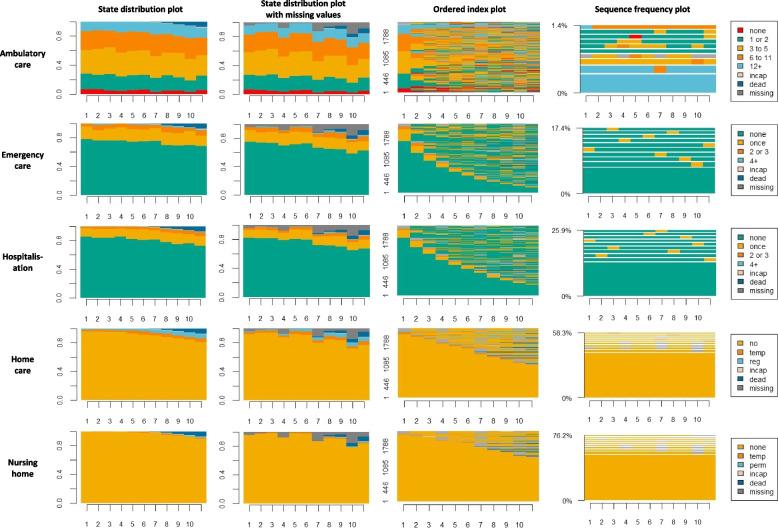
Our work used data from the Lc65 + study, a population-based cohort of individuals aged 65 to 70 years at enrolment. The dimensions of healthcare utilization considered were ambulatory care, emergency care, hospitalizations, professional home care and nursing home stay. We applied the Sequence Analysis framework, within which we quantified the variation between each multidimensional pair of sequences, implemented a clustering procedure that grouped together older persons with similar profiles of health services use, and characterized clusters of individuals using selected baseline covariates.
RESULTS
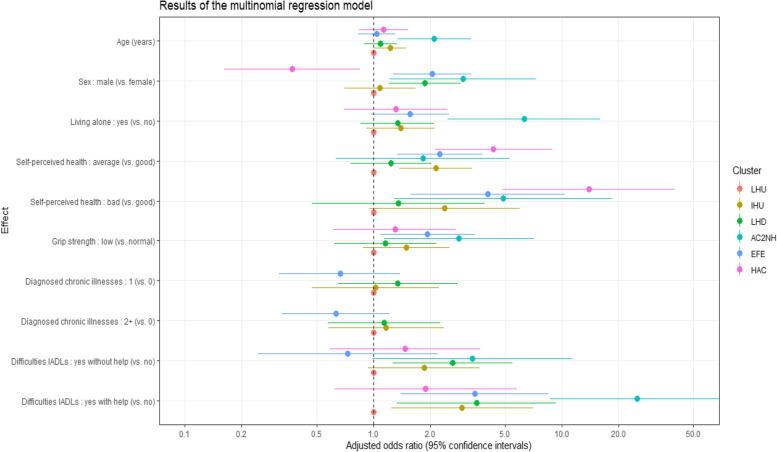
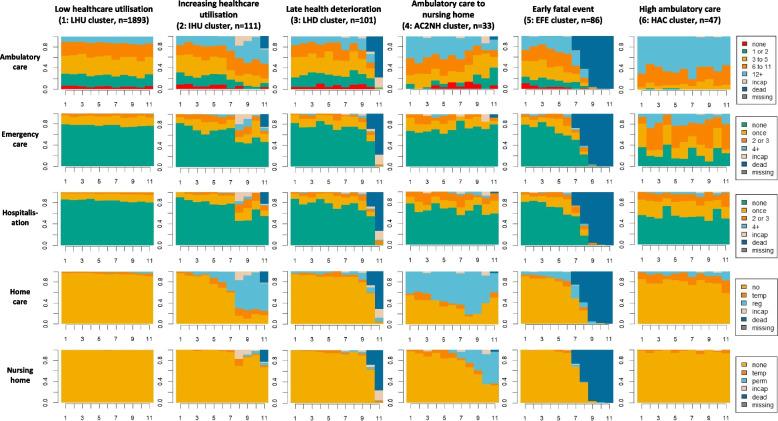
Healthcare utilization trajectories were analysed for 2271 community-dwelling older adults over a period of 11 years. Six homogeneous subgroups were identified: constant low utilization (83.3% of participants), increased utilization (4.9%), late health deterioration (4.4%), ambulatory care to nursing home (1.5%), early fatal event (3.8%) and high ambulatory care (2.1%). Associations were found between cluster membership and age, sex, household composition, self-perceived health, grip strength measurement, comorbidities, and functional dependency.
CONCLUSIONS
The heterogeneous healthcare utilization profiles can be clustered into six common patterns. Different manifestations of functional decline were apparent in two distinct trajectory groups featuring regular home care use. Furthermore, a small proportion of individuals with a unique set of characteristics was related to the highest levels of ambulatory and emergency care use. New research avenues are outlined to investigate time-varying effects of health factors inside the clusters containing most unfavourable outcomes.
背景
人口老龄化给最初设计用于处理急性和偶发性疾病的卫生系统带来压力。根据医疗保健利用情况对老龄化人口进行细分,可能使政策制定者能够进行基于证据的资源规划。我们旨在为瑞士老年人确定一种医疗保健利用轨迹的分类方法。
方法
我们的工作使用了 Lc65+研究的数据,这是一项基于人群的队列研究,研究对象在入组时年龄为 65 至 70 岁。考虑的医疗保健利用维度包括门诊护理、急诊护理、住院治疗、专业家庭护理和疗养院护理。我们应用序列分析框架,在该框架内量化了每个多维对序列之间的变化,实施了聚类程序,将具有相似健康服务使用情况的老年人分组,并使用选定的基线协变量对个体进行特征描述。
结果
在 11 年的时间内,对 2271 名居住在社区的老年人进行了医疗保健利用轨迹分析。确定了六个同质亚组:持续低利用率(83.3%的参与者)、利用率增加(4.9%)、晚期健康恶化(4.4%)、门诊护理到疗养院(1.5%)、早期致命事件(3.8%)和高门诊护理(2.1%)。发现聚类成员身份与年龄、性别、家庭构成、自我感知健康、握力测量、合并症和功能依赖性之间存在关联。
结论
不同的功能下降表现出两种截然不同的轨迹组,这两个轨迹组的特点是定期家庭护理使用。此外,一小部分具有独特特征的个体与最高水平的门诊和急诊护理使用有关。概述了新的研究途径,以调查集群内随时间变化的健康因素对最不利结果的影响。
 Zotero 插件