
pIChemiSt ─ 用于计算修饰肽等电点的免费工具。
pIChemiSt ─ Free Tool for the Calculation of Isoelectric Points of Modified Peptides.
机构信息
Medicinal Chemistry, Research and Early Development, Cardiovascular, Renal and Metabolism (CVRM), BioPharmaceuticals R&D, AstraZeneca, Gothenburg, Sweden.
Early Chemical Development, Pharmaceutical Sciences, BioPharmaceuticals R&D, AstraZeneca, Gothenburg, Sweden.
出版信息
J Chem Inf Model. 2023 Jan 9;63(1):187-196. doi: 10.1021/acs.jcim.2c01261. Epub 2022 Dec 27.
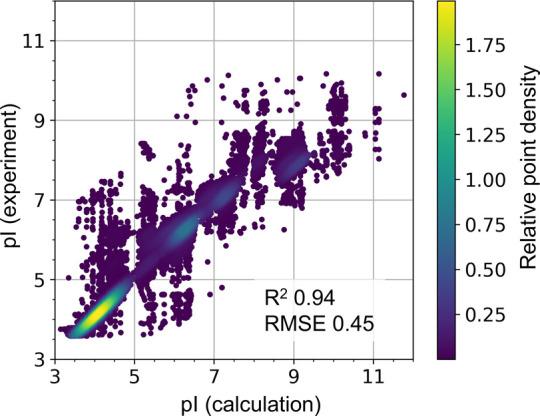
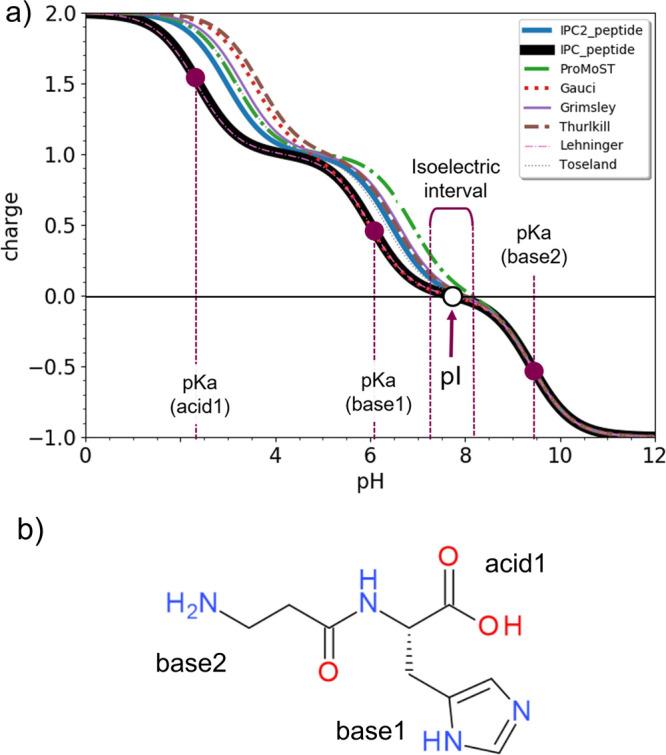
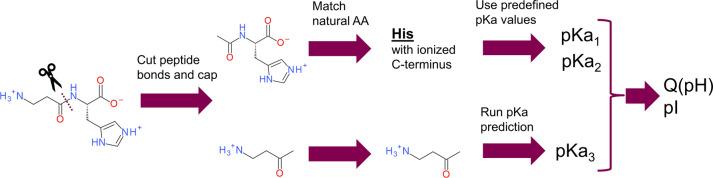
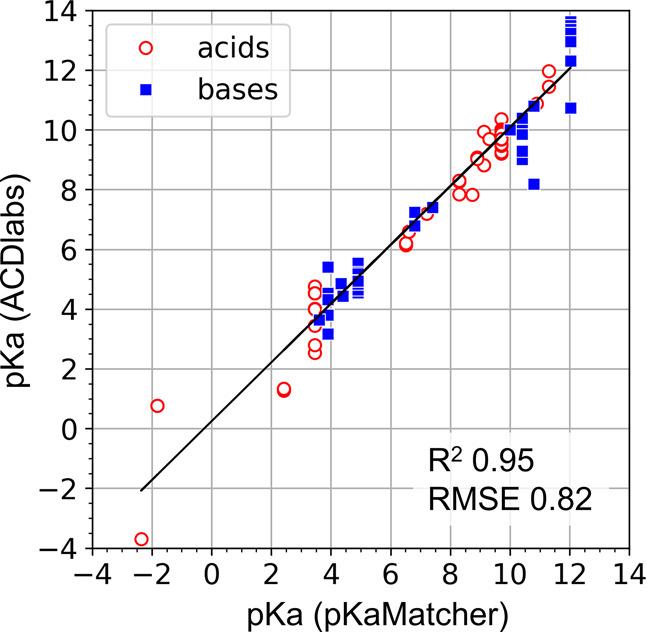
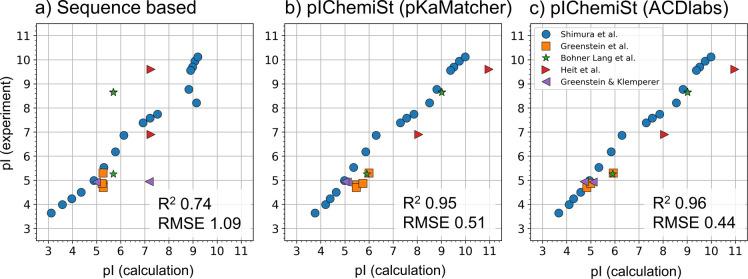
The isoelectric point (pI) is a fundamental physicochemical property of peptides and proteins. It is widely used to steer design away from low solubility and aggregation and guide peptide separation and purification. Experimental measurements of pI can be replaced by calculations knowing the ionizable groups of peptides and their corresponding p values. Different p sets are published in the literature for natural amino acids, however, they are insufficient to describe synthetically modified peptides, complex peptides of natural origin, and peptides conjugated with structures of other modalities. Noncanonical modifications (nCAAs) are ignored in the conventional sequence-based pI calculations, therefore producing large errors in their pI predictions. In this work, we describe a pI calculation method that uses the chemical structure as an input, automatically identifies ionizable groups of nCAAs and other fragments, and performs p predictions for them. The method is validated on a curated set of experimental measures on 29 modified and 119093 natural peptides, providing an improvement of from 0.74 to 0.95 and 0.96 against the conventional sequence-based approach for modified peptides for the two studied p prediction tools, ACDlabs and pKaMatcher, correspondingly. The method is available in the form of an open source Python library at https://github.com/AstraZeneca/peptide-tools, which can be integrated into other proprietary and free software packages. We anticipate that the pI calculation tool may facilitate optimization and purification activities across various application domains of peptides, including the development of biopharmaceuticals.
等电点(pI)是肽和蛋白质的基本物理化学性质。它广泛用于指导设计避免低溶解度和聚集,并指导肽的分离和纯化。pI 的实验测量可以通过计算已知肽的可电离基团及其相应的 p 值来代替。天然氨基酸的文献中有不同的 p 值集出版,但它们不足以描述合成修饰的肽、天然来源的复杂肽以及与其他模态结构缀合的肽。非典型修饰(nCAAs)在常规基于序列的 pI 计算中被忽略,因此在预测 pI 时会产生很大的误差。在这项工作中,我们描述了一种 pI 计算方法,该方法将化学结构作为输入,自动识别 nCAAs 和其他片段的可电离基团,并对其进行 p 值预测。该方法在 29 种修饰肽和 119093 种天然肽的经过验证的实验测量集上进行了验证,为两种研究的 p 值预测工具 ACDlabs 和 pKaMatcher 提供了对修饰肽的改进,分别从 0.74 提高到 0.95 和 0.96。该方法以开源 Python 库的形式提供,可在 https://github.com/AstraZeneca/peptide-tools 上获得,可集成到其他专有的和免费的软件包中。我们预计,pI 计算工具可能会促进肽在各个应用领域的优化和纯化活动,包括生物制药的开发。

 Zotero 插件