
开发和验证一种列线图模型,以预测 2 型糖尿病患者外周动脉疾病的风险。
Development and validation of a nomogram to predict the risk of peripheral artery disease in patients with type 2 diabetes mellitus.
机构信息
Hebei North University, Zhangjiakou, Hebei, China.
Air Force Medical Center, PLA, Beijing, China.
出版信息
Front Endocrinol (Lausanne). 2022 Dec 12;13:1059753. doi: 10.3389/fendo.2022.1059753. eCollection 2022.
OBJECTIVE
To develop and validate a nomogram for predicting the risk of peripheral artery disease (PAD) in patients with type 2 diabetes mellitus (T2DM) and assess its clinical application value.
METHODS
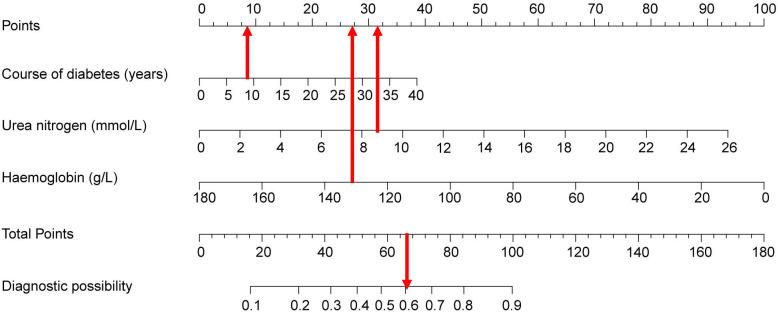
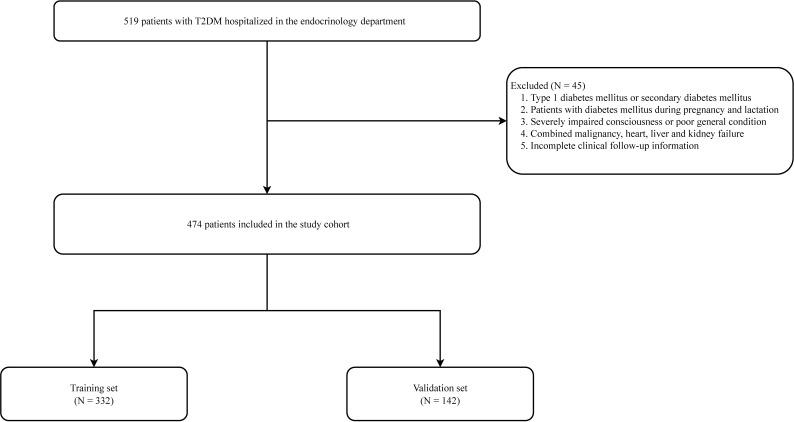
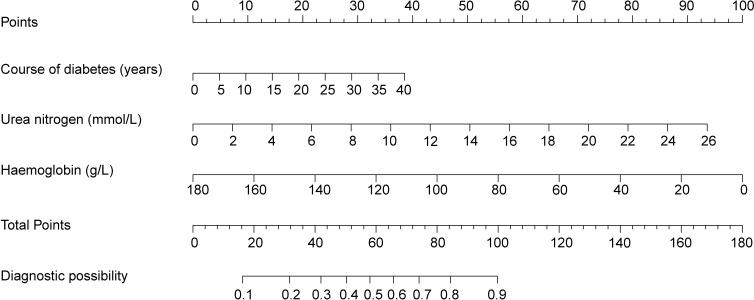
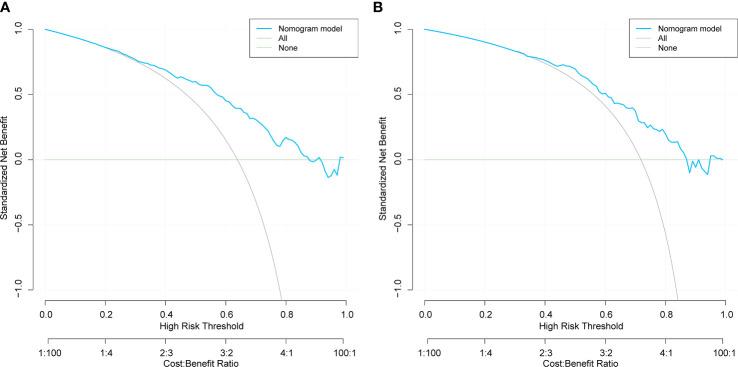
Clinical data were retrospectively collected from 474 patients with T2DM at the Air Force Medical Center between January 2019 and April 2022. The patients were divided into training and validation sets using the random number table method in a ratio of 7:3. Multivariate logistic regression analysis was performed to identify the independent risk factors for PAD in patients with T2DM. A nomogram prediction model was developed based on the independent risk factors. The predictive efficacy of the prediction model was evaluated using the consistency index (C-index), area under the curve (AUC), receiver operating characteristic (ROC) curve, Hosmer-Lemeshow (HL) test, and calibration curve analysis. Additionally, decision curve analysis (DCA) was performed to evaluate the prediction model's performance during clinical application.
RESULTS
Age, disease duration, blood urea nitrogen (BUN), and hemoglobin (<0.05) were observed as independent risk factors for PAD in patients with T2DM. The C-index and the AUC were 0.765 (95% CI: 0.711-0.819) and 0.716 (95% CI: 0.619-0.813) for the training and validation sets, respectively, indicating that the model had good discriminatory power. The calibration curves showed good agreement between the predicted and actual probabilities for both the training and validation sets. In addition, the -values of the HL test for the training and validation sets were 0.205 and 0.414, respectively, indicating that the model was well-calibrated. Finally, the DCA curve indicated that the model had good clinical utility.
CONCLUSION
A simple nomogram based on three independent factors-duration of diabetes, BUN, and hemoglobin levels-may help clinicians predict the risk of developing PAD in patients with T2DM.
目的
建立并验证预测 2 型糖尿病(T2DM)患者外周动脉疾病(PAD)风险的列线图,并评估其临床应用价值。
方法
回顾性收集 2019 年 1 月至 2022 年 4 月空军军医大学 474 例 T2DM 患者的临床资料,采用随机数字表法按 7:3 将患者分为训练集和验证集。采用多因素 logistic 回归分析识别 T2DM 患者 PAD 的独立危险因素,基于独立危险因素构建列线图预测模型。采用一致性指数(C-index)、曲线下面积(AUC)、受试者工作特征(ROC)曲线、Hosmer-Lemeshow(HL)检验和校准曲线分析评估预测模型的预测效能。此外,采用决策曲线分析(DCA)评估预测模型在临床应用中的性能。
结果
年龄、病程、血尿素氮(BUN)和血红蛋白(<0.05)是 T2DM 患者 PAD 的独立危险因素。训练集和验证集的 C-index 和 AUC 分别为 0.765(95%CI:0.711-0.819)和 0.716(95%CI:0.619-0.813),表明模型具有良好的区分度。校准曲线显示训练集和验证集的预测概率与实际概率吻合较好。此外,HL 检验的-值分别为 0.205 和 0.414,表明模型校准良好。最后,DCA 曲线表明模型具有良好的临床应用价值。
结论
基于 3 个独立因素(糖尿病病程、BUN 和血红蛋白水平)构建的简单列线图有助于临床医生预测 T2DM 患者 PAD 的发病风险。


 Zotero 插件