
使用两种基于实时PCR的同步检测方法对孟加拉国家禽呼吸道疾病暴发情况进行调查。
Investigation of respiratory disease outbreaks of poultry in Bangladesh using two real-time PCR-based simultaneous detection assays.
作者信息
Parvin Rokshana, Kabiraj Congriev Kumar, Hossain Ismail, Hassan Alamgir, Begum Jahan Ara, Nooruzzaman Mohammed, Islam Md Taohidul, Chowdhury Emdadul Haque
机构信息
Department of Pathology, Faculty of Veterinary Science, Bangladesh Agricultural University, Mymensingh, Bangladesh.
Population Medicine and AMR Laboratory, Department of Medicine, Faculty of Veterinary Science, Bangladesh Agricultural University, Mymensingh, Bangladesh.
出版信息
Front Vet Sci. 2022 Dec 13;9:1036757. doi: 10.3389/fvets.2022.1036757. eCollection 2022.
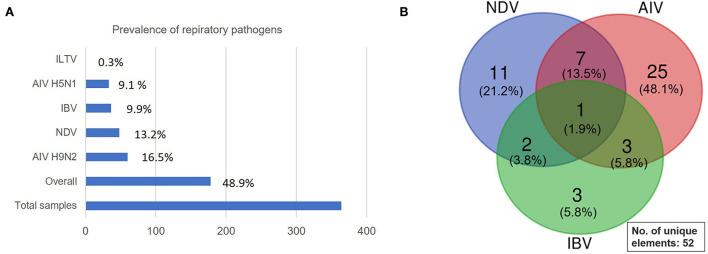
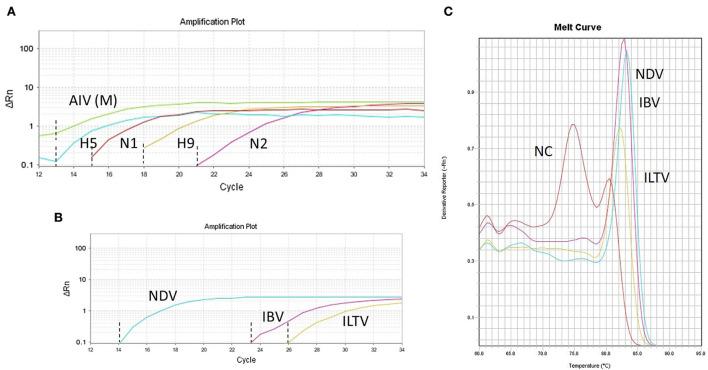
For rapid and sensitive pathogen screening from field outbreaks, molecular techniques such as qPCR-based simultaneous detections are efficient. Respiratory diseases are the most detrimental diseases to the poultry industry and need to be addressed because of their major economic losses. In the current study, we have applied two different detection assays: one for simultaneous detection of avian influenza virus (AIV; M gene) and subtyping (H5, N1, H9, N2) using TaqMan probe chemistry (TaqMan multitarget) and another for simultaneous detection of Newcastle disease virus (NDV), infectious bronchitis virus (IBV), and infectious laryngotracheitis virus (ILTV) using SYBR Green chemistry (SYBR Green multitarget). Two individual qPCRs were conducted for the detection of four pathogens. Surveillance of tissue ( = 158) and oropharyngeal swab (206) samples from multiple poultry flocks during the years April 2020-July 2022 applying the TaqMan and SYBR Green multitarget qPCRs revealed that 48.9% of samples were positive for respiratory infections, of which 17.2% were positive for NDV, 25.5% were positive for AIV, 9.9% were positive for IBV, and only a single positive (0.3%) for ILTV. Among the AIV, 35% were highly pathogenic subtype H5N1 and 65% were low pathogenic subtype H9N2. Co-infections of 2-3 respiratory viruses were also accurately detected. Respiratory viral pathogens are quite common in Bangladeshi poultry and can be successfully detected using multitarget simultaneous real-time quantitative polymerase chain reaction (RT-qPCR) assays like those adopted in the current study. Increased mass surveillance, along with the molecular characterization of the circulating respiratory viruses, is crucial to control the epidemic and subsequently save the Bangladeshi poultry industry.
对于从现场疫情中快速、灵敏地筛查病原体,基于定量聚合酶链反应(qPCR)的同步检测等分子技术十分有效。呼吸道疾病是对家禽业危害最大的疾病,因其造成重大经济损失而需要加以应对。在本研究中,我们应用了两种不同的检测方法:一种是使用TaqMan探针化学法(TaqMan多靶点法)同时检测禽流感病毒(AIV;M基因)并进行亚型分型(H5、N1、H9、N2),另一种是使用SYBR Green化学法(SYBR Green多靶点法)同时检测新城疫病毒(NDV)、传染性支气管炎病毒(IBV)和传染性喉气管炎病毒(ILTV)。针对四种病原体进行了两次单独的qPCR检测。在2020年4月至2022年7月期间,应用TaqMan和SYBR Green多靶点qPCR对多个家禽群的组织样本(n = 158)和口咽拭子样本(206)进行监测,结果显示48.9%的样本呼吸道感染呈阳性,其中17.2%的样本NDV呈阳性,25.5%的样本AIV呈阳性,9.9%的样本IBV呈阳性,而ILTV仅一个样本呈阳性(0.3%)。在AIV中,35%为高致病性H5N1亚型,65%为低致病性H9N2亚型。同时也准确检测到了2 - 3种呼吸道病毒的混合感染。呼吸道病毒病原体在孟加拉国家禽中相当常见,使用本研究采用的多靶点同步实时定量聚合酶链反应(RT - qPCR)检测方法能够成功检测到。加强大规模监测以及对流行的呼吸道病毒进行分子特征分析,对于控制疫情进而拯救孟加拉国家禽业至关重要。

 Zotero 插件