
评估艾滋病毒对南非消除宫颈癌的影响:疫苗接种和筛查影响的比较建模
Estimating the effect of HIV on cervical cancer elimination in South Africa: Comparative modelling of the impact of vaccination and screening.
作者信息
Boily Marie-Claude, Barnabas Ruanne V, Rönn Minttu M, Bayer Cara J, van Schalkwyk Cari, Soni Nirali, Rao Darcy W, Staadegaard Lisa, Liu Gui, Silhol Romain, Brisson Marc, Johnson Leigh F, Bloem Paul, Gottlieb Sami, Broutet Nathalie, Dalal Shona
机构信息
MRC Centre for Global Infectious Disease Analysis, School of Public Health, Imperial College London, London, United Kingdom.
Division of Infectious Diseases, Massachusetts General Hospital, Harvard Medical School, Boston, MA, USA.
出版信息
EClinicalMedicine. 2022 Nov 17;54:101754. doi: 10.1016/j.eclinm.2022.101754. eCollection 2022 Dec.
BACKGROUND
In 2020, the World Health Organization (WHO) launched its initiative to eliminate cervical cancer as a public health problem. To inform global efforts for countries with high HIV and cervical cancer burden, we assessed the impact of human papillomavirus (HPV) vaccination and cervical cancer screening and treatment in South Africa, on cervical cancer and the potential for achieving elimination before 2120, considering faster HPV disease progression and higher cervical cancer risk among women living with HIV(WLHIV) and HIV interventions.
METHODS
Three independent transmission-dynamic models simulating HIV and HPV infections and disease progression were used to predict the impact on cervical cancer incidence of three scenarios for all women: 1) girls' vaccination (9-14 years old), 2) girls' vaccination plus 1 lifetime cervical screen (at 35 years), and 3) girls' vaccination plus 2 lifetime cervical screens (at 35 and 45 years) and three enhanced scenarios for WLHIV: 4) vaccination of young WLHIV aged 15-24 years, 5) three-yearly cervical screening of WLHIV aged 15-49 years, or 6) both. Vaccination assumed 90% coverage and 100% lifetime protection with the nonavalent vaccine (against HPV-16/18/31/33/45/52/58). Cervical cancer screening assumed HPV testing with uptake increasing from 45% (2023), 70% (2030) to 90% (2045+). We also assumed that UNAIDS 90-90-90 HIV treatment and 70% male circumcision targets are reached by 2030. We examined three elimination thresholds: age-standardised cervical cancer incidence rates below 4 or 10 per 100,000 women-years, and >85% reduction in cervical cancer incidence rate. We conducted sensitivity analyses and presented the median age-standardised predictions of outcomes of the three models (minimum-maximum across models).
FINDINGS
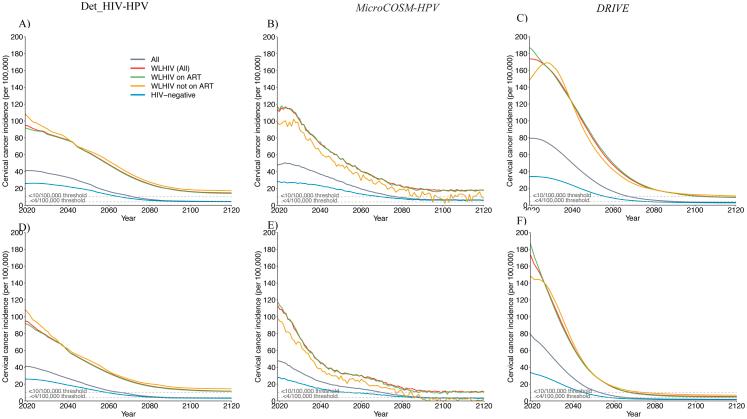
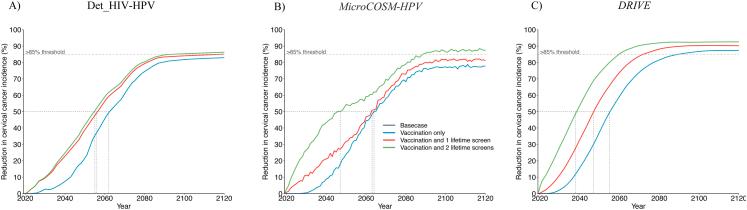
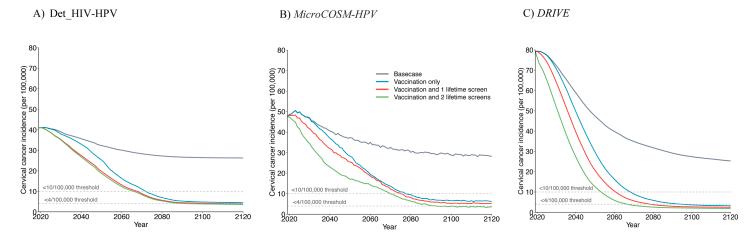
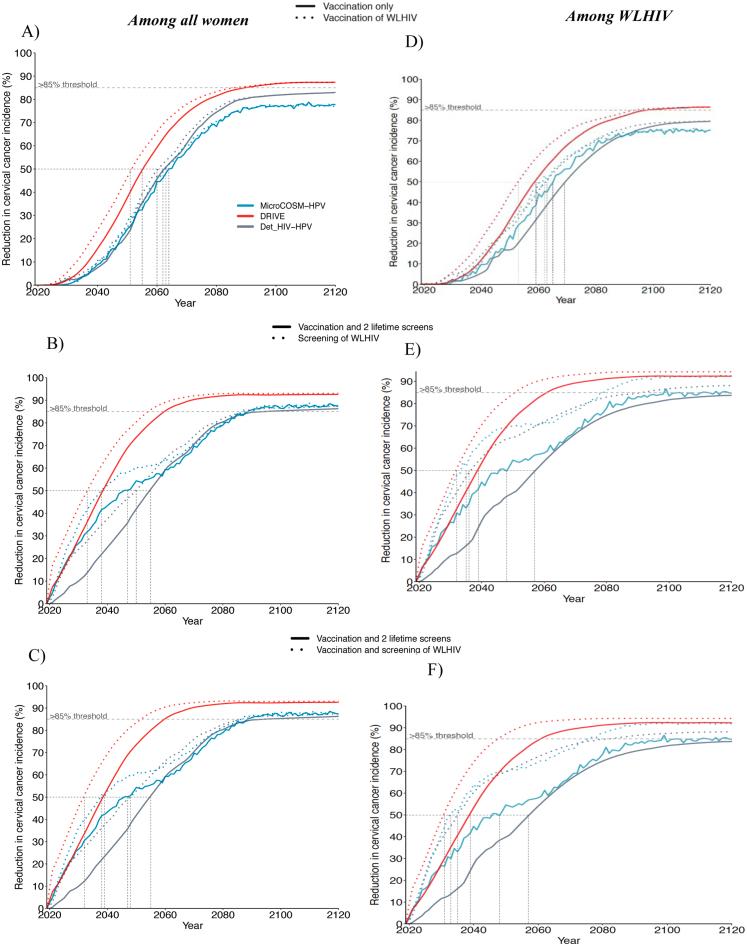
Girls' vaccination could reduce age-standardised cervical cancer incidence from a median of 47.6 (40.9-79.2) in 2020 to 4.5 (3.2-6.3) per 100,000 women-years by 2120, averting on average ∼4% and ∼46% of age-standardised cumulative cervical cancer cases over 25 and 100 years, respectively, compared to the . Adding 2 lifetime screens helped achieve elimination over the century among all women (2120 cervical cancer incidence: 3.6 (1.9-3.6) per 100,000 women-years), but not among WLHIV (10.8 (5.3-11.6)), and averted more cumulative cancer cases overall (∼45% over 25 years and ∼61% over 100 years compared to ) than girls' vaccination alone. Adding three-yearly cervical screening among WLHIV (to girls' vaccination and 2 lifetime cervical screens) further reduced age-standardised cervical cancer incidence to 3.3 (1.8-3.6) per 100,000 women-years overall and to 5.2 (3.9-8.5) among WLHIV by 2120 and averted on average 12-13% additional cumulative cancer cases among all women and 21-24% among WLHIV than girls' vaccination and 2 lifetime cervical screens over 25 years or longer. Long-term vaccine protection and using the nonavalent vaccine was required for elimination.
INTERPRETATION
High HPV vaccination coverage of girls and 2 lifetime cervical screens could eliminate cervical cancer among women overall in South Africa by the end of the century and substantially decrease cases among all women and WLHIV over the short and medium term. Cervical cancer elimination in WLHIV would likely require enhanced prevention strategies for WLHIV. Screening of WLHIV remains an important strategy to reduce incidence and alleviate disparities in cervical cancer burden between women with and without HIV, despite HIV interventions scale-up.
FUNDING
World Health Organization. National Cancer Institute, National Institutes of Health. MRC Centre for Global Infectious Disease Analysis, UK Medical Research Council. National Institute of Child Health and Human Development research. Cancer Association of South Africa. Canadian Institutes of Health Research and the Fonds de recherche du Québec - Santé research.
背景
2020年,世界卫生组织(WHO)发起了将宫颈癌作为公共卫生问题消除的倡议。为指导全球针对艾滋病毒和宫颈癌负担较重国家的工作,我们评估了南非人乳头瘤病毒(HPV)疫苗接种、宫颈癌筛查和治疗对宫颈癌的影响,以及在考虑到艾滋病毒感染者(WLHIV)中HPV疾病进展更快和宫颈癌风险更高以及艾滋病毒干预措施的情况下,在2120年前实现消除宫颈癌的可能性。
方法
使用三个独立的模拟艾滋病毒和HPV感染及疾病进展的传播动力学模型,预测以下三种针对所有女性的情景以及针对WLHIV的三种强化情景对宫颈癌发病率的影响:所有女性的三种情景为1)女孩接种疫苗(9至14岁),2)女孩接种疫苗加1次终身宫颈癌筛查(35岁时),3)女孩接种疫苗加2次终身宫颈癌筛查(35岁和45岁时);WLHIV的三种强化情景为4)15至24岁年轻WLHIV接种疫苗,5)15至49岁WLHIV每三年进行一次宫颈癌筛查,或6)两者皆有。疫苗接种假设九价疫苗(针对HPV-16/18/31/33/45/52/58)覆盖率为90%且提供100%终身保护。宫颈癌筛查假设采用HPV检测,接受率从2023年的45%、2030年的70%提高到2045年及以后的90%。我们还假设到2030年实现联合国艾滋病规划署的90-90-90艾滋病毒治疗目标和70%的男性包皮环切目标。我们研究了三个消除阈值:年龄标准化宫颈癌发病率低于每10万妇女年4例或10例,以及宫颈癌发病率降低>85%。我们进行了敏感性分析,并给出了三个模型结果的年龄标准化预测中位数(各模型中的最小值-最大值)。
结果
女孩接种疫苗可使年龄标准化宫颈癌发病率从2020年的中位数47.6(40.9 - 79.2)降至2120年的每10万妇女年4.5(3.2 - 6.3)例,与[未提及的对比情况]相比,在25年和100年期间分别平均避免约4%和约46%的年龄标准化累积宫颈癌病例。增加2次终身筛查有助于在一个世纪内实现所有女性的宫颈癌消除(2120年宫颈癌发病率:每10万妇女年3.6(1.9 - 3.6)例),但在WLHIV中无法实现(10.8(5.3 - 11.6)),并且总体上比仅女孩接种疫苗避免了更多的累积癌症病例(25年期间约45%,100年期间约61%)。在WLHIV中增加每三年一次的宫颈癌筛查(结合女孩接种疫苗和2次终身宫颈癌筛查)到2120年可进一步将总体年龄标准化宫颈癌发病率降至每10万妇女年3.3(1.8 - 3.6)例,在WLHIV中降至5.2(3.9 - 8.5)例,与女孩接种疫苗和2次终身宫颈癌筛查相比,在25年及更长时间内,所有女性中平均额外避免12 - 13%的累积癌症病例,WLHIV中额外避免21 - 24%。消除宫颈癌需要长期疫苗保护并使用九价疫苗。
解读
女孩高HPV疫苗接种覆盖率和2次终身宫颈癌筛查可在本世纪末消除南非女性中的宫颈癌,并在短期和中期大幅减少所有女性和WLHIV中的病例。消除WLHIV中的宫颈癌可能需要针对WLHIV加强预防策略。尽管扩大了艾滋病毒干预措施,但对WLHIV进行筛查仍然是降低发病率和减轻有和没有艾滋病毒女性之间宫颈癌负担差距的重要策略。
资金来源
世界卫生组织。美国国立卫生研究院国家癌症研究所。英国医学研究理事会全球传染病分析MRC中心。国家儿童健康与人类发展研究所研究。南非癌症协会。加拿大卫生研究院和魁北克卫生研究基金研究。

 Zotero 插件