
混合人群中慢性肾脏病检测的精准医学实施挑战
Precision medicine implementation challenges for testing in chronic kidney disease in admixed populations.
作者信息
Giudicelli Giovanna Câmara, De Souza Celia Mariana Barbosa, Veronese Francisco Veríssimo, Pereira Lygia V, Hünemeier Tábita, Vianna Fernanda Sales Luiz
机构信息
Departamento de Genética e Biologia Evolutiva, Instituto de Biociências, Universidade de São Paulo, São Paulo, SP, Brazil.
Laboratório de Medicina Genômica, Centro de Pesquisa Experimental, Hospital de Clínicas de Porto Alegre, Porto Alegre, RS, Brazil.
出版信息
Front Genet. 2022 Dec 15;13:1016341. doi: 10.3389/fgene.2022.1016341. eCollection 2022.
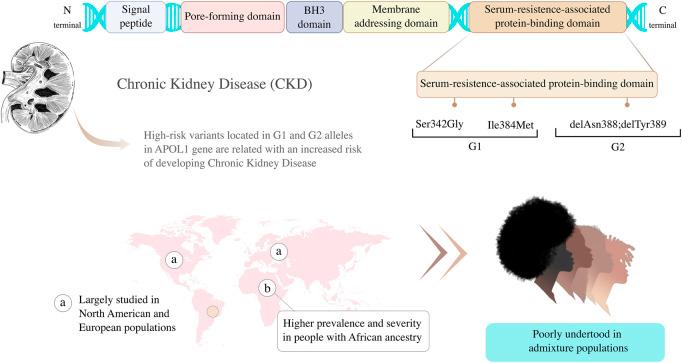
Chronic Kidney Disease (CKD) is a public health problem that presents genetic and environmental risk factors. Two alleles in the Apolipoprotein L1 () gene were associated with chronic kidney disease; these alleles are common in individuals of African ancestry but rare in European descendants. Genomic studies on Afro-Americans have indicated a higher prevalence and severity of chronic kidney disease in people of African ancestry when compared to other ethnic groups. However, estimates in low- and middle-income countries are still limited. Precision medicine approaches could improve clinical outcomes in carriers of risk alleles in the Apolipoprotein L1 gene through early diagnosis and specific therapies. Nevertheless, to enhance the definition of studies on these variants, it would be necessary to include individuals with different ancestry profiles in the sample, such as Latinos, African Americans, and Indigenous peoples. There is evidence that measuring genetic ancestry improves clinical care for admixed people. For chronic kidney disease, this knowledge could help establish public health strategies for monitoring patients and understanding the impact of the Apolipoprotein L1 genetic variants in admixed populations. Therefore, researchers need to develop resources, methodologies, and incentives for vulnerable and disadvantaged communities, to develop and implement precision medicine strategies and contribute to consolidating diversity in science and precision medicine in clinical practice.
慢性肾脏病(CKD)是一个存在遗传和环境风险因素的公共卫生问题。载脂蛋白L1(APOL1)基因中的两个等位基因与慢性肾脏病相关;这些等位基因在非洲裔个体中常见,但在欧洲后裔中罕见。对非裔美国人的基因组研究表明,与其他种族群体相比,非洲裔人群中慢性肾脏病的患病率和严重程度更高。然而,低收入和中等收入国家的相关估计仍然有限。精准医学方法可通过早期诊断和特定治疗改善载脂蛋白L1基因风险等位基因携带者的临床结局。尽管如此,为了加强对这些变异的研究定义,有必要在样本中纳入具有不同血统特征的个体,如拉丁裔、非裔美国人和原住民。有证据表明,测量遗传血统可改善混血人群的临床护理。对于慢性肾脏病而言,这一知识有助于制定公共卫生策略,以监测患者并了解载脂蛋白L1基因变异在混血人群中的影响。因此,研究人员需要为弱势群体和处境不利的社区开发资源、方法和激励措施,以制定和实施精准医学策略,并为巩固临床实践中科学和精准医学的多样性做出贡献。
 Zotero 插件