
2021 年瑞士 COVID-19 大流行期间及前后心理困扰的流行率及其预测因素。
Prevalence and predictors of psychological distress before, during, and after a COVID-19 pandemic wave in Switzerland, 2021.
机构信息
Division of Primary Care, Unit of Population Epidemiology, Geneva University Hospitals, Geneva, Switzerland.
Division of Primary Care, Unit of Population Epidemiology, Geneva University Hospitals, Geneva, Switzerland.
出版信息
J Psychiatr Res. 2023 Feb;158:192-201. doi: 10.1016/j.jpsychires.2022.12.042. Epub 2022 Dec 27.
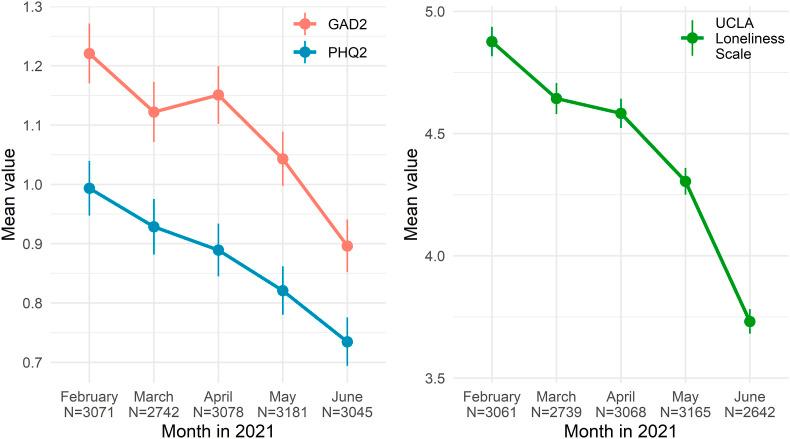
There are concerns about acute and long-term mental health effects of the COVID-19 pandemic. This study examined the prevalence and predictors of psychological distress before, during, and after a pandemic wave in Switzerland, 2021. Prevalence of psychological distress was estimated in adults aged 35-96 years using the General Health Questionnaire-12 administered in June 2021 (Specchio-COVID19 cohort, N = 3965), and compared to values from 2003 to 2006 (CoLaus|PsyCoLaus cohort, N = 5667). Anxiety and depression were assessed from February to June 2021 using the Generalised Anxiety Disorder scale-2 and the Patient Health Questionnaire-2, respectively. Prevalence of psychological distress in June 2021, after the pandemic wave (16.0% [95% CI, 14.6%-17.4%]) was comparable to pre-pandemic levels (15.1% [14.0%-16.2%]). Anxiety and depression were highest at the start of the pandemic wave in February 2021, and declined from February to June with the relaxation of measures. Predictors of psychological distress included being younger, female, a single parent, unemployed, a change in working hours or job loss in the past 6 months, greater perceived severity and contagiousness of COVID-19, and self-reported post COVID-19. By June 2021, following a pandemic wave, prevalence of psychological distress in Switzerland was closer to pre-pandemic levels. These findings highlight the need for additional mental health support during times of stricter government policies relating to COVID-19; yet they also suggest that individuals can adapt relatively quickly to the changing context.
人们对 COVID-19 大流行的急性和长期心理健康影响感到担忧。本研究调查了 2021 年瑞士大流行期间及之后,使用一般健康问卷-12(在 2021 年 6 月进行,Specchio-COVID19 队列,N=3965)评估的 35-96 岁成年人的心理困扰的患病率和预测因素,并与 2003 年至 2006 年(CoLaus|PsyCoLaus 队列,N=5667)的值进行了比较。2021 年 2 月至 6 月,使用广泛性焦虑障碍量表-2 和患者健康问卷-2 评估焦虑和抑郁。2021 年 6 月大流行波后心理困扰的患病率(16.0%[95%CI,14.6%-17.4%])与大流行前水平相当(15.1%[14.0%-16.2%])。2021 年 2 月大流行开始时焦虑和抑郁程度最高,随着措施的放宽,从 2 月到 6 月下降。心理困扰的预测因素包括年龄较小、女性、单亲父母、失业、过去 6 个月工作时间或工作岗位发生变化、对 COVID-19 的严重程度和传染性的感知更大,以及自我报告的 COVID-19 后。到 2021 年 6 月,瑞士在经历了一次大流行浪潮后,心理困扰的患病率更接近大流行前的水平。这些发现强调了在与 COVID-19 相关的政府政策更加严格的时期需要额外的心理健康支持;但它们也表明,个人可以相对较快地适应不断变化的环境。

 Zotero 插件