
硼酸过渡态抑制剂作为强效的 KPC 和 CTX-M 型β-内酰胺酶抑制剂:生化和结构分析。
Boronic Acid Transition State Inhibitors as Potent Inactivators of KPC and CTX-M β-Lactamases: Biochemical and Structural Analyses.
机构信息
Department of Biochemistry, Case Western Reserve University School of Medicine, Cleveland, Ohio, USA.
Universidad de Buenos Aires, Facultad de Farmacia y Bioquimica, Instituto de Investigaciones en Bacteriologia y Virologia Molecular, Buenos Aires, Argentina.
出版信息
Antimicrob Agents Chemother. 2023 Jan 24;67(1):e0093022. doi: 10.1128/aac.00930-22. Epub 2023 Jan 5.
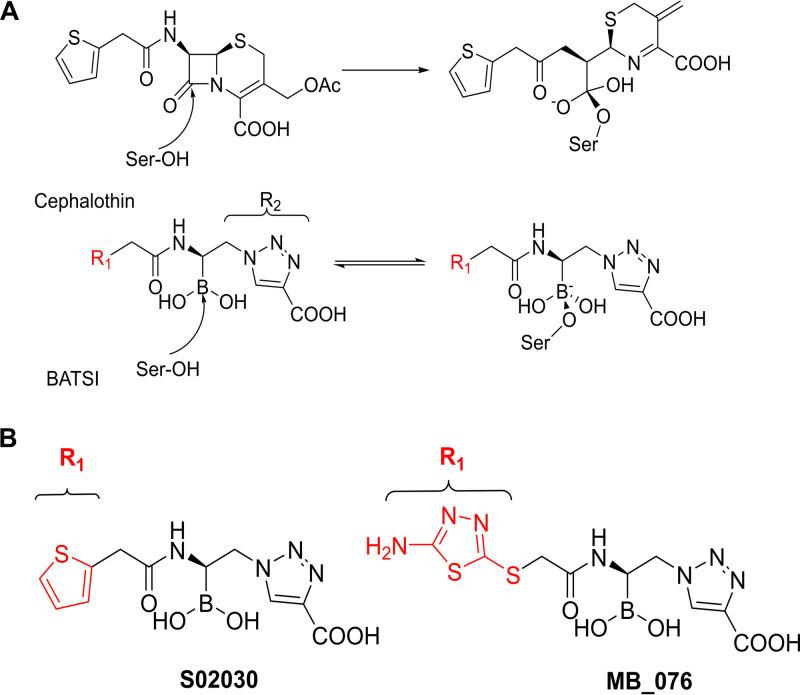
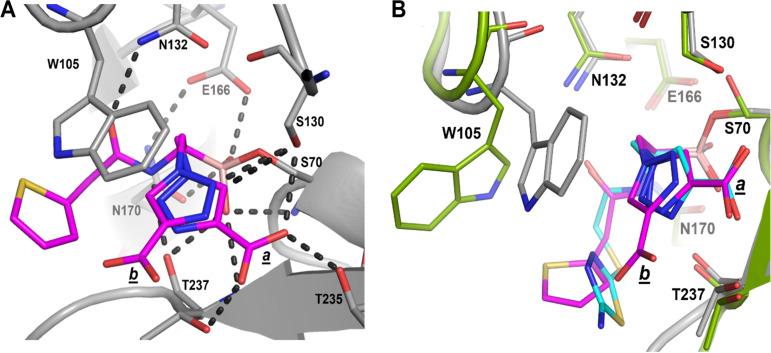
Design of novel β-lactamase inhibitors (BLIs) is one of the currently accepted strategies to combat the threat of cephalosporin and carbapenem resistance in Gram-negative bacteria. oronic cid ransition tate nhibitors (BATSIs) are competitive, reversible BLIs that offer promise as novel therapeutic agents. In this study, the activities of two α-amido-β-triazolylethaneboronic acid transition state inhibitors (S02030 and MB_076) targeting representative KPC (KPC-2) and CTX-M (CTX-M-96, a CTX-M-15-type extended-spectrum β-lactamase [ESBL]) β-lactamases were evaluated. The 50% inhibitory concentrations (ICs) for both inhibitors were measured in the nanomolar range (2 to 135 nM). For S02030, the / for CTX-M-96 (24,000 M s) was twice the reported value for KPC-2 (12,000 M s); for MB_076, the / values ranged from 1,200 M s (KPC-2) to 3,900 M s (CTX-M-96). Crystal structures of KPC-2 with MB_076 (1.38-Å resolution) and S02030 and the models of CTX-M-96 with these two BATSIs show that interaction in the CTX-M-96-S02030 and CTX-M-96-MB_076 complexes were overall equivalent to that observed for the crystallographic structure of KPC-2-S02030 and KPC-2-MB_076. The tetrahedral interaction surrounding the boron atom from S02030 and MB_076 creates a favorable hydrogen bonding network with S70, S130, N132, N170, and S237. However, the changes from W105 in KPC-2 to Y105 in CTX-M-96 and the missing residue R220 in CTX-M-96 alter the arrangement of the inhibitors in the active site of CTX-M-96, partially explaining the difference in kinetic parameters. The novel BATSI scaffolds studied here advance our understanding of structure-activity relationships (SARs) and illustrate the importance of new approaches to β-lactamase inhibitor design.
设计新型β-内酰胺酶抑制剂(BLIs)是应对革兰氏阴性菌头孢菌素和碳青霉烯类耐药性威胁的一种现有策略。翁氏酸过渡态抑制剂(BATSIs)是竞争性、可还原的 BLIs,有望成为新型治疗药物。在这项研究中,评估了两种针对代表性 KPC(KPC-2)和 CTX-M(CTX-M-96,CTX-M-15 型扩展谱β-内酰胺酶 [ESBL])β-内酰胺酶的 α-氨甲酰基-β-三唑基乙烷硼酸盐过渡态抑制剂(S02030 和 MB_076)的活性。两种抑制剂的 50%抑制浓度(IC)均在纳摩尔范围内(2 至 135 nM)。对于 S02030,对于 CTX-M-96(24,000 M s)的 / 值是报道的 KPC-2(12,000 M s)的两倍;对于 MB_076,/ 值范围从 1,200 M s(KPC-2)到 3,900 M s(CTX-M-96)。KPC-2 与 MB_076(1.38-Å 分辨率)和 S02030 的晶体结构以及 CTX-M-96 与这两种 BATSIs 的模型表明,CTX-M-96-S02030 和 CTX-M-96-MB_076 复合物中的相互作用总体上与 KPC-2-S02030 和 KPC-2-MB_076 的晶体结构观察到的相互作用相当。来自 S02030 和 MB_076 的硼原子的四面体型相互作用与 S70、S130、N132、N170 和 S237 形成有利的氢键网络。然而,KPC-2 中的 W105 到 CTX-M-96 中的 Y105 的变化以及 CTX-M-96 中缺失的残基 R220 改变了抑制剂在 CTX-M-96 活性位点中的排列方式,部分解释了动力学参数的差异。这里研究的新型 BATSI 支架加深了我们对结构-活性关系(SARs)的理解,并说明了采用新方法设计β-内酰胺酶抑制剂的重要性。




 Zotero 插件