
群体性与强化门诊式延长暴露疗法治疗战斗相关创伤后应激障碍:一项随机临床试验。
Massed vs Intensive Outpatient Prolonged Exposure for Combat-Related Posttraumatic Stress Disorder: A Randomized Clinical Trial.
机构信息
Department of Psychiatry and Behavioral Sciences, University of Texas Health Science Center at San Antonio, San Antonio.
Research and Development Service, South Texas Veterans Health Care System, San Antonio.
出版信息
JAMA Netw Open. 2023 Jan 3;6(1):e2249422. doi: 10.1001/jamanetworkopen.2022.49422.
IMPORTANCE
Improved, efficient, and acceptable treatments are needed for combat-related posttraumatic stress disorder (PTSD).
OBJECTIVE
To determine the efficacy of 2 compressed prolonged exposure (PE) therapy outpatient treatments for combat-related PTSD.
DESIGN, SETTING, AND PARTICIPANTS: This randomized clinical trial was conducted among military personnel and veterans at 4 sites in Texas from 2017 to 2019. Assessors were blinded to conditions. Data were analyzed from November 2020 to October 2022.
INTERVENTIONS
The interventions were massed-PE, which included 15 therapy sessions of 90 minutes each over 3 weeks, vs intensive outpatient program PE (IOP-PE), which included 15 full-day therapy sessions over 3 weeks with 8 treatment augmentations. The IOP-PE intervention was hypothesized to be superior to massed-PE.
MAIN OUTCOMES AND MEASURES
Coprimary outcomes included the Clinician-Administered PTSD Scale for Diagnostic and Statistical Manual of Mental Disorders (Fifth Edition) (DSM-5) (CAPS-5) and the PTSD Checklist for DSM-5 (PCL-5) administered at baseline and posttreatment follow-ups. Measures ranged from 0 to 80, with higher scores indicating greater severity. Diagnostic remission and reliable change were secondary outcomes.
RESULTS
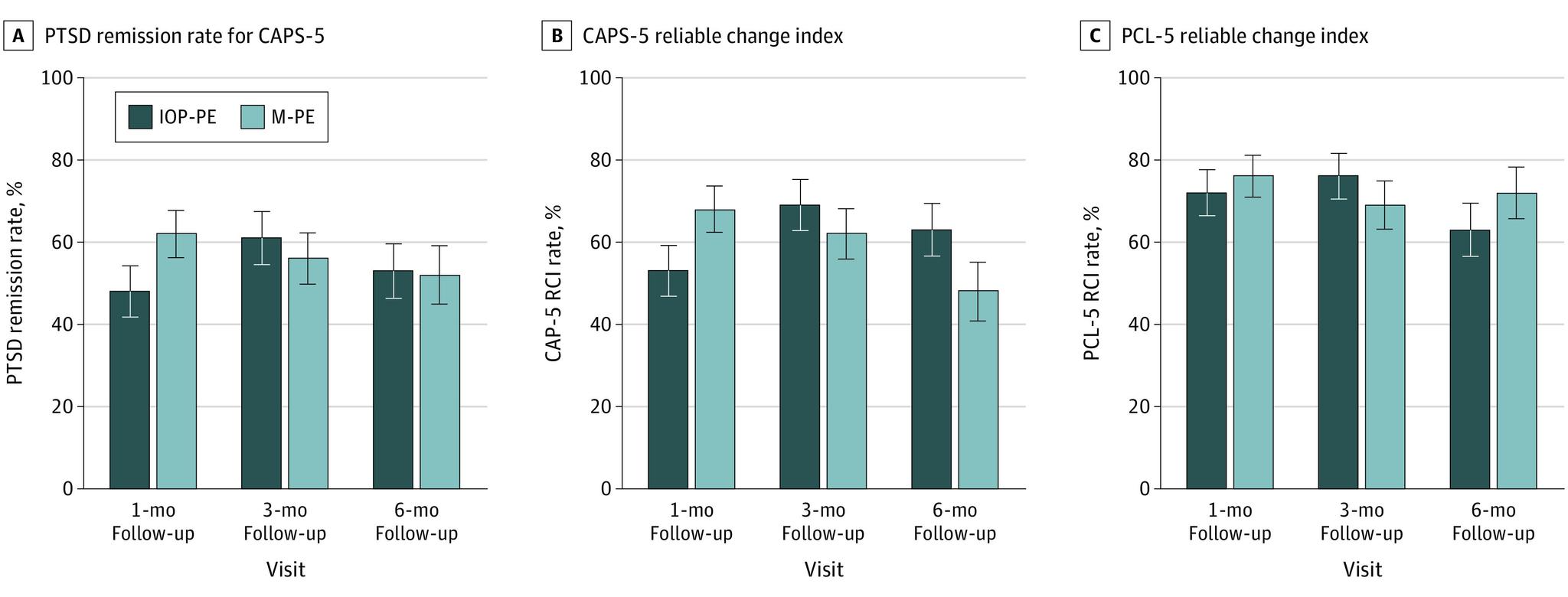
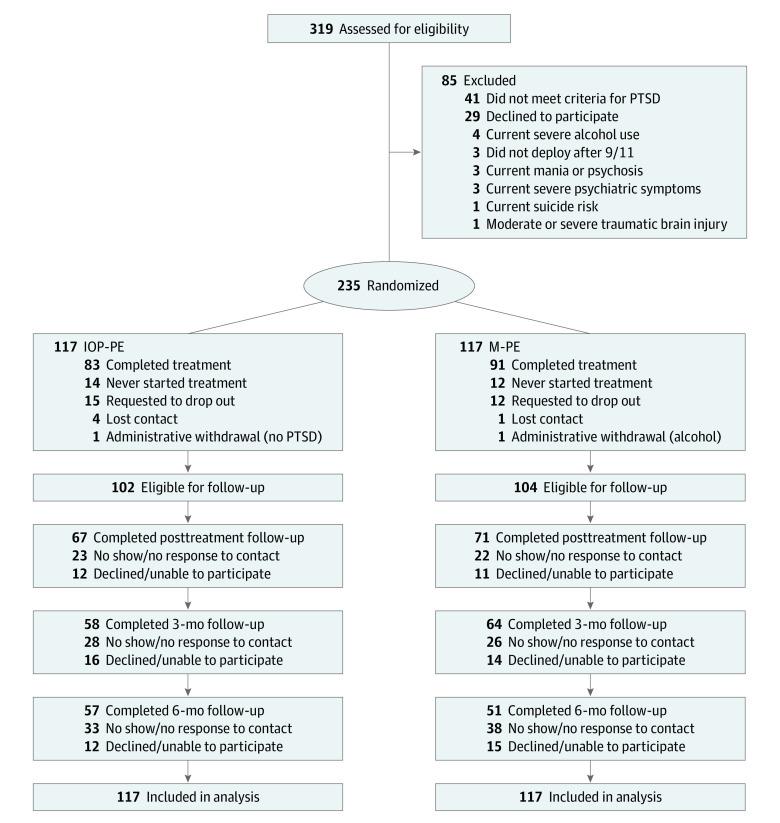
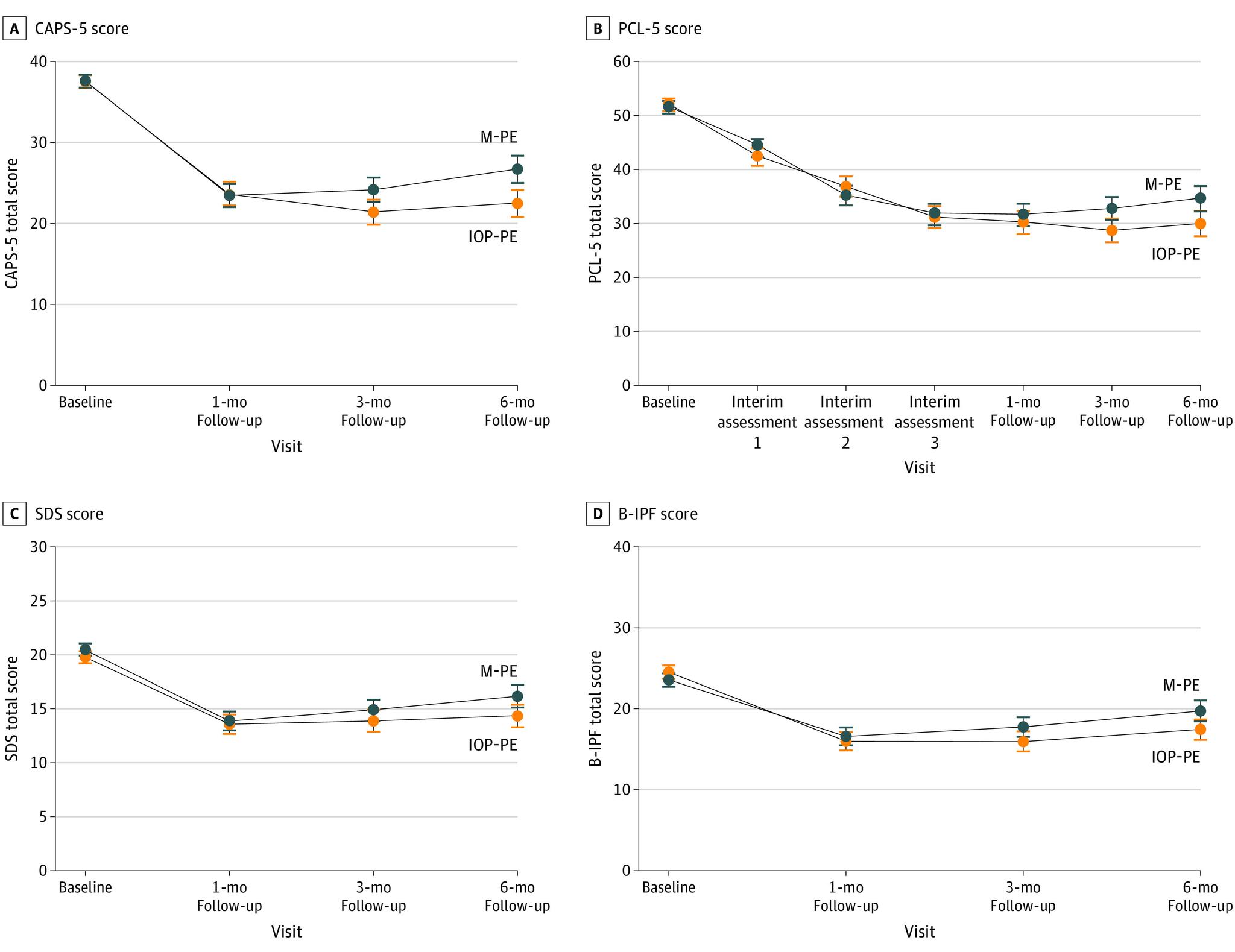
Among 319 military personnel and veterans screened, 234 were randomized (mean [SD] age, 39.20 [7.72] years; 182 [78%] male participants), with 117 participants randomized to IOP-PE and 117 participants randomized to massed-PE. A total of 61 participants (26%) were African American, 58 participants (25%) were Hispanic, and 102 participants (44%) were White; 151 participants (65%) were married. Linear mixed-effects models found that CAPS-5 scores decreased in both treatment groups at the 1-month follow-up (IOP-PE: mean difference, -13.85 [95% CI, -16.47 to -11.23]; P < .001; massed-PE: mean difference, -14.13 [95% CI, -16.63 to -11.62]; P < .001). CAPS-5 change scores differed from 1- to 6-month follow-ups (mean difference, 4.44 [95% CI, 0.89 to 8.01]; P = .02). PTSD symptoms increased in massed-PE participants during follow-up (mean difference, 3.21 [95% CI, 0.65 to 5.77]; P = .01), whereas IOP-PE participants maintained treatment gains (mean difference, 1.23 [95% CI, -3.72 to 1.27]; P = .33). PCL-5 scores decreased in both groups from baseline to 1-month follow-up (IOP-PE: mean difference, -21.81 [95% CI, -25.57 to -18.04]; P < .001; massed-PE: mean difference, -19.96 [95% CI, -23.56 to -16.35]; P < .001) and were maintained at 6 months (IOP-PE: mean change, -0.21 [95% CI, -3.47 to 3.06]; P = .90; massed-PE: mean change, 3.02 [95% CI, -0.36 to 6.40]; P = .08). Both groups had notable PTSD diagnostic remission at posttreatment (IOP-PE: 48% [95% CI, 36% to 61%] of participants; massed-PE: 62% [95% CI, 51% to 73%] of participants), which was maintained at 6 months (IOP-PE: 53% [95% CI, 40% to 66%] of participants; massed-PE: 52% [95% CI, 38% to 66%] of participants). Most participants demonstrated reliable change on the CAPS-5 (61% [95% CI, 52% to 69%] of participants) and the PCL-5 (74% [95% CI, 66% to 81%] of participants) at the 1-month follow-up.
CONCLUSIONS AND RELEVANCE
These findings suggest that PE can be adapted into compressed treatment formats that effectively reduce PTSD symptoms.
TRIAL REGISTRATION
ClinicalTrials.gov Identifier: NCT03529435.
重要性
需要改进、有效的且可接受的治疗方法来治疗与战斗相关的创伤后应激障碍(PTSD)。
目的
确定 2 种压缩式延长暴露(PE)治疗门诊治疗与战斗相关 PTSD 的疗效。
设计、地点和参与者:这项随机临床试验于 2017 年至 2019 年在德克萨斯州的 4 个地点进行,参与者为军人和退伍军人。评估人员对条件一无所知。数据于 2020 年 11 月至 2022 年 10 月进行分析。
干预措施
干预措施为集中式 PE,包括 15 次每次 90 分钟的治疗,共 3 周;强化门诊计划 PE(IOP-PE),包括 15 次全天治疗,共 3 周,有 8 次治疗增强。假设 IOP-PE 干预优于集中式 PE。
主要结果和测量指标
主要结果包括基于《精神障碍诊断与统计手册(第五版)》(DSM-5)的临床医生管理 PTSD 量表(CAPS-5)和 PTSD 检查表(DSM-5)(PCL-5),在基线和治疗后随访时进行测量。测量范围从 0 到 80,得分越高表示症状越严重。诊断缓解和可靠变化是次要结果。
结果
在筛选的 319 名军人和退伍军人中,有 234 名被随机分组(平均[标准差]年龄,39.20[7.72]岁;182[78%]名男性参与者),其中 117 名被随机分配至 IOP-PE 组,117 名被随机分配至集中式 PE 组。共有 61 名参与者(26%)为非裔美国人,58 名参与者(25%)为西班牙裔,102 名参与者(44%)为白人;151 名参与者(65%)已婚。线性混合效应模型发现,两组在 1 个月随访时 CAPS-5 评分均降低(IOP-PE:平均差异,-13.85[95%CI,-16.47 至-11.23];P<0.001;集中式 PE:平均差异,-14.13[95%CI,-16.63 至-11.62];P<0.001)。从 1 个月到 6 个月的随访中,CAPS-5 变化评分不同(平均差异,4.44[95%CI,0.89 至 8.01];P=0.02)。集中式 PE 组的 PTSD 症状在随访期间增加(平均差异,3.21[95%CI,0.65 至 5.77];P=0.01),而 IOP-PE 组则保持治疗效果(平均差异,1.23[95%CI,-3.72 至 1.27];P=0.33)。两组在基线到 1 个月随访时 PCL-5 评分均降低(IOP-PE:平均差异,-21.81[95%CI,-25.57 至-18.04];P<0.001;集中式 PE:平均差异,-19.96[95%CI,-23.56 至-16.35];P<0.001),并在 6 个月时保持稳定(IOP-PE:平均变化,-0.21[95%CI,-3.47 至 3.06];P=0.90;集中式 PE:平均变化,3.02[95%CI,-0.36 至 6.40];P=0.08)。两组在治疗后均有显著的 PTSD 诊断缓解(IOP-PE:48%[95%CI,36% 至 61%]的参与者;集中式 PE:62%[95%CI,51% 至 73%]的参与者),并在 6 个月时保持稳定(IOP-PE:53%[95%CI,40% 至 66%]的参与者;集中式 PE:52%[95%CI,38% 至 66%]的参与者)。大多数参与者在 1 个月随访时在 CAPS-5(61%[95%CI,52% 至 69%]的参与者)和 PCL-5(74%[95%CI,66% 至 81%]的参与者)上表现出可靠的变化。
结论和相关性
这些发现表明,PE 可以改编为压缩式治疗方案,有效减轻 PTSD 症状。
试验注册
ClinicalTrials.gov 标识符:NCT03529435。
 Zotero 插件