
十六烷基三甲基氯化铵通过改变细胞膜通透性诱导临床重要物种细胞死亡。
Alteration of Cell Membrane Permeability by Cetyltrimethylammonium Chloride Induces Cell Death in Clinically Important Species.
机构信息
Department of Biotechnology, Science Campus, Alagappa University, Karaikudi 630 003, Tamil Nadu, India.
Center of Emphasis in Infectious Diseases, Department of Molecular and Translational Medicine, Paul L. Foster School of Medicine, Texas Tech University Health Sciences Center, El Paso, TX 79905, USA.
出版信息
Int J Environ Res Public Health. 2022 Dec 20;20(1):27. doi: 10.3390/ijerph20010027.
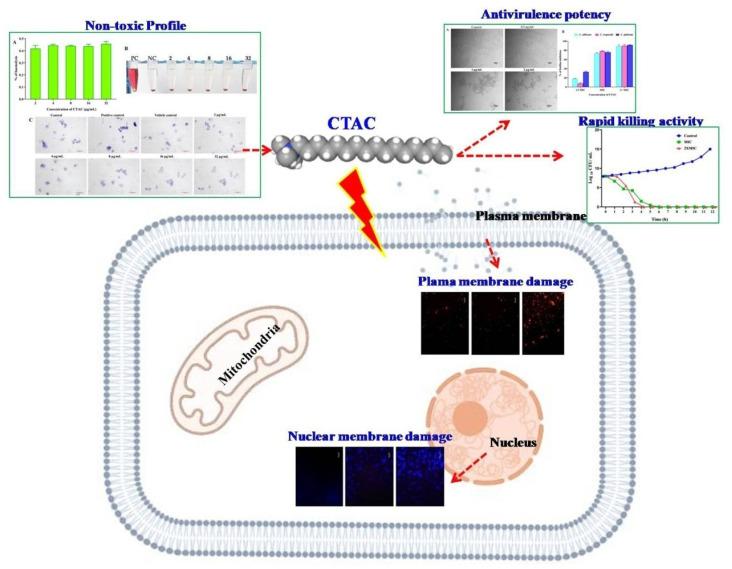
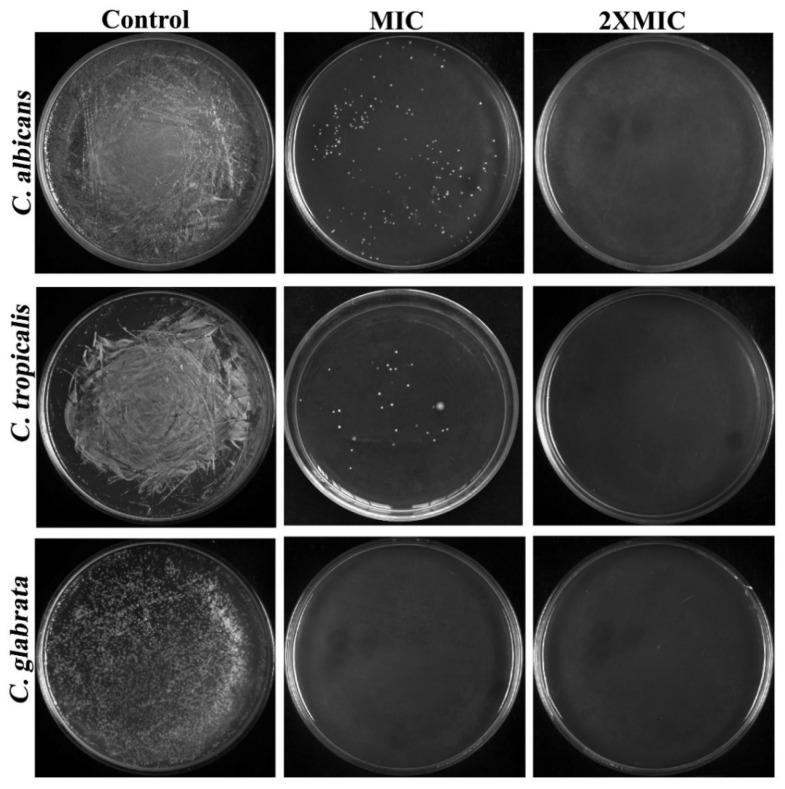
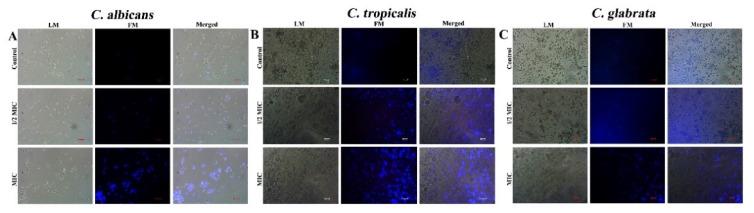
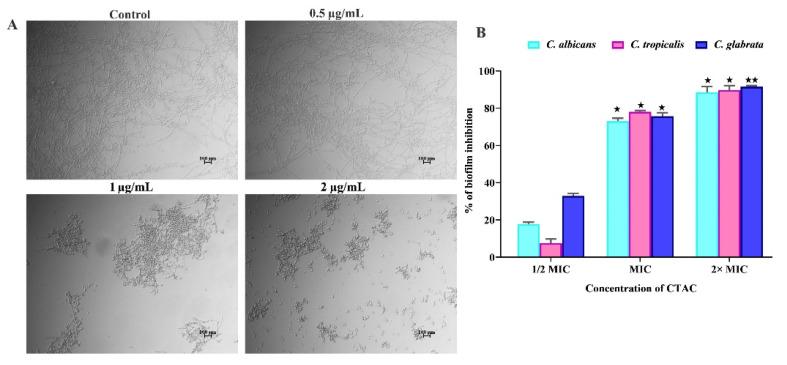
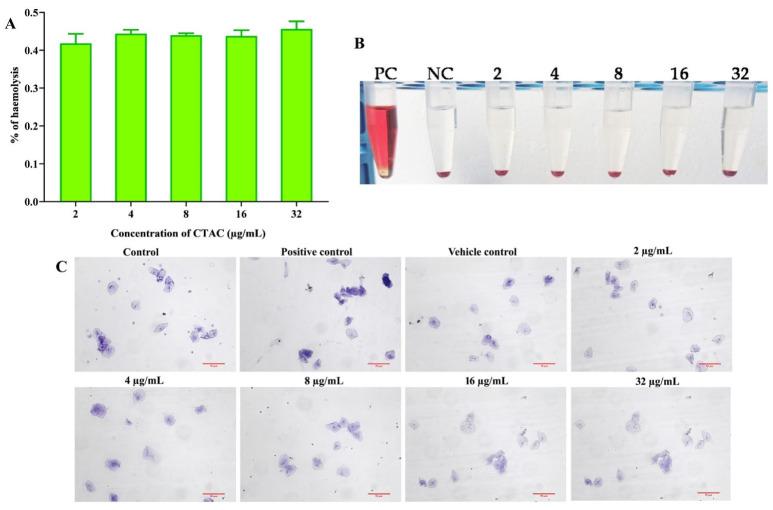
The increased incidence of healthcare-related Candida infection has necessitated the use of effective disinfectants/antiseptics in healthcare settings as a preventive measure to decontaminate the hospital environment and stop the persistent colonization of the offending pathogens. Quanternary ammonium surfactants (QASs), with their promising antimicrobial efficacy, are considered as intriguing and appealing candidates for disinfectants. From this perspective, the present study investigated the antifungal efficacy and action mechanism of the QAS cetyltrimethylammonium chloride (CTAC) against three clinically important Candida species: C. albicans, C. tropicalis, and C. glabrata. CTAC exhibited phenomenal antifungal activity against all tested Candida spp., with minimum inhibitory concentrations (MIC) and minimum fungicidal concentrations (MFC) between 2 and 8 µg/mL. The time−kill kinetics of CTAC (at 2XMIC) demonstrated that an exposure time of 2 h was required to kill 99.9% of the inoculums in all tested strains. An important observation was that CTAC treatment did not influence intracellular reactive oxygen species (ROS), signifying that its phenomenal anticandidal efficacy was not mediated via oxidative stress. In addition, sorbitol supplementation increased CTAC’s MIC values against all tested Candida strains by three times (8−32 μg/mL), indicating that CTAC’s possible antifungal activity involves fungus cell membrane destruction. Interestingly, the increased fluorescence intensity of CTAC-treated cells in both propidium iodide (PI) and DAPI staining assays indicated the impairment of cell plasma membrane and nuclear membrane integrity by CTAC, respectively. Additionally, CTAC at MIC and 2XMIC was sufficient (>80%) to disrupt the mature biofilms of all tested spp., and it inhibited the yeast-to-hyphae transition at sub-MIC in C. albicans. Finally, the non-hemolytic activity of CTAC (upto 32 µg/mL) in human blood cells and HBECs signified its non-toxic nature at the investigated concentrations. Furthermore, thymol and citral, two phytocompounds, together with CTAC, showed synergistic fungicidal effectiveness against C. albicans planktonic cells. Altogether, the data of the present study appreciably broaden our understanding of the antifungal action mechanism of CTAC and support its future translation as a potential disinfectant against Candida-associated healthcare infections.
医疗机构相关念珠菌感染发病率的增加,促使人们必须使用有效的消毒剂/防腐剂,以作为预防措施来净化医院环境并阻止致病病原体的持续定植。季铵盐表面活性剂(QASs)以其有前景的抗菌功效,被视为有吸引力的消毒剂候选物。从这个角度来看,本研究调查了 QAS 十六烷基三甲基氯化铵(CTAC)对三种临床重要念珠菌的抗真菌功效和作用机制:白色念珠菌、热带念珠菌和光滑念珠菌。CTAC 对所有测试的念珠菌均表现出显著的抗真菌活性,其最低抑菌浓度(MIC)和最低杀菌浓度(MFC)在 2 至 8 µg/mL 之间。CTAC(2XMIC)的时间杀伤动力学表明,所有测试菌株均需要 2 小时的暴露时间才能杀死 99.9%的接种物。一个重要的观察结果是,CTAC 处理不会影响细胞内活性氧物种(ROS),这表明其显著的抗真菌功效不是通过氧化应激介导的。此外,山梨糖醇的添加使 CTAC 对所有测试念珠菌菌株的 MIC 值增加了三倍(8-32 μg/mL),表明 CTAC 的可能抗真菌活性涉及真菌细胞膜破坏。有趣的是,在用碘化丙啶(PI)和 DAPI 染色试验处理的 CTAC 处理细胞中,荧光强度增加分别表明 CTAC 分别损害了细胞质膜和核膜的完整性。此外,MIC 和 2XMIC 的 CTAC 足以(>80%)破坏所有测试 spp.的成熟生物膜,并在亚 MIC 抑制白色念珠菌的酵母到菌丝的转变。最后,CTAC 在人血细胞和 HBECs 中的非溶血活性(高达 32 µg/mL)表明,在研究浓度下,其具有非毒性。此外,百里香酚和柠檬醛这两种植物化合物与 CTAC 一起对白色念珠菌浮游细胞表现出协同杀菌作用。总的来说,本研究的数据显著扩展了我们对 CTAC 抗真菌作用机制的理解,并支持将其作为潜在的消毒剂用于对抗与念珠菌相关的医疗保健感染。




 Zotero 插件