
理论为基础的营养教育干预通过男性伴侣参与对新生儿出生体重的影响:在埃塞俄比亚西南部的一项三臂基于社区的类实验研究。
Effect of a theory-based nutrition education intervention during pregnancy through male partner involvement on newborns' birth weights in Southwest Ethiopia. A three-arm community based Quasi-Experimental study.
机构信息
Department of Nutrition and Dietetics, Institute of Health, Jimma University, Jimma, Ethiopia.
出版信息
PLoS One. 2023 Jan 17;18(1):e0280545. doi: 10.1371/journal.pone.0280545. eCollection 2023.
BACKGROUND
Low birth weight is one of the most serious public health issues affecting newborns, with estimates ranging from 15% to 20% of all births worldwide. According to the Ethiopian demographic health survey report, the prevalence of Low Birth Weight rose from 11% in 2011 to 13% in 2016. The high proportion of birth weight in Ethiopia is hypothesized to be due to inadequate maternal diet which is associated with poor nutrition education during pregnancy. This study aimed to assess the effect of theory-based nutrition education during pregnancy through male partner involvement on birth weight in rural parts of the southwest Ethiopia.
STUDY DESIGN
A community-based quasi-experimental study was conducted.
METHODS
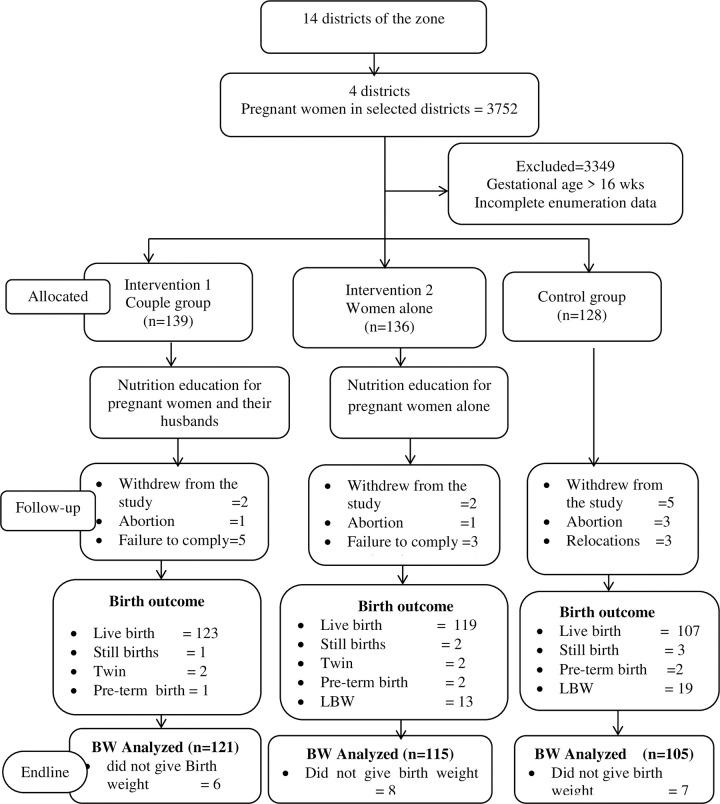
A total of 403 pregnant women were selected from 22 rural kebeles of Illu Aba Bor Zone, Southwest Ethiopia from June to December 2019. Participants were assigned to one of the three study arms: Couple group:-husband and wife received nutrition education together, women alone:-pregnant women received the nutrition education alone and control group:-received the routine care during Antenatal care. The nutrition education was guided by theory of planned behavior. Monthly home visits were made to the pregnant women in the intervention groups and leaflets with key counseling messages were distributed to each woman in the intervention arms. A structured interviewer-administered questionnaire was used to collect the data. A qualitative 24-h dietary recall was used to assess dietary data, and the Mid-Upper Arm Circumference was used to assess nutritional status. Birth weight was measured within 24 hours of birth. Analysis of variance, linear mixed-effects model, and mediation analysis were used to assess effect of the intervention on birth weight.
RESULTS
A higher proportion of the newborns in the control group had low birth weight as compared to the couple group and the women alone group (18.1% vs 7.0% vs 11.5%, p = 0.037) respectively. The mean birth weight of babies born to women from the couple group was 0.42 kg greater than that of newborns born to women in the comparison group (3.34 vs 2.92 kg, p< 0.001). The linear mixed effect model showed that the average birth weight of babies born from women in the couple group was 0.40 kg higher than that of the control group (β = 0.400, P<0.001). The direct effect of the intervention on birth weight of babies born from women in the couple group was 0.23 (β = 0.227, P<0.001) whereas the indirect effect mediated by maternal dietary diversity practice was 0.18 (β = 0.178, P<0.001), accounting for 43.9% of the total effect of the intervention.
CONCLUSION
The involvement of males and the application of the theory of planned behavior in nutrition education interventions during pregnancy resulted in improved birth weight. Maternal dietary diversity mediated the effect of nutrition education on birth weight. The findings highlight the implication of improving pregnant women's nutrition education through male involvement and the application of theories to improve birth weight.
背景
低出生体重是影响新生儿的最严重的公共卫生问题之一,全球所有出生婴儿中约有 15%至 20%存在低出生体重。根据埃塞俄比亚人口健康调查报告,低出生体重的患病率从 2011 年的 11%上升到 2016 年的 13%。埃塞俄比亚高比例的出生体重可能是由于孕产妇饮食不足导致的,这与怀孕期间营养不良教育不足有关。本研究旨在评估通过男性参与基于理论的孕期营养教育对埃塞俄比亚西南部农村地区出生体重的影响。
研究设计
这是一项基于社区的准实验研究。
方法
2019 年 6 月至 12 月,从埃塞俄比亚西南部伊卢阿巴博尔地区的 22 个农村基贝拉共选取了 403 名孕妇。参与者被分配到三个研究组之一:夫妻组 - 丈夫和妻子一起接受营养教育;孕妇组 - 孕妇单独接受营养教育;对照组 - 在产前护理期间接受常规护理。营养教育以计划行为理论为指导。每月对干预组的孕妇进行家访,并向干预组的每位妇女发放带有关键咨询信息的传单。使用结构式访谈员管理的问卷收集数据。使用 24 小时膳食回顾法评估膳食数据,使用中臂围(MUAC)评估营养状况。在出生后 24 小时内测量新生儿体重。方差分析、线性混合效应模型和中介分析用于评估干预对出生体重的影响。
结果
与对照组相比,夫妻组和孕妇组的新生儿低出生体重比例更高(18.1%比 7.0%比 11.5%,p=0.037)。夫妻组新生儿的平均出生体重比对照组新生儿重 0.42 公斤(3.34 公斤比 2.92 公斤,p<0.001)。线性混合效应模型显示,夫妻组孕妇所生婴儿的平均出生体重比对照组高 0.40 公斤(β=0.400,P<0.001)。夫妻组孕妇所生婴儿的干预对出生体重的直接影响为 0.23(β=0.227,P<0.001),而通过产妇饮食多样性实践的中介效应为 0.18(β=0.178,P<0.001),占干预总效应的 43.9%。
结论
男性的参与和在孕期营养教育干预中应用计划行为理论,可提高出生体重。产妇饮食多样性中介了营养教育对出生体重的影响。研究结果强调了通过男性参与和应用理论来改善孕妇营养教育以提高出生体重的意义。

 Zotero 插件