
一项调整后的治疗比较,比较 Amivantamab 与欧洲和美国真实世界临床实践用于治疗晚期非小细胞肺癌伴表皮生长因子受体 20 号外显子插入突变患者。
An Adjusted Treatment Comparison Comparing Amivantamab Versus Real-World Clinical Practice in Europe and the United States for Patients with Advanced Non-Small Cell Lung Cancer with Activating Epidermal Growth Factor Receptor Exon 20 Insertion Mutations.
机构信息
Service de Pneumologie, Pneumology, Intercommunal Hospital, 40 avenue de Verdun, 94010, Créteil, France.
Health Data and Partnerships Department, Unicancer, Paris, France.
出版信息
Adv Ther. 2023 Mar;40(3):1187-1203. doi: 10.1007/s12325-022-02408-7. Epub 2023 Jan 18.
INTRODUCTION
Patients with advanced, epidermal growth factor receptor (EGFR)-mutated, non-small cell lung cancer (NSCLC) with Exon 20 insertion mutations (Exon20ins) have poor prognoses, exacerbated by a previous lack of specific treatment guidelines and unmet need for targeted therapies. Amivantamab, an EGFR and MET bispecific antibody, demonstrated efficacy and tolerability in patients with advanced EGFR-mutated NSCLC with Exon20ins following platinum-based therapy in CHRYSALIS (NCT02609776; Cohort D+). Since CHRYSALIS was single-arm, individual patient data (IPD)-based adjusted analyses versus similar patients in real-world clinical practice (RWCP) were conducted to generate comparative evidence.
METHODS
RWCP cohorts were derived from seven European and US real-world sources, comprising patients fulfilling CHRYSALIS Cohort D+ eligibility criteria. Amivantamab was compared with a basket of RWCP treatments. Differences in prognostic characteristics were adjusted for using inverse probability weighting (IPW; average treatment effect among the treated [ATT]). Balance between cohorts was assessed using standardized mean differences (SMDs). Overall response rate (ORR; investigator- [INV] and independent review committee-assessed [IRC]), overall survival (OS), progression-free survival (PFS; INV and IRC) and time-to-next treatment (TTNT) were compared. Binary and time-to-event endpoints were analyzed using weighted logistic regression and proportional hazards regression, respectively.
RESULTS
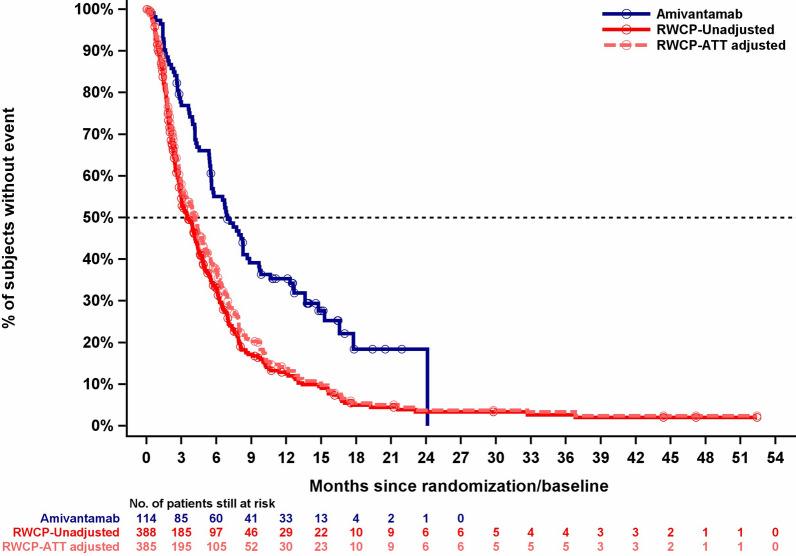
Pre-adjustment, baseline characteristics were comparable between cohorts. IPW ATT-adjustment improved comparability, giving closely matched characteristics. ORR (INV) was 36.8% for amivantamab versus 17.0% for the adjusted EU + US cohort (response rate ratio [RR]: 2.16). Median OS, PFS (INV) and TTNT were 22.77 versus 12.52 months (hazard ratio [HR]: 0.47; p < 0.0001), 6.93 versus 4.17 months (HR: 0.55; p < 0.0001) and 12.42 versus 5.36 months (HR: 0.44; p < 0.0001) for amivantamab versus the adjusted EU + US cohort, respectively. Results were consistent versus EU- and US-only cohorts, and when using IRC assessment.
CONCLUSION
Adjusted comparisons demonstrated significantly improved outcomes for amivantamab versus RWCP, highlighting the value of amivantamab in addressing unmet need in patients with advanced EGFR Exon20ins NSCLC following platinum-based therapy.
TRIAL REGISTRATION
CHRYSALIS: NCT02609776.
介绍
接受过铂类为基础的治疗的晚期、表皮生长因子受体 (EGFR)-突变、非小细胞肺癌 (NSCLC) 伴外显子 20 插入突变 (Exon20ins) 的患者预后较差,之前缺乏特定的治疗指南和对靶向治疗的未满足需求进一步加剧了这一情况。Amivantamab 是一种 EGFR 和 MET 双特异性抗体,在 CHRYSALIS (NCT02609776; Cohort D+) 中,在铂类为基础的治疗后,对接受过治疗的晚期 EGFR 突变 NSCLC 伴 Exon20ins 的患者表现出疗效和耐受性。由于 CHRYSALIS 是单臂研究,因此对个体患者数据 (IPD) 进行了基于调整的分析,与真实世界临床实践 (RWCP) 中的类似患者进行了比较,以生成比较证据。
方法
RWCP 队列来自七个欧洲和美国的真实世界来源,包括符合 CHRYSALIS Cohort D+ 入选标准的患者。Amivantamab 与 RWCP 治疗方案的篮子进行了比较。使用逆概率加权 (IPW; 治疗中的平均治疗效果 [ATT]) 对预后特征的差异进行调整。使用标准化均数差 (SMD) 评估队列之间的平衡。使用加权逻辑回归和比例风险回归分别分析总缓解率 (ORR; 研究者 [INV] 和独立审查委员会评估 [IRC])、总生存期 (OS)、无进展生存期 (PFS; INV 和 IRC) 和下一次治疗时间 (TTNT)。
结果
在调整前,队列之间的基线特征具有可比性。IPW ATT 调整改善了可比性,使特征更匹配。Amivantamab 的 INV 缓解率为 36.8%,而调整后的欧盟+美国队列为 17.0%(缓解率比 [RR]:2.16)。Amivantamab 的中位 OS、PFS (INV) 和 TTNT 分别为 22.77 个月和 12.52 个月 (HR: 0.47;p<0.0001)、6.93 个月和 4.17 个月 (HR: 0.55;p<0.0001)、12.42 个月和 5.36 个月 (HR: 0.44;p<0.0001)。结果与调整后的欧盟+美国队列以及欧盟和美国队列一致,并且当使用 IRC 评估时也是如此。
结论
调整后的比较表明,Amivantamab 与 RWCP 相比,显著改善了患者的结局,突出了 Amivantamab 在满足铂类为基础的治疗后晚期 EGFR Exon20ins NSCLC 患者的未满足需求方面的价值。
试验注册
CHRYSALIS:NCT02609776。


 Zotero 插件