
可切除结肠癌的术前化疗:一项国际随机对照试验的成熟结果。
Preoperative Chemotherapy for Operable Colon Cancer: Mature Results of an International Randomized Controlled Trial.
机构信息
University Hospital Birmingham, Birmingham, United Kingdom.
St James's University Hospital, Leeds, United Kingdom.
出版信息
J Clin Oncol. 2023 Mar 10;41(8):1541-1552. doi: 10.1200/JCO.22.00046. Epub 2023 Jan 19.
PURPOSE
Neoadjuvant chemotherapy (NAC) has potential advantages over standard postoperative chemotherapy for locally advanced colon cancer but requires formal evaluation.
METHODS
Patients with radiologically staged T3-4, N0-2, M0 colon cancer were randomly allocated (2:1) to 6 weeks oxaliplatin-fluoropyrimidine preoperatively plus 18 postoperatively (NAC group) or 24 weeks postoperatively (control group). Patients with -wildtype tumors could also be randomly assigned 1:1 to receive panitumumab or not during NAC. The primary end point was residual disease or recurrence within 2 years. Secondary outcomes included surgical morbidity, histopathologic stage, regression grade, completeness of resection, and cause-specific mortality. Log-rank analyses were by intention-to-treat.
RESULTS
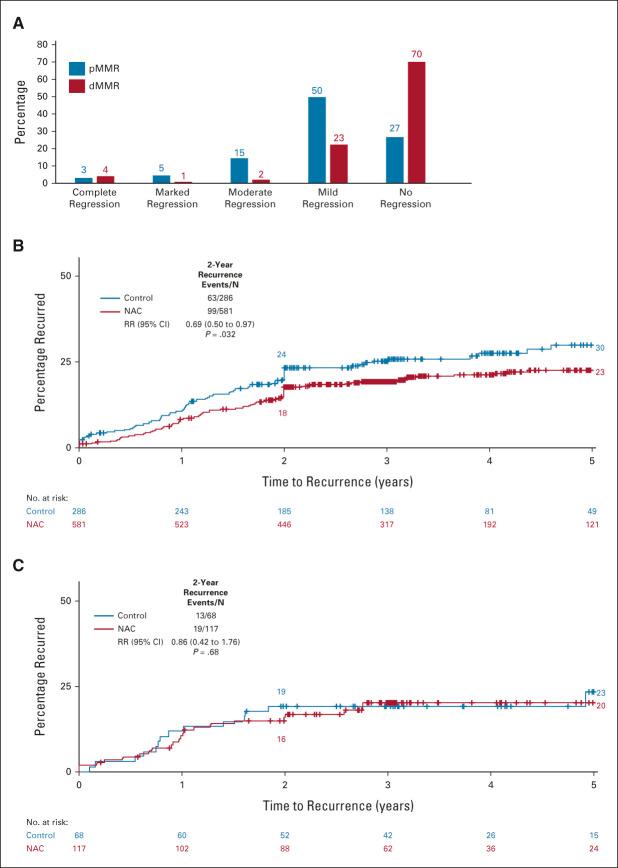
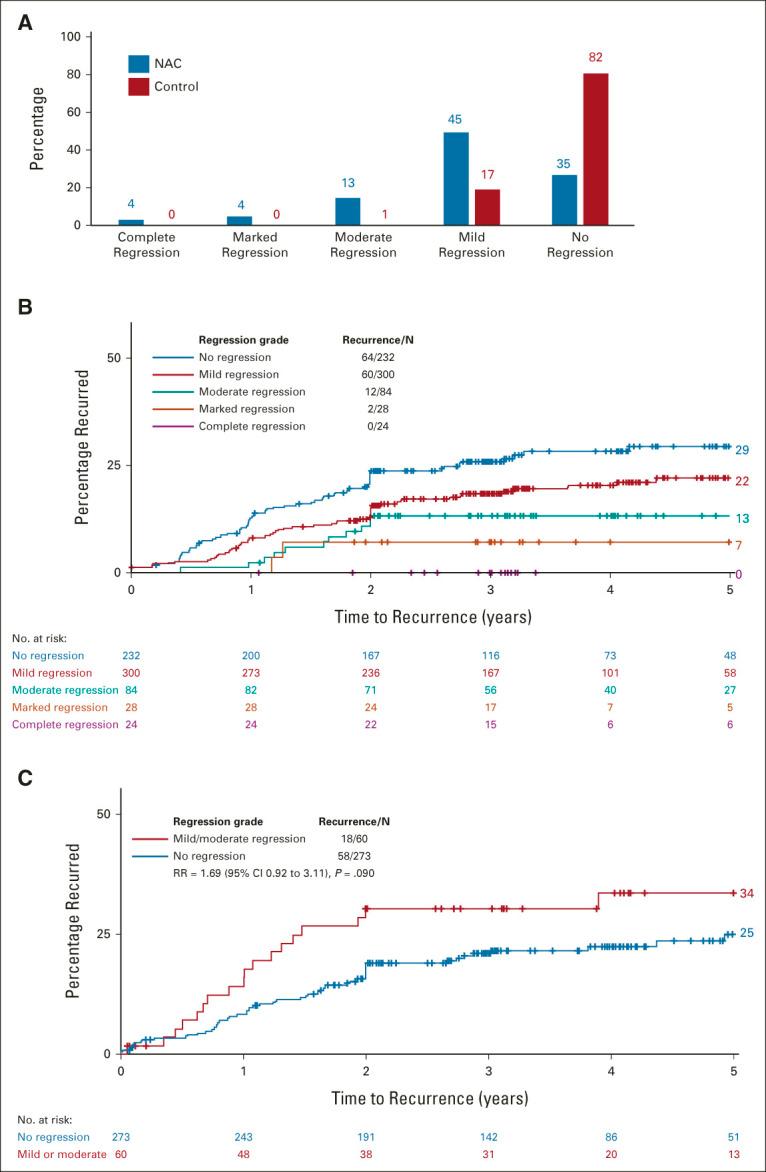
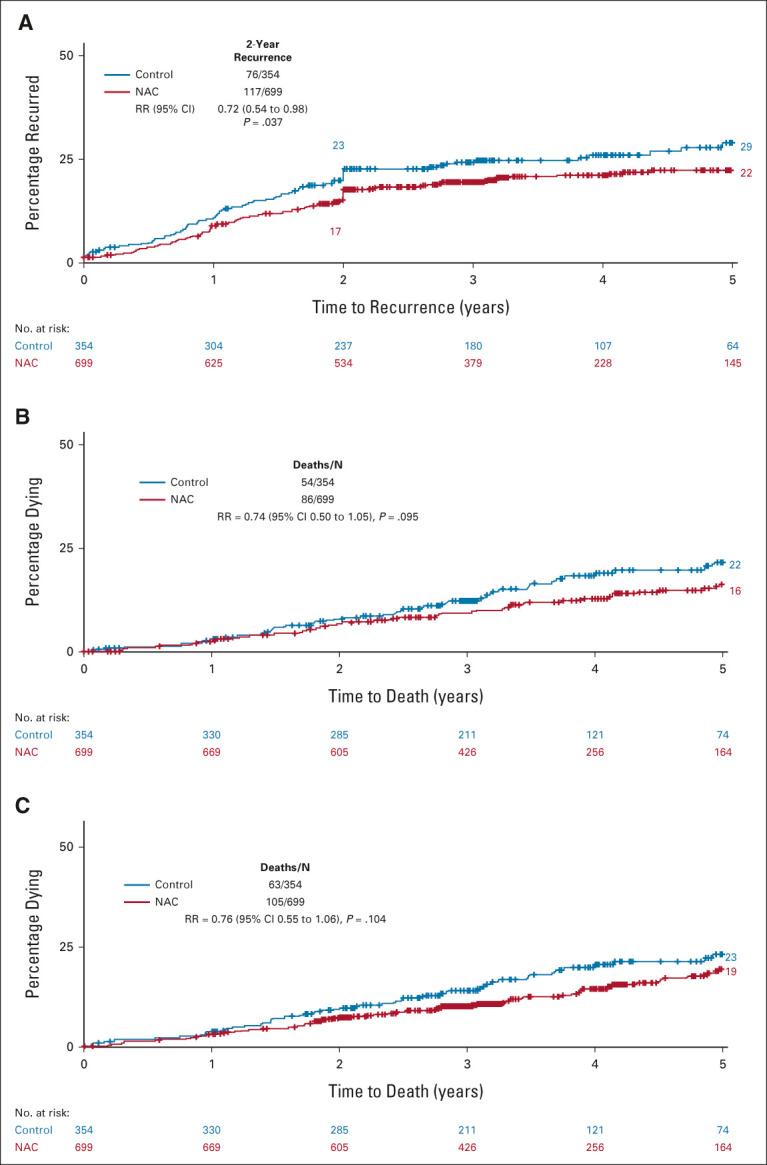
Of 699 patients allocated to NAC, 674 (96%) started and 606 (87%) completed NAC. In total, 686 of 699 (98.1%) NAC patients and 351 of 354 (99.2%) control patients underwent surgery. Thirty patients (4.3%) allocated to NAC developed obstructive symptoms requiring expedited surgery, but there were fewer serious postoperative complications with NAC than with control. NAC produced marked T and N downstaging and histologic tumor regression (all < .001). Resection was more often histopathologically complete: 94% (648/686) versus 89% (311/351), < .001. Fewer NAC than control patients had residual or recurrent disease within 2 years (16.9% [118/699] 21.5% [76/354]; rate ratio, 0.72 [95% CI, 0.54 to 0.98]; = .037). Tumor regression correlated strongly with freedom from recurrence. Panitumumab did not enhance the benefit from NAC. Little benefit from NAC was seen in mismatch repair-deficient tumors.
CONCLUSION
Six weeks of preoperative oxaliplatin-fluoropyrimidine chemotherapy for operable colon cancer can be delivered safely, without increasing perioperative morbidity. This chemotherapy regimen, when given preoperatively, produces marked histopathologic down-staging, fewer incomplete resections, and better 2-year disease control. Histologic regression after NAC is a strong predictor of lower postoperative recurrence risk so has potential use as a guide for postoperative therapy. Six weeks of NAC should be considered as a treatment option for locally advanced colon cancer.
目的
新辅助化疗(NAC)在局部晚期结肠癌方面优于标准术后化疗,但需要进行正式评估。
方法
将影像学分期为 T3-4、N0-2、M0 的结肠癌患者随机分为 2:1 比例分配至术前 6 周接受奥沙利铂-氟嘧啶治疗加术后 18 周(NAC 组)或术后 24 周(对照组)。肿瘤 -野生型患者也可随机分配 1:1 接受帕尼单抗或不接受 NAC。主要终点为 2 年内残留疾病或复发。次要结局包括手术发病率、组织病理学分期、消退分级、切除完整性和特定原因死亡率。采用意向治疗进行对数秩分析。
结果
699 例患者分配至 NAC,674 例(96%)开始并完成 NAC,606 例(87%)完成 NAC。共 686 例 NAC 患者和 351 例对照组患者接受手术。30 例(4.3%)接受 NAC 的患者出现需要紧急手术的梗阻症状,但 NAC 的严重术后并发症少于对照组。NAC 显著降低 T 和 N 分期,并导致组织学肿瘤消退(均<0.001)。切除更常为组织病理学完全:94%(648/686)比 89%(311/351),<0.001。NAC 组 2 年内有残留或复发疾病的患者少于对照组(16.9%[118/699]比 21.5%[76/354];率比,0.72[95%CI,0.54 至 0.98];=0.037)。肿瘤消退与无复发率密切相关。帕尼单抗不能增强 NAC 的获益。错配修复缺陷型肿瘤从 NAC 中获益较小。
结论
对于可手术的结肠癌,术前 6 周给予奥沙利铂-氟嘧啶化疗是安全的,不会增加围手术期发病率。这种化疗方案术前应用可显著降低组织病理学分期,减少不完全切除,改善 2 年疾病控制。NAC 后组织学消退是术后复发风险较低的有力预测指标,因此具有作为术后治疗指导的潜在用途。6 周 NAC 应被视为局部晚期结肠癌的一种治疗选择。

 Zotero 插件